You don’t lose money in crypto because you lack indicators.
You lose it because your nervous system hijacks your decision-making at precisely the wrong moment.
Every chart pattern, every funding rate, every on-chain metric ultimately funnels through one fragile bottleneck: your psychology. The market doesn’t care about your strategy. It only reacts to order flow. And you—with your expectations, fears, dopamine spikes, and cognitive shortcuts—are part of that flow.
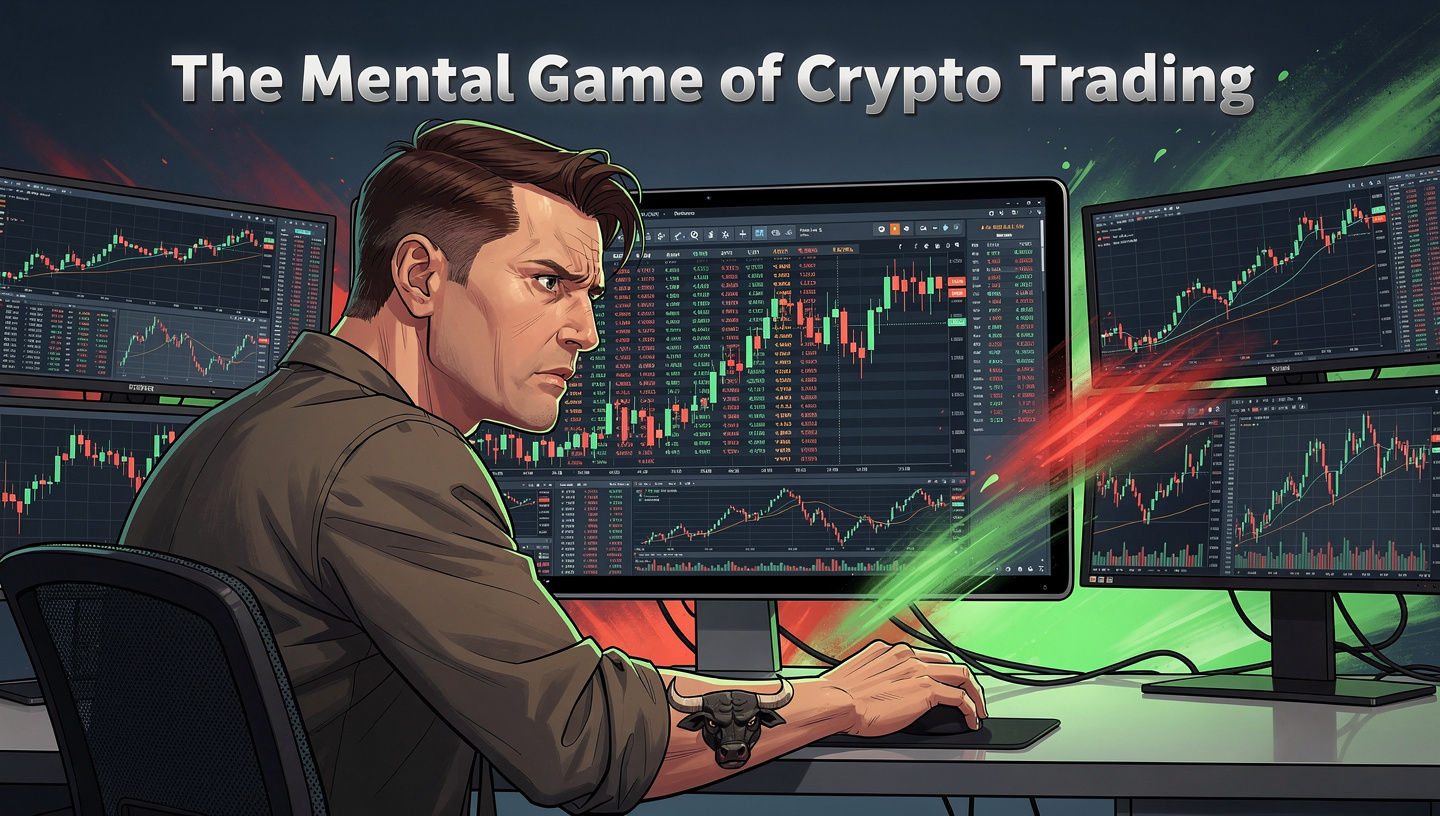
Crypto trading is not primarily a technical contest. It is a behavioral one.
Most participants approach this arena armed with tools but untrained minds. They optimize entries while ignoring emotional regulation. They study price action but never study themselves. They build systems for markets that run 24/7, yet operate with brains evolved for hunting on savannas.
This mismatch is why so many capable people fail.
This article dissects that mismatch.
Not in motivational terms. In structural terms.
We will examine how the crypto environment amplifies psychological pressure, why even intelligent traders repeatedly self-sabotage, and how professionals engineer mental resilience as deliberately as they engineer their portfolios. This is not philosophy. This is applied cognitive mechanics for survival in a hyper-volatile financial system.
Why Crypto Exposes Psychological Weakness Like Nothing Else
Traditional markets close. Crypto never does.
Traditional assets move slowly. Crypto compresses months of emotion into minutes.
Traditional finance filters participants through credentials and capital requirements. Crypto admits everyone with an internet connection.
That combination creates something unprecedented: a global, nonstop, reflexive marketplace driven largely by retail emotion.
Assets like Bitcoin and Ethereum routinely swing 10–30% in days. Leverage is frictionless. News propagates instantly. Social media converts rumor into price action in real time.
This environment doesn’t merely test strategy.
It systematically exploits human cognitive biases.
Crypto is a psychological stress test disguised as a market.
The Hidden Architecture of Trader Psychology
Every decision you make sits atop three interacting systems:
- Emotional circuitry (limbic system)
- Pattern recognition (subconscious heuristics)
- Executive control (prefrontal cortex)
Under calm conditions, executive control dominates. You follow your plan.
Under volatility, emotional circuitry takes over.
Price spikes trigger dopamine. Drawdowns activate threat responses. Your brain shifts from analytical mode to survival mode. That’s when you chase candles, widen stops, revenge trade, or freeze entirely.
This is not weakness. It is biology.
Professional traders don’t “overcome” this. They design around it.
The Core Emotional Cycles of Crypto Trading
Every retail trader eventually experiences the same psychological loop:
1. Euphoria Phase
A few wins. Confidence rises. Risk increases.
You feel “in sync” with the market. You size up. You loosen rules. You start imagining compounding trajectories.
This is when damage is planted.
2. Overconfidence Phase
You stop respecting probability. You interpret randomness as skill.
Losses feel temporary. Wins feel deserved.
Your internal narrative shifts from I’m executing a strategy to I understand the market.
That shift is lethal.
3. Drawdown Phase
The market turns.
You hesitate to cut. You rationalize. You wait for bounce. You add to losers.
Pain replaces clarity.
4. Capitulation Phase
You exit at emotional exhaustion—often near local bottoms.
Then you promise yourself to be disciplined next time.
Repeat.
This loop is not accidental. It is structurally induced by volatility, leverage, and continuous feedback.
Breaking it requires intentional psychological engineering.
Why Smart People Lose Faster
High intelligence does not protect you.
In fact, it often accelerates failure.
Why?
Because smart traders are better at rationalizing bad decisions.
They construct sophisticated narratives around emotional impulses. They justify poor risk management with macro theories. They confuse explanation with edge.
Crypto is brutally efficient at exposing this.
The market doesn’t reward reasoning. It rewards execution under uncertainty.
The Illusion of Control
Charts give the impression of order.
Indicators imply predictability.
Backtests create confidence.
But crypto remains probabilistic.
No setup guarantees outcome. Every trade is a distribution, not a certainty.
Retail traders subconsciously seek control in randomness. They over-optimize entries while neglecting risk. They obsess over precision in an environment governed by tails.
Professionals invert this:
They assume uncertainty first, and design systems accordingly.
Risk Management Is Psychological Infrastructure
Most people treat risk management as a technical layer.
It isn’t.
It’s a mental prosthetic.
Position sizing, stop placement, and maximum drawdown rules exist to compensate for emotional impairment under stress.
A proper risk framework:
- Caps per-trade exposure
- Limits daily losses
- Enforces cooldown periods after large wins or losses
- Prevents compounding emotional errors
Without these constraints, your psychology will sabotage you eventually.
Not maybe. Certainly.
The Role of Leverage in Mental Collapse
Leverage doesn’t just magnify returns.
It magnifies emotional amplitude.
A 1% move against you at 20× feels existential. Your nervous system reacts accordingly. You stop thinking in probabilities and start reacting in impulses.
This is why many traders perform well spot trading, then implode on derivatives.
It’s not strategy.
It’s nervous system overload.
Platforms like Binance and Coinbase make leverage accessible in seconds. That convenience hides the psychological cost.
Professional traders treat leverage as a surgical instrument. Retail traders treat it as a shortcut.
The difference determines survival.
Cognitive Biases That Destroy Crypto Traders
Let’s be explicit.
These are the recurring mental traps:
Confirmation Bias
You seek information that supports your position and ignore contrary data.
Loss Aversion
You hold losers longer than winners, distorting expectancy.
Recency Bias
You overweight the last few trades and abandon systems prematurely.
Anchoring
You fixate on entry price instead of current market structure.
Availability Heuristic
You trade based on what’s loud, not what’s relevant.
These are not character flaws. They are default human wiring.
The solution is not awareness alone. It’s procedural design that prevents these biases from influencing execution.
Discipline Is Not Willpower
Retail traders think discipline is emotional strength.
It isn’t.
Discipline is automation.
Professionals remove discretionary decisions wherever possible. They predefine risk. They predefine exits. They journal trades. They review statistics.
They build environments that make bad behavior difficult.
Willpower is unreliable under stress.
Systems are not.
Journaling: The Most Ignored Edge
A proper trading journal tracks:
- Entry rationale
- Emotional state
- Risk parameters
- Outcome
- Post-trade analysis
Not to feel productive.
To expose patterns.
Over time, journals reveal:
- Which setups actually work
- Which emotions precede losses
- How behavior changes after wins
- Where rules are broken
This feedback loop is how professionals refine performance.
Without it, you’re guessing.
Detaching Identity From P&L
This is foundational.
If your self-worth moves with your account balance, you cannot trade objectively.
You will defend positions emotionally.
You will avoid stops.
You will chase validation.
Elite traders view themselves as operators executing probabilistic systems. Trades are inputs. Results are feedback.
Your value is not your last candle.
Until that separation exists, psychology will dominate outcomes.
The Long Game: Psychological Capital
Everyone talks about financial capital.
Few talk about psychological capital.
Psychological capital includes:
- Emotional regulation
- Patience
- Focus
- Recovery speed after losses
- Ability to remain process-driven during drawdowns
This capital is depleted by overtrading, lack of sleep, constant screen time, and social media noise.
Professional traders actively protect it.
They take breaks. They limit exposure. They train physical health. They disengage from market chatter.
They understand that degraded mental state produces degraded decisions.
Why Most Traders Never Reach Consistency
Not because they lack strategies.
Because they lack process maturity.
They jump between systems. They chase performance. They abandon plans after small drawdowns. They consume endless content without integrating anything.
Consistency requires boring repetition of sound behavior.
Most people cannot tolerate boredom.
They prefer stimulation.
Markets punish that preference.
Information Overload Is a Silent Killer
Crypto media runs nonstop.
Price predictions, influencer threads, breaking news alerts.
This constant input fragments attention and destabilizes conviction.
Professionals curate information ruthlessly.
They define data sources. They ignore noise. They operate from structured frameworks, not social sentiment.
Retail traders confuse activity with progress.
Building a Professional Trading Mindset
This is what separates survivors from casualties:
1. Think in distributions, not outcomes
Every trade is one sample in a large series.
2. Optimize for longevity
Your goal is not maximum return this month. It is staying solvent long enough for edge to manifest.
3. Measure everything
What gets measured gets improved.
4. Reduce decision points
Predefine rules. Remove improvisation.
5. Respect fatigue
Mental exhaustion leads directly to impulsive trades.
6. Treat losses as operational costs
Not personal failures.
Crypto Doesn’t Reward Intelligence. It Rewards Emotional Engineering.
This is the uncomfortable truth.
You can understand blockchain mechanics, tokenomics, and macro flows—and still lose everything if your psychology collapses under pressure.
The market doesn’t care how much you know.
It cares how you behave when price moves against you.
That is the real exam.
Final Perspective
Crypto trading is not a battle against charts.
It is a confrontation with your own cognitive architecture.
Every spike tests greed. Every drawdown tests fear. Every winning streak tests humility.
Those who survive don’t do so because they predict better.
They survive because they build internal systems as rigorously as they build external ones.
They manage risk mechanically.
They regulate emotion deliberately.
They treat trading as a performance discipline, not a gamble.
Master that mental game, and strategy finally has room to work.
Ignore it, and no amount of technical brilliance will save you.
That’s not opinion.
That’s market physics.