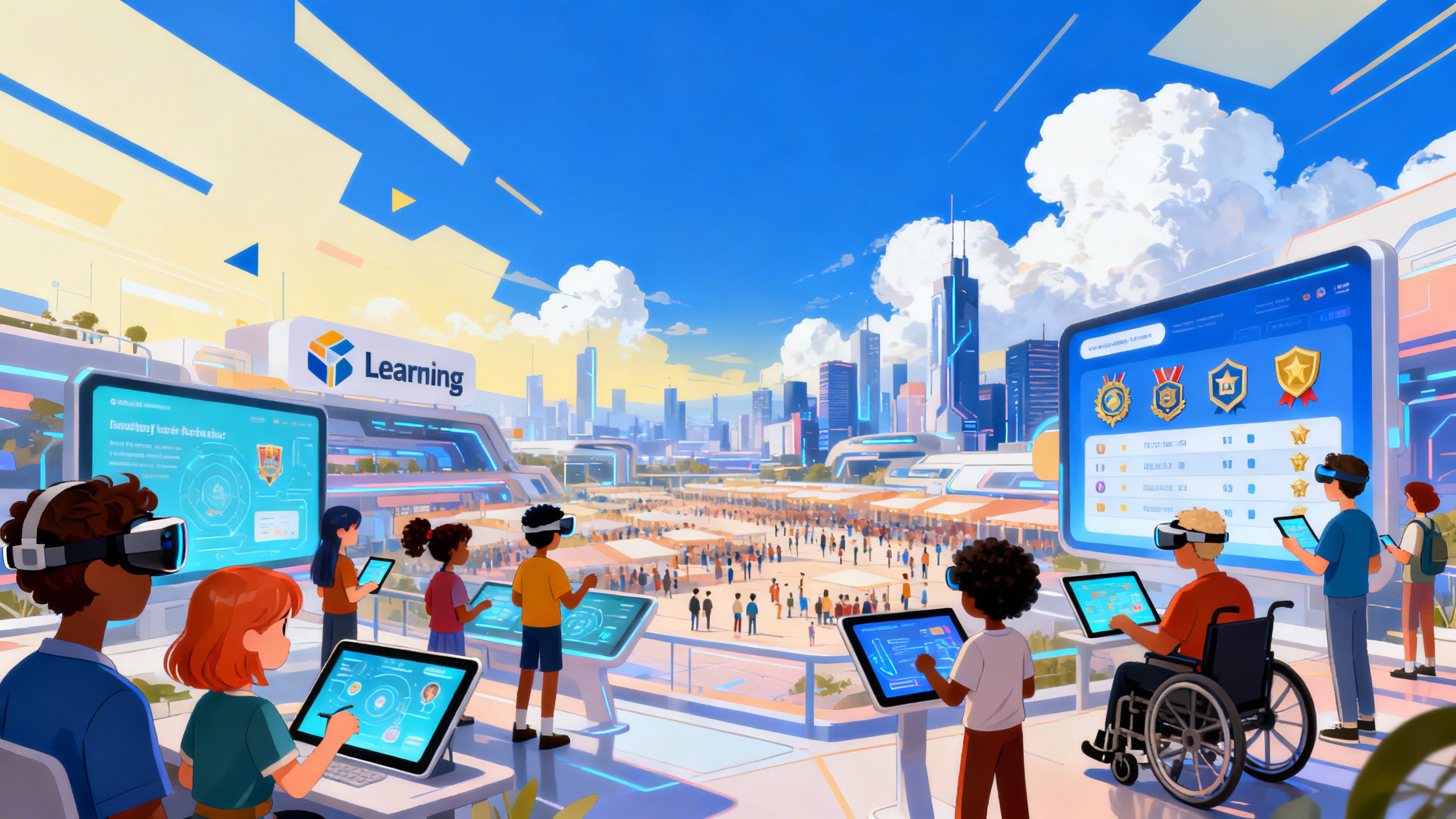
Education is undergoing a structural transformation. For centuries, learning has been governed by centralized institutions, standardized curricula, and linear credentialing systems. Yet in the digital era—shaped by decentralized networks, programmable incentives, and global connectivity—education is evolving into something more dynamic, participatory, and economically integrated.
At the center of this transformation lies the concept of Gamified Learning Economies: systems where education is structured as an interactive, incentive-driven environment powered by blockchain technology, digital assets, and tokenized reward mechanisms. These economies align learner motivation with measurable skill acquisition, community contribution, and real-world utility.
Unlike traditional gamification—which merely adds points and badges to existing systems—gamified learning economies create true ownership, economic participation, and verifiable achievement. In such systems, learners do not just consume information. They contribute, earn, build reputation, and participate in governance.
This article provides a comprehensive, research-oriented exploration of gamified learning economies within crypto education. We will analyze their theoretical foundations, technological architecture, token design models, behavioral economics underpinnings, governance structures, risks, scalability considerations, and long-term implications for global knowledge distribution.
1. Defining Gamified Learning Economies
A Gamified Learning Economy (GLE) is a blockchain-enabled ecosystem where:
- Educational progress is measurable and verifiable.
- Achievements are tokenized.
- Incentives are aligned with meaningful skill development.
- Participants earn digital assets for learning-related activities.
- Reputation and credentials are portable and trust-minimized.
- Economic value circulates within and beyond the platform.
The concept draws inspiration from the evolution of decentralized technologies such as Ethereum and early digital asset experiments like Bitcoin, which introduced programmable money and trustless verification.
In traditional education:
- Institutions issue credentials.
- Learners pay tuition.
- Economic value flows primarily to centralized providers.
In gamified learning economies:
- Value flows between learners, educators, developers, and communities.
- Skill acquisition directly connects to economic opportunity.
- Credentials become composable digital primitives.
2. The Theoretical Foundations
2.1 Behavioral Economics and Motivation Design
Gamified learning economies rely heavily on behavioral economics. Core concepts include:
- Intrinsic vs. extrinsic motivation
- Reward reinforcement loops
- Social proof
- Status signaling
- Loss aversion
In traditional systems, grades act as delayed extrinsic rewards. In GLEs, feedback loops are immediate and measurable.
However, careless incentive design risks undermining intrinsic motivation. Effective systems reward:
- Mastery
- Contribution
- Collaboration
- Long-term engagement
Poorly designed systems reward:
- Spam behavior
- Surface-level completion
- Short-term token farming
The distinction determines sustainability.
2.2 Game Theory and Coordination
Gamified learning economies are coordination systems. Participants must act in ways that:
- Increase collective knowledge
- Improve content quality
- Maintain economic balance
Game theory principles help designers:
- Prevent exploitative behavior
- Align token emissions with real value creation
- Ensure governance fairness
The system must incentivize productive cooperation over extractive competition.
2.3 Decentralization and Trust Minimization
Blockchain enables:
- Verifiable credentials
- Transparent reward distribution
- Immutable achievement records
- Decentralized governance
Unlike centralized platforms, blockchain-based systems reduce reliance on institutional trust. Instead, trust is encoded in smart contracts.
This shift redefines the authority of certification.
3. Core Components of a Gamified Learning Economy
3.1 Tokenized Incentives
Tokens serve multiple purposes:
- Rewards for course completion
- Incentives for peer review
- Governance participation
- Access to advanced modules
- Reputation signaling
Tokens may be:
- Utility tokens
- Governance tokens
- Non-transferable reputation tokens
- NFTs representing credentials
The architecture often resembles ecosystems pioneered by organizations such as Binance or Coinbase, though education-focused implementations require more nuanced incentive modeling.
3.2 Verifiable Credentials
Blockchain allows issuance of:
- Tamper-proof certificates
- On-chain skill proofs
- NFT-based degrees
- Micro-credential badges
Emerging standards within networks like Polygon and Solana reduce costs and improve scalability.
Verifiable credentials support:
- Employer validation
- Cross-platform portability
- Lifelong skill tracking
3.3 Reputation Systems
Reputation tokens may be:
- Non-transferable (soulbound)
- Earned through peer validation
- Weighted by community trust
Reputation often matters more than token quantity. A well-designed reputation system discourages exploitation and encourages expertise.
3.4 Governance Mechanisms
Participants may vote on:
- Curriculum updates
- Token emission changes
- Reward structures
- Moderation policies
Governance mechanisms mirror decentralized autonomous organizations (DAOs). These structures ensure adaptability and collective ownership.
4. Designing Sustainable Tokenomics
Tokenomics determines whether a gamified learning economy thrives or collapses.
4.1 Emission Control
Over-emission leads to:
- Inflation
- Token devaluation
- Short-term farming behavior
Controlled emission models:
- Reward mastery milestones
- Penalize inactivity
- Encourage staking
4.2 Utility Beyond Speculation
Tokens must provide:
- Access rights
- Governance power
- Premium content unlocks
- Reputation amplification
Without real utility, tokens become speculative instruments rather than learning incentives.
4.3 Long-Term Value Creation
Value must correlate with:
- Employer recognition
- Marketplace demand
- Skill verification integrity
Sustainable systems integrate with real-world economic demand rather than relying solely on internal token circulation.
5. Educational Architecture Models
5.1 Learn-to-Earn (L2E)
Participants earn tokens for:
- Completing lessons
- Passing assessments
- Teaching others
- Creating content
But L2E must avoid shallow reward structures that incentivize minimal engagement.
5.2 Skill-Based Reward Systems
Advanced systems reward:
- Demonstrated competency
- Real-world application
- Peer-reviewed projects
This creates a meritocratic incentive structure.
5.3 Contribution-Based Economies
Learners may earn for:
- Translating content
- Moderating discussions
- Building tools
- Improving curriculum
Contribution-based models decentralize educational growth.
6. The Role of NFTs in Gamified Learning
NFTs can represent:
- Completion certificates
- Unique skill badges
- Access passes
- Identity anchors
Unlike traditional diplomas, NFT credentials can be:
- Publicly verifiable
- Interoperable
- Programmatically composable
They can integrate with decentralized identity systems to enable frictionless validation.
7. Risks and Challenges
7.1 Over-Gamification
Excessive rewards may:
- Distract from mastery
- Encourage superficial learning
- Create dependency on incentives
7.2 Regulatory Uncertainty
Tokens may be:
- Classified as securities
- Subject to compliance requirements
- Restricted in certain jurisdictions
Education-focused token models must consider global regulatory landscapes.
7.3 Economic Exploitation
Bad actors may:
- Automate completion
- Create fake accounts
- Farm rewards
Anti-sybil mechanisms are critical.
8. Psychological Impacts
Gamified learning economies influence:
- Dopamine cycles
- Motivation sustainability
- Competitive behavior
- Social comparison
Healthy systems promote:
- Mastery orientation
- Community collaboration
- Skill pride over token obsession
9. Global Implications
Gamified learning economies enable:
- Borderless education
- Micro-credential monetization
- Alternative career pathways
- Access for underserved regions
For learners in emerging economies, tokenized incentives can offset financial barriers and provide global recognition.
10. Integration with Workforce Markets
For maximum impact, gamified learning economies must connect to:
- Employers
- Freelance platforms
- DAOs
- On-chain job marketplaces
Verified credentials reduce hiring friction and increase trust in remote collaboration.
11. Case Study Patterns
Successful systems share characteristics:
- Clear learning objectives
- Transparent token models
- Reputation over speculation
- Community governance
- Employer integration
Failure patterns include:
- Unsustainable token inflation
- Weak assessment standards
- Lack of real-world demand
Conclusion: Education as a Living Economy
Gamified learning economies represent more than a trend—they signal a paradigm shift. Education is evolving from a static, institution-centered model into a dynamic, decentralized, economically participatory system.
When designed responsibly, these systems:
- Align incentives with mastery.
- Democratize credential ownership.
- Reward contribution.
- Create sustainable educational ecosystems.
The challenge lies not in the technology, but in the design. Incentives must be aligned with truth, value, and human development.
If built correctly, gamified learning economies will not merely distribute tokens—they will distribute opportunity, skill, and agency in a decentralized world.