Imagine you could prove you’re over 18 without showing your birthdate.
Prove you own a house without revealing the address.
Prove you paid your taxes without exposing your income.
No screenshots.
No documents.
No trust required.
Just proof.
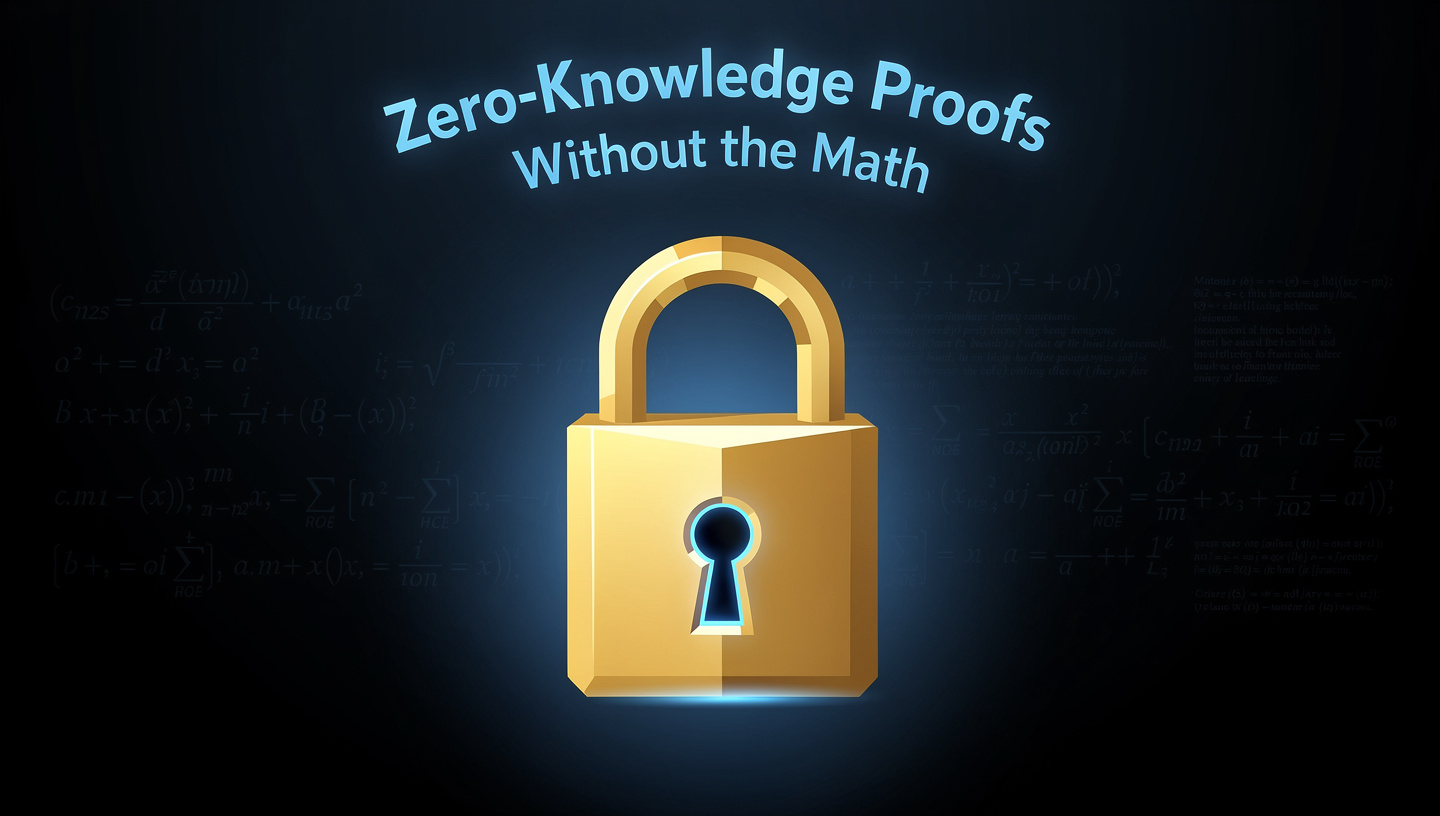
That’s the quiet superpower of Zero-Knowledge Proofs (ZKPs). And despite the intimidating name, the idea behind them is surprisingly human, intuitive, and deeply relevant to the future of the internet.
This article explains zero-knowledge proofs without equations, symbols, or cryptography jargon. Instead, we’ll use stories, analogies, and real-world intuition—because the core idea isn’t about math.
It’s about trust.
The Problem We’ve Always Had: Trust Leaks Information
Every system of trust leaks data.
When you log into a website, you usually give:
- A password
- Or an email
- Or a social login
- Or a phone number
Each one reveals something about you.
When you apply for a loan, you expose:
- Your income
- Your employment
- Your credit history
When you vote, pay taxes, or cross borders, you hand over identity details that far exceed what’s actually needed.
The core issue is this:
To prove something, we usually reveal everything.
That’s a terrible design.
It worked in a paper-based world, but in a digital world—where data can be copied infinitely, leaked instantly, and abused permanently—it’s a liability.
Zero-knowledge proofs flip this model upside down.
The One-Sentence Idea of Zero-Knowledge Proofs
Here it is, stripped to the bone:
A zero-knowledge proof lets you prove a statement is true without revealing why it’s true.
Not “trust me.”
Not “here’s my data.”
But: “Here’s cryptographic proof that I’m not lying.”
No secrets shared.
No information leaked.
Just certainty.
A Classic Analogy: The Cave of Secrets
Let’s use a famous story that perfectly captures the idea.
Imagine a cave shaped like a loop, with two entrances: A and B.
Inside the cave is a locked door that only opens with a secret word.
Alice claims she knows the secret word.
Bob doesn’t believe her.
Bob doesn’t want the word.
He just wants proof that Alice knows it.
Here’s what they do:
- Alice enters the cave and randomly chooses entrance A or B.
- Bob waits outside and doesn’t see which entrance she chose.
- Bob then shouts: “Come out through entrance A!” or “Come out through entrance B!”
- If Alice truly knows the secret word, she can always comply—she can open the door and exit wherever Bob asks.
- If she doesn’t know the word, she can only exit the way she entered—and will eventually get caught.
Repeat this process many times.
If Alice succeeds every time, Bob becomes convinced she knows the secret.
Crucially:
- Bob never learns the secret word
- Alice never reveals it
- Yet Bob gains confidence approaching certainty
That’s a zero-knowledge proof.
What Makes a Proof “Zero-Knowledge”?
A real zero-knowledge proof must satisfy three properties. Don’t worry—no math here.
1. It’s Correct (Completeness)
If the statement is true, an honest prover can convince an honest verifier.
If you really know the password, you can always pass the test.
2. It’s Sound (Soundness)
If the statement is false, a liar can’t consistently fake it.
Luck might work once.
Not forever.
3. It Reveals Nothing Else (Zero-Knowledge)
The verifier learns only that the statement is true.
Not how.
Not why.
Not any hidden details.
This third property is the revolutionary one.
Why This Is a Big Deal (Even If You’re Not a Cryptographer)
Zero-knowledge proofs solve a problem most people don’t even realize exists:
We constantly over-share to gain trust.
ZKPs let us decouple trust from exposure.
That changes everything.
Passwords Are a Terrible Example of Trust
Let’s talk about passwords.
To log in, you usually:
- Send your password (or a hash of it)
- Hope the server stores it securely
- Hope the database never leaks
- Hope attackers never brute-force it
Even with best practices, breaches happen constantly.
With zero-knowledge authentication:
- The server never learns your password
- You prove you know it without revealing it
- Even a hacked server can’t impersonate you
This isn’t hypothetical.
Some modern authentication systems already use ZK-style techniques.
Zero-Knowledge Proofs in Blockchain (The Obvious Use Case)
Blockchains made everything public.
That was the point.
But total transparency has side effects:
- Anyone can see balances
- Anyone can track transactions
- Anyone can build profiles of behavior
Zero-knowledge proofs reintroduce privacy without sacrificing verification.
You can prove:
- A transaction is valid
- The sender has enough funds
- The rules were followed
…without revealing:
- Who sent it
- How much was sent
- Or which account was involved
This is how privacy-focused blockchains and Layer-2 systems work.
The chain doesn’t “trust” you.
It verifies you—blindly.
The Subtle Power: Selective Disclosure
One of the most underrated aspects of zero-knowledge proofs is selective disclosure.
Instead of handing over your entire identity, you prove a single fact.
Examples:
- Prove you’re over 18 (not your birthday)
- Prove you live in a country (not your address)
- Prove you passed KYC (not your documents)
- Prove you’re solvent (not your balance)
This aligns with how humans naturally think.
When a bartender checks ID, they don’t care where you were born or your middle name. They care about one thing.
ZKPs formalize that intuition digitally.
Why “Without the Math” Still Works
You might wonder:
“If this is all math under the hood, why can we ignore it?”
Because users don’t need to understand cryptography—just like drivers don’t need to understand combustion engines.
What matters is:
- The guarantees
- The incentives
- The failure modes
Zero-knowledge proofs give us a new primitive: verifiable truth without exposure.
That’s a design breakthrough, not just a mathematical one.
Where This Is Going (And Why It Matters)
We’re moving toward a world where:
- AI agents verify facts
- Governments digitize identity
- Financial systems run on open ledgers
- Data becomes more valuable than oil
In that world, privacy isn’t a luxury—it’s survival.
Zero-knowledge proofs offer a path where:
- Verification doesn’t require surveillance
- Compliance doesn’t require surrender
- Trust doesn’t require vulnerability
They let us build systems that are:
- Trustless
- Private
- Verifiable
- Scalable
At the same time.
That combination is rare.
The Big Mental Shift
Here’s the real takeaway:
Zero-knowledge proofs are not about hiding lies.
They’re about proving truth responsibly.
They don’t weaken trust.
They strengthen it—by removing unnecessary exposure.
Instead of asking:
“Show me everything so I can trust you,”
We can finally say:
“Show me proof, and keep your secrets.”
That’s not just cryptography.
That’s progress.