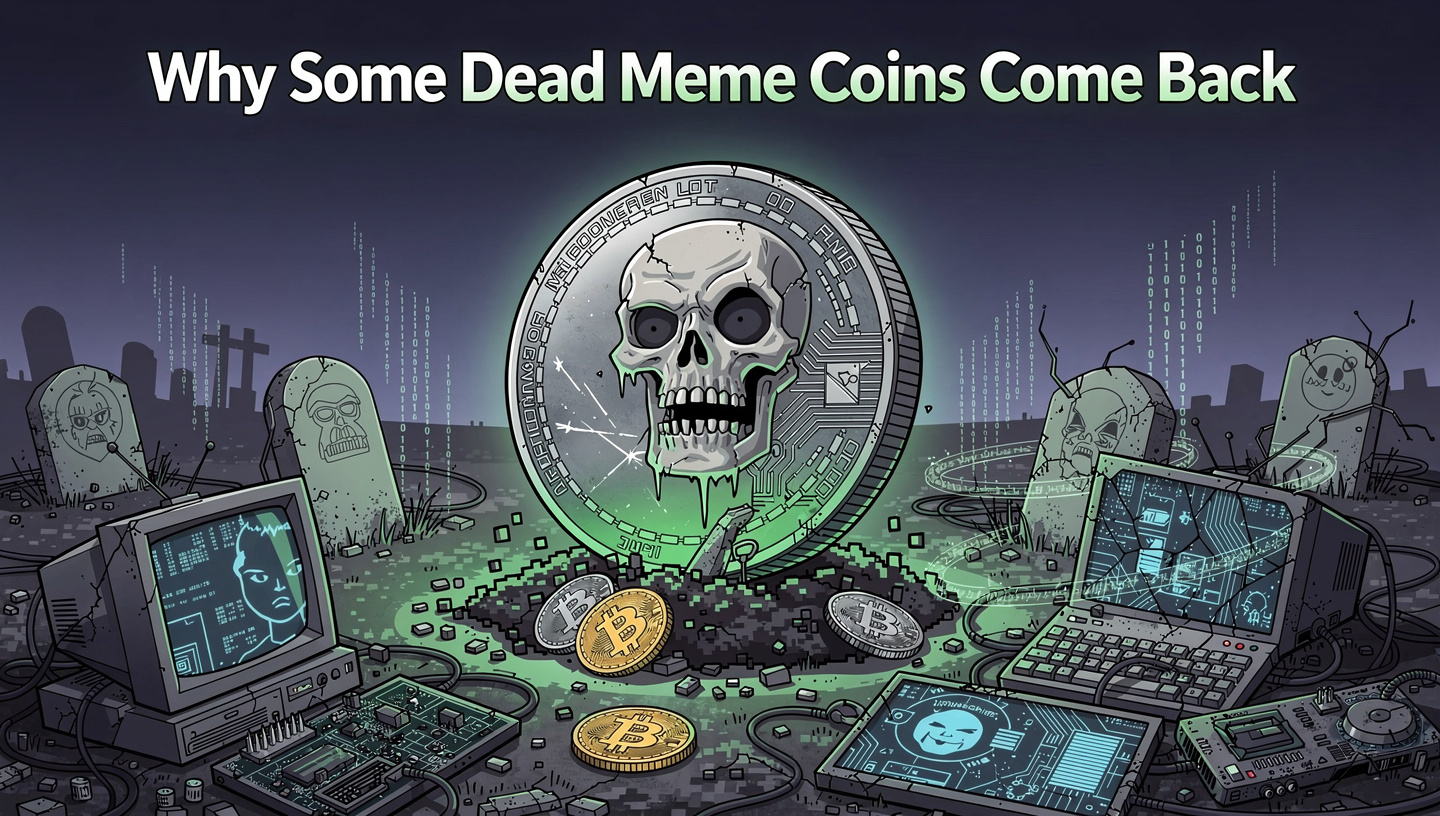
In traditional markets, when an asset dies, it stays dead.
In crypto — especially meme coins — death is often just a phase.
Charts that look terminal. Communities that go silent. Liquidity that evaporates. Twitter accounts abandoned. Telegrams filled with ghosts. On-chain activity flatlining.
And then, weeks or months later, suddenly:
Volume returns.
The ticker starts moving.
CT notices.
Liquidity rotates in.
The “dead” coin does a casual 5x.
This isn’t random.
It’s not magic.
And it’s definitely not just “degens being degens.”
There are structural reasons why some meme coins resurrect while thousands disappear forever.
If you understand these mechanics, you stop viewing meme coins as pure chaos — and start seeing them as reflexive micro-markets driven by liquidity memory, narrative compression, and behavioral loops.
This article breaks down:
- What “dead” actually means in meme coin markets
- Why certain coins revive while others never do
- The liquidity and psychology cycles behind comebacks
- Real structural patterns that repeat every market phase
- How traders identify resurrection candidates
- Why this phenomenon is uniquely crypto-native
No fairy tales. No motivational fluff. Just market structure.
What Does “Dead” Even Mean in Meme Coins?
Before we go further, we need precision.
A meme coin is considered “dead” when:
- Daily volume drops below relevance threshold (often <$50k–$100k)
- Social engagement collapses
- Core holders capitulate
- Development activity stops (if any existed)
- Price retraces 80–99% from ATH
- CT stops talking about it
But “dead” in crypto does not mean:
- Contract destroyed
- Trading halted
- Liquidity removed
As long as the token still trades permissionlessly on-chain, it exists in a latent state.
This is crucial.
In traditional finance, delisting equals extinction.
In DeFi, everything remains callable by capital.
Every meme coin is a dormant option.
The Core Truth: Meme Coins Are Liquidity Containers, Not Projects
This is the mental shift most traders never make.
Meme coins are not startups.
They are not products.
They are liquidity vessels attached to cultural identifiers.
Their value is not derived from:
- Roadmaps
- Technology
- Utility
It’s derived from:
- Attention
- Collective memory
- Ease of access
- Narrative recognizability
A meme coin doesn’t need builders to survive.
It only needs:
- A ticker
- A recognizable meme
- Existing holders
- A liquidity pool
That’s it.
Once you understand this, revivals become logical.
Why Only SOME Dead Meme Coins Come Back
Most meme coins die permanently.
A small minority resurrect.
The difference lies in five structural factors.
Let’s go through them.
1. Narrative Residue
Every major meme coin leaves behind narrative residue.
This includes:
- Old CT threads
- Archived hype cycles
- Screenshots of ATH charts
- Influencer memories
- Bagholders waiting for redemption
This residue matters.
Human memory is asymmetric: people remember former winners far more than former losers.
When liquidity returns to the ecosystem, traders don’t scan random contracts.
They scan:
- Previous runners
- Familiar names
- Coins they once missed
A dead coin with strong narrative residue has reactivation potential.
One without it is invisible.
2. Liquidity Memory and Order Book Gravity
Markets remember price levels.
Even on-chain.
When a coin previously traded at:
- $50M
- $200M
- $1B
those levels remain psychologically encoded in trader minds.
So when price collapses to $5M, the mental model becomes:
“This used to be huge.”
That creates asymmetric speculation.
Low float + historical reference points = reflexive bounce setups.
This is called liquidity memory.
It’s why old meme coins often outperform brand-new launches during rotation phases.
3. Holder Distribution After Capitulation
Here’s a subtle one.
After a meme coin dies, something important happens:
Weak hands leave.
What remains is:
- Stubborn bagholders
- High-conviction cult members
- Dormant wallets
- Lost keys
This creates supply compression.
When revival demand arrives, there is less liquid supply than during the initial hype phase.
That’s why resurrected meme coins often pump harder than they did originally.
Supply has already been purged.
4. Cultural Anchoring
Some memes transcend their token.
Think:
- DOGE
- PEPE
- SHIB
- BONK
Even when price collapses, the meme itself persists.
These coins are culturally anchored.
They exist beyond charts.
As long as the meme remains relevant, capital can reattach to the ticker.
Coins without cultural anchoring don’t get second chances.
5. Low Re-entry Friction
Dead meme coins are easy to revive because:
- Contracts already exist
- Liquidity pools already exist
- Tickers are indexed on trackers
- Wallets already hold supply
All it takes is:
- One influencer
- One narrative
- One rotation event
There is no deployment overhead.
This is unique to crypto.
The Macro Trigger: Liquidity Rotation
Resurrections don’t happen randomly.
They occur during rotation phases.
The pattern is consistent:
- Majors pump
- Midcaps follow
- Fresh memes explode
- Traders look for laggards
- Old memes reactivate
This is capital recycling.
Traders take profits from hot assets and redeploy into assets with:
- Familiar names
- Lower market caps
- Historical relevance
Dead meme coins become natural rotation targets.
Not because they’re good.
Because they’re cheap relative to memory.
Reflexivity: How Comebacks Feed Themselves
Once revival begins, reflexivity takes over.
Price moves → CT notices
CT notices → volume increases
Volume increases → more eyes
More eyes → higher price
The narrative becomes:
“It’s back.”
That alone attracts speculative capital.
No fundamentals required.
George Soros described this decades ago: perception influences reality.
Meme coins are reflexivity in its purest form.
The Bagholder Effect
One of the most powerful forces behind meme coin revivals is bagholder psychology.
Millions of wallets sit underwater from previous cycles.
When price starts moving:
- Old holders stop selling
- New buyers arrive
- Supply tightens
Bagholders don’t want to exit at break-even.
They want redemption.
This creates upward pressure.
Ironically, the people who suffered most become the structural support for the next pump.
Why New Meme Coins Don’t Always Win
Fresh launches dominate attention, but they lack:
- Historical reference
- Emotional attachment
- Legacy communities
They also have:
- Heavier insider allocations
- Faster dumps
- Less hardened holder bases
Dead meme coins already went through their distribution phase.
They’re “cleaner” structurally.
This is why veterans often prefer revivals over launches.
What Traders Look For in Revival Candidates
Experienced meme traders evaluate:
On-chain
- Holder count stability
- Dormant wallet clusters
- Liquidity depth
Social
- Meme recognition
- Old CT presence
- Community remnants
Market structure
- Previous ATH
- Current market cap
- Supply concentration
They’re not asking:
“Is this project building?”
They’re asking:
“Can attention reconnect to this ticker?”
That’s the game.
This Is Not Random Chaos — It’s Patterned Speculation
From the outside, meme coin revivals look irrational.
Inside the market, they’re predictable.
They follow:
- Liquidity cycles
- Behavioral finance
- Cultural persistence
- Supply mechanics
Crypto simply exposes these forces more nakedly than TradFi ever could.
Final Thoughts: Death Is Temporary in Permissionless Markets
In crypto, nothing truly disappears.
As long as a contract exists, capital can return.
Dead meme coins come back because:
- Humans remember former winners
- Liquidity seeks asymmetry
- Supply compresses after capitulation
- Memes outlive price charts
- Permissionless markets never close doors
This isn’t nostalgia.
It’s structural.
If you want to understand meme coins, stop thinking like a VC.
Start thinking like a market psychologist.
Because in this arena, value is not created.
It is remembered, forgotten, and rediscovered.
And sometimes, what looks dead is just waiting for liquidity to remember its name.