In March 2021, a digital collage by the artist Beeple sold for $69 million at Christie’s. The artwork existed as a JPEG—an image that anyone could right-click, save, and view for free. This moment didn’t just shock the art world; it confused nearly everyone else.
Why would anyone pay so much for something infinitely copyable?
Why would people spend thousands, sometimes millions, on NFTs—digital tokens that seem intangible, abstract, and volatile?
To skeptics, NFTs are pure hype: speculative madness powered by greed, influencers, and fear of missing out.
To believers, NFTs represent a fundamental shift in how humanity assigns value, ownership, and meaning in the digital age.
The truth, as always, lies somewhere in between.
This article explores why people pay so much for NFTs, dissecting the tension between hype and real value, and uncovering what NFTs reveal about human psychology, economics, technology, and culture.
1. Ownership Has Never Been About the Object
At first glance, NFTs appear irrational. But only if we misunderstand what people are actually buying.
Historically, ownership has rarely been about utility alone.
- A Rolex doesn’t tell time better than a $20 watch.
- A Picasso isn’t “better paint” than a street mural.
- A signed basketball isn’t more playable than a new one.
Yet people pay astronomical prices for these objects.
Why?
Because ownership is about:
- Status
- Identity
- Scarcity
- Story
- Belonging
NFTs simply transfer these ancient human behaviors into a digital environment.
The NFT is not the image.
The NFT is the proof of ownership, the symbol, the social signal, and the historical record.
Once you see that, the price starts to make more sense.
2. Digital Scarcity: The Psychological Breakthrough
Before NFTs, the internet had a fundamental problem: everything was copyable.
Music, art, videos, memes—digital culture was rich, but ownership was meaningless. Scarcity, the backbone of value, simply didn’t exist online.
NFTs introduced verifiable digital scarcity.
For the first time:
- A digital item could be provably unique
- Ownership could be publicly verified
- History could be immutably tracked
This was not just a technical innovation—it was a psychological one.
Humans are wired to value what is scarce. NFTs tap directly into this instinct, even when the underlying asset is “just a file.”
Scarcity doesn’t need to be physical to feel real.
3. Hype: The Fuel That Ignited the Explosion
Let’s be honest: hype played a massive role in NFT pricing.
Several forces converged at once:
- A global pandemic
- Excess liquidity and stimulus money
- A generation raised online
- Crypto millionaires looking for cultural assets
- Social media amplifying success stories instantly
NFTs became the perfect storm.
People didn’t just buy NFTs—they bought narratives:
- “This will be the next Bitcoin.”
- “Early adopters always win.”
- “This is the future of art.”
- “If I don’t buy now, I’ll regret it forever.”
This is classic speculative psychology, seen before in:
- Tulips
- Dot-com stocks
- Real estate bubbles
- Meme stocks
Hype inflated prices far beyond intrinsic value in many cases.
And yes—many NFTs were, and still are, overpriced.
But hype alone does not explain why some NFTs retain value long after the noise fades.
4. Value: When NFTs Become More Than Speculation
The mistake critics often make is treating all NFTs as identical.
They are not.
Just as:
- Not all paintings are valuable art
- Not all websites became Amazon
- Not all startups survived the dot-com crash
NFT value emerges when multiple layers align.
a) Cultural Significance
Some NFTs matter because they capture a moment in internet history.
Early CryptoPunks, for example, are not visually impressive—but they are historically important. They represent the birth of NFT culture.
Cultural artifacts gain value not because they are beautiful, but because they are foundational.
b) Strong Communities
NFTs are not just assets; they are membership tokens.
Many buyers are paying for:
- Access to private communities
- Shared identity
- Networking opportunities
- Social belonging
In this sense, NFTs behave more like clubs, movements, or tribes than artworks.
People pay for connection as much as ownership.
c) Creator Reputation
Artists with strong narratives, consistency, and vision tend to retain value better than anonymous cash grabs.
Collectors don’t just buy art—they buy belief in the creator’s future relevance.
d) Utility and Evolution
Some NFTs evolve over time:
- Unlock content
- Grant rights
- Generate yield
- Change based on behavior or events
When NFTs become dynamic systems rather than static images, they justify higher valuations.
5. Status Signaling in the Digital Age
In the physical world, luxury is visible through:
- Cars
- Watches
- Clothing
- Houses
In digital spaces, these signals disappear.
NFTs filled that void.
Your profile picture, wallet holdings, and on-chain history became digital status symbols.
Owning a high-profile NFT publicly signals:
- Wealth
- Early adoption
- Cultural awareness
- Risk tolerance
- Tech fluency
This is not shallow—it’s human.
People have always used visible markers to communicate who they are and where they belong. NFTs simply translate this instinct into online environments.
6. Speculation vs. Belief: The Invisible Line
There is a crucial difference between:
- Buying NFTs to flip
- Buying NFTs to believe
Speculators chase momentum.
Believers chase meaning.
During boom cycles, speculators dominate. Prices rise fast, logic disappears, and narratives become exaggerated.
During crashes, only belief remains.
That is why NFT markets feel extreme—because they oscillate between financial speculation and cultural conviction.
People who pay the most are often not gambling blindly; they are placing asymmetric bets on a future they believe in.
7. The Harsh Reality: Most NFTs Will Be Worth Nothing
This must be said clearly.
Just as:
- Most startups fail
- Most books never become classics
- Most artists never achieve recognition
Most NFTs will not hold long-term value.
They were experiments, learning curves, or outright cash grabs.
High prices do not guarantee lasting worth.
But failure is not evidence that the entire system is meaningless—it is evidence that the system is real.
Only real markets produce real winners and losers.
8. NFTs as a Mirror of Humanity
Ultimately, NFTs are not about technology.
They are about:
- How humans assign value
- How stories shape perception
- How communities form
- How status evolves
- How culture adapts to new environments
People pay so much for NFTs because:
- They are buying identity
- They are buying belief
- They are buying participation in history
- They are buying optionality on the future
Sometimes this leads to brilliance.
Sometimes it leads to excess.
Often, it leads to both.
Conclusion: Hype Fades, Value Reveals Itself
The NFT phenomenon is neither pure scam nor pure revolution.
It is a messy, human, emotional experiment unfolding in real time.
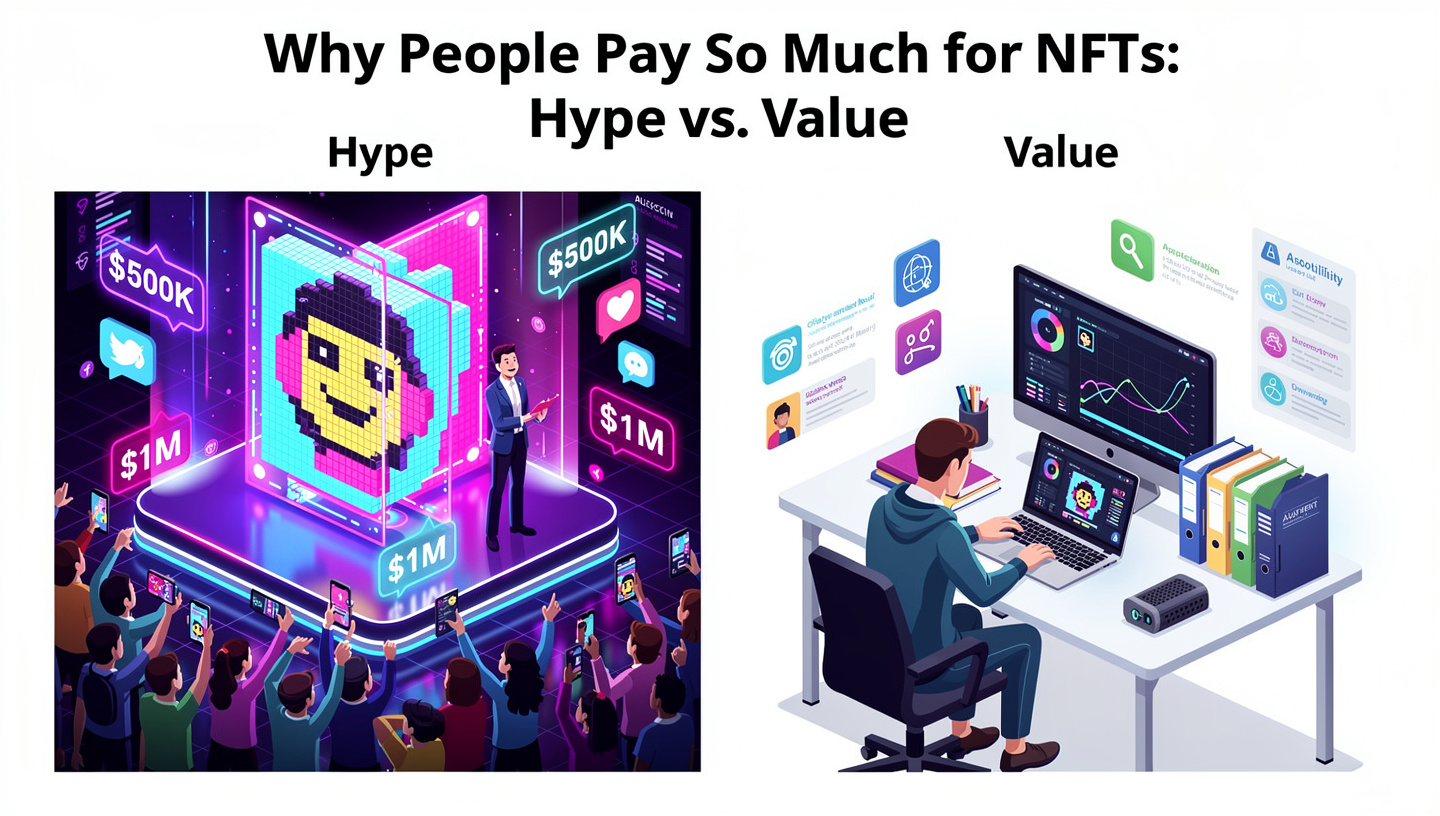
Hype explains the peaks.
Value explains what remains after the noise disappears.
And years from now, when today’s arguments feel outdated, one thing will be clear:
NFTs were not about overpriced JPEGs.
They were about redefining ownership, meaning, and value in a digital world that had forgotten how to price them.
Whether you believe or not, NFTs forced humanity to ask a timeless question in a new form:
What is something worth—when everyone can see it, copy it, but only one person can truly own it?
That question alone is priceless.