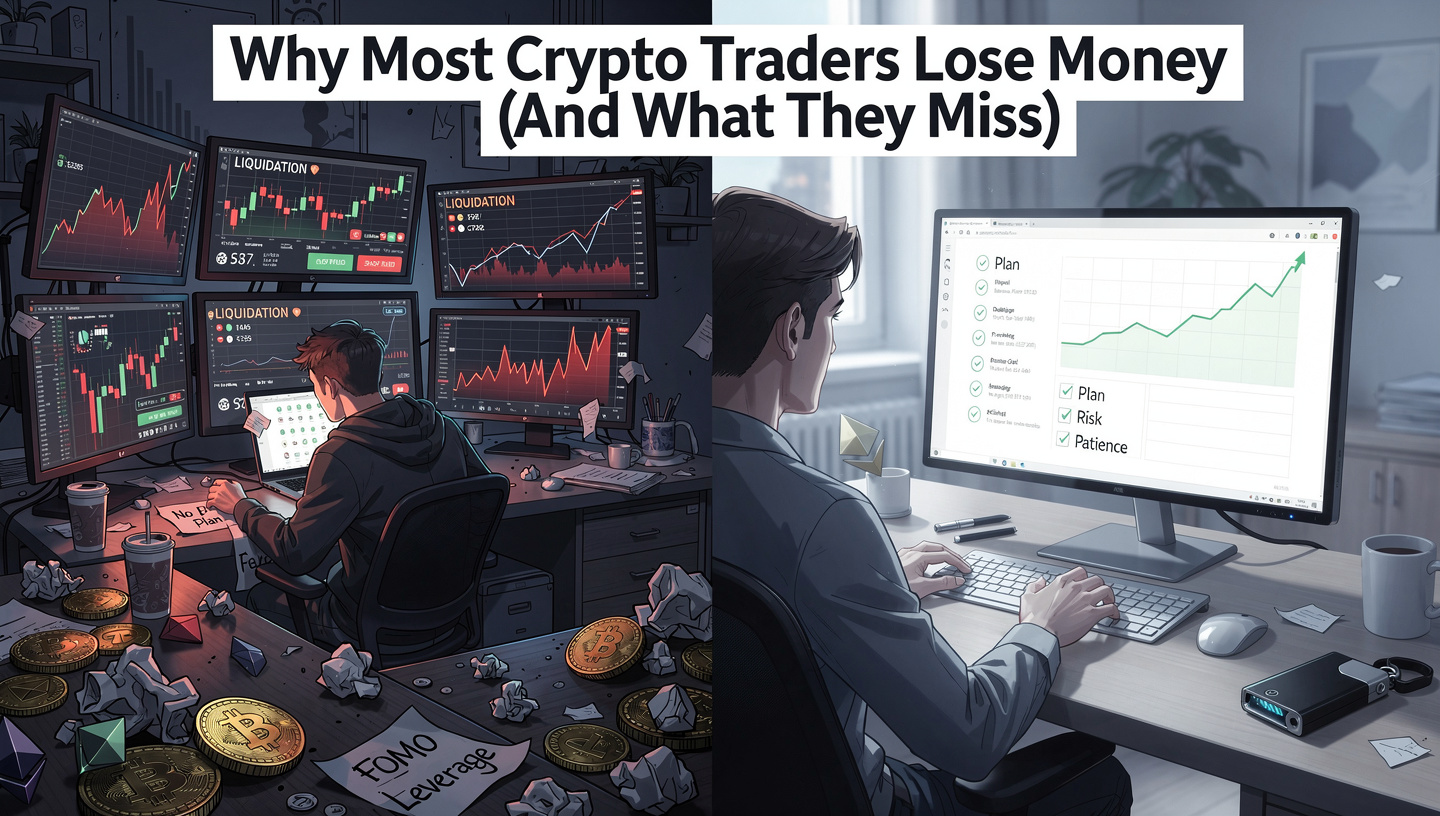
Crypto has created overnight millionaires, yes. But it has also quietly manufactured millions of disappointed, confused, and financially bruised traders. For every viral screenshot of a 1,000% gain, there are thousands of invisible losses—accounts drained slowly, confidence eroded quietly, dreams deferred indefinitely.
Here’s the uncomfortable truth: most crypto traders lose money. Not because they are stupid. Not because the market is rigged (at least not entirely). They lose because they misunderstand what game they are actually playing.
This article is not another surface-level “buy low, sell high” sermon. This is a deep autopsy of why crypto traders fail, where they go wrong psychologically and structurally, and what they consistently miss—even after years in the market.
If you’ve ever wondered why you seem to work harder than the market yet fall further behind, read on.
1. They Think They’re Investors, But They’re Actually Gamblers
Most people enter crypto believing they are investing. In reality, they are speculating without a framework.
An investor understands:
- What they own
- Why it should grow in value
- Under what conditions they would exit
A gambler understands only one thing: price can go up.
Crypto makes gambling feel intelligent. Charts look scientific. Indicators feel mathematical. Twitter threads sound confident. But beneath the surface, many traders are simply reacting to price movement with no thesis, no edge, and no patience.
They don’t ask:
- What problem does this asset solve?
- Who needs this token in five years?
- What must go right for this price to justify itself?
Instead, they ask:
“Is this pumping?”
That single question has destroyed more portfolios than any hack ever could.
2. They Confuse Volatility With Opportunity
Crypto is volatile. That volatility seduces traders into believing opportunity is everywhere.
But volatility is a double-edged blade.
High volatility means:
- Faster gains
- Faster losses
- Strong emotional swings
Most traders are not emotionally equipped to handle this environment. They overtrade. They revenge trade. They chase green candles and panic-sell red ones.
Volatility doesn’t reward activity. It rewards discipline.
Ironically, the traders who trade the most often earn the least.
3. They Overestimate Skill and Underestimate Randomness
A few lucky trades can convince someone they are a genius.
Early success is dangerous.
Crypto markets, especially during bull runs, can reward almost any behavior. Buying randomly feels like skill when the entire market is rising. This creates false confidence.
When conditions change:
- Strategies stop working
- Luck runs out
- Losses compound
Instead of adapting, traders double down. They increase position sizes. They ignore risk. They blame manipulation.
What they miss is this:
Short-term results prove nothing. Long-term survival proves everything.
4. They Trade Without Understanding Market Cycles
Crypto is not a straight line upward. It moves in cycles:
- Accumulation
- Expansion
- Distribution
- Collapse
Most traders only learn about cycles after being financially introduced to the collapse phase.
They buy when narratives are loud.
They sell when hope is gone.
The market transfers wealth from the impatient to the patient—not because patience is moral, but because it is rare.
5. They Worship Influencers Instead of Thinking Independently
Crypto has replaced financial advisors with Twitter personalities.
Influencers are not inherently evil—but their incentives are misaligned with yours.
They are rewarded for:
- Engagement, not accuracy
- Confidence, not nuance
- Speed, not reflection
Many traders outsource their thinking completely:
- What to buy
- When to sell
- What narrative to believe
This creates dependency. And dependency is fatal in markets.
What most traders miss is simple:
If someone is telling you exactly what to do, you are the product.
6. They Ignore Risk Because Loss Isn’t Immediate
Risk is invisible until it isn’t.
In crypto, losses often arrive suddenly, violently, and without warning.
Most traders:
- Don’t size positions properly
- Don’t define invalidation points
- Don’t plan for black swan events
They treat risk management as optional.
But here’s the paradox:
Risk management is what allows you to stay in the game long enough to win.
You don’t need to be right often. You need to not be wrong catastrophically.
7. They Trade Emotionally While Pretending They’re Rational
Crypto doesn’t just test intelligence—it tests identity.
Price movement triggers:
- Fear of missing out
- Fear of being wrong
- Fear of looking stupid
Traders swear they are logical, yet:
- They hold losers hoping to break even
- They sell winners too early out of fear
- They change strategies mid-trade
Emotion is not the enemy. Unacknowledged emotion is.
Professional traders don’t feel less—they manage better.
8. They Don’t Realize the Market Is Designed to Exploit Human Behavior
Markets are not neutral arenas. They are psychological battlegrounds.
Liquidity is taken where emotions peak:
- Tops form when greed is highest
- Bottoms form when despair feels endless
Most traders assume markets are about information.
In reality, markets are about behavioral imbalance.
Those who understand human psychology have an edge over those who only understand charts.
9. They Chase Complexity Instead of Clarity
Crypto traders love:
- Advanced indicators
- Complicated strategies
- Obscure metrics
Complexity feels sophisticated.
But clarity wins.
Many successful traders use:
- Simple trend frameworks
- Clear risk rules
- Few, well-understood assets
What most traders miss:
If you can’t explain your strategy simply, you don’t understand it.
10. They Measure Success Incorrectly
Most traders define success as:
“Did I make money today?”
This is a trap.
Short-term profit can be:
- Random
- Unsustainable
- Risky
True success looks like:
- Consistency over years
- Emotional stability
- Capital preservation
The goal is not to win every trade.
The goal is to still be here when real opportunities arrive.
What Most Crypto Traders Completely Miss
Here is the core insight few want to accept:
Crypto is not a shortcut to wealth. It is an amplifier.
It amplifies:
- Discipline or recklessness
- Patience or impatience
- Humility or ego
Those who bring chaos into crypto get chaos back—with leverage.
Those who bring structure, humility, and long-term thinking give themselves a chance.
The Shift That Changes Everything
Successful crypto participants don’t ask:
“How much can I make?”
They ask:
“How do I avoid losing?”
They don’t seek certainty.
They seek asymmetry.
They don’t chase every move.
They wait for conditions.
And most importantly, they understand this:
The market is not here to reward effort. It rewards alignment.
Final Thoughts: This Is a Mirror, Not a Market
Crypto does not create your weaknesses.
It reveals them.
If you lose money repeatedly, the market is giving feedback—not punishment.
Listen.
Adjust.
Slow down.
Because the biggest mistake most crypto traders make…
Is believing the problem is out there.
When the real edge has always been within.