Stocks have earnings.
Bonds have yield curves.
Real estate has cash flow and zoning laws.
Crypto itself already bends those rules — but meme coins go further. They exist almost entirely outside traditional valuation logic. No discounted cash flow. No product-market fit. Often no roadmap worth mentioning.
And yet.
They generate billions in volume.
They dominate retail narratives every cycle.
They routinely outperform “serious” projects during speculative phases.
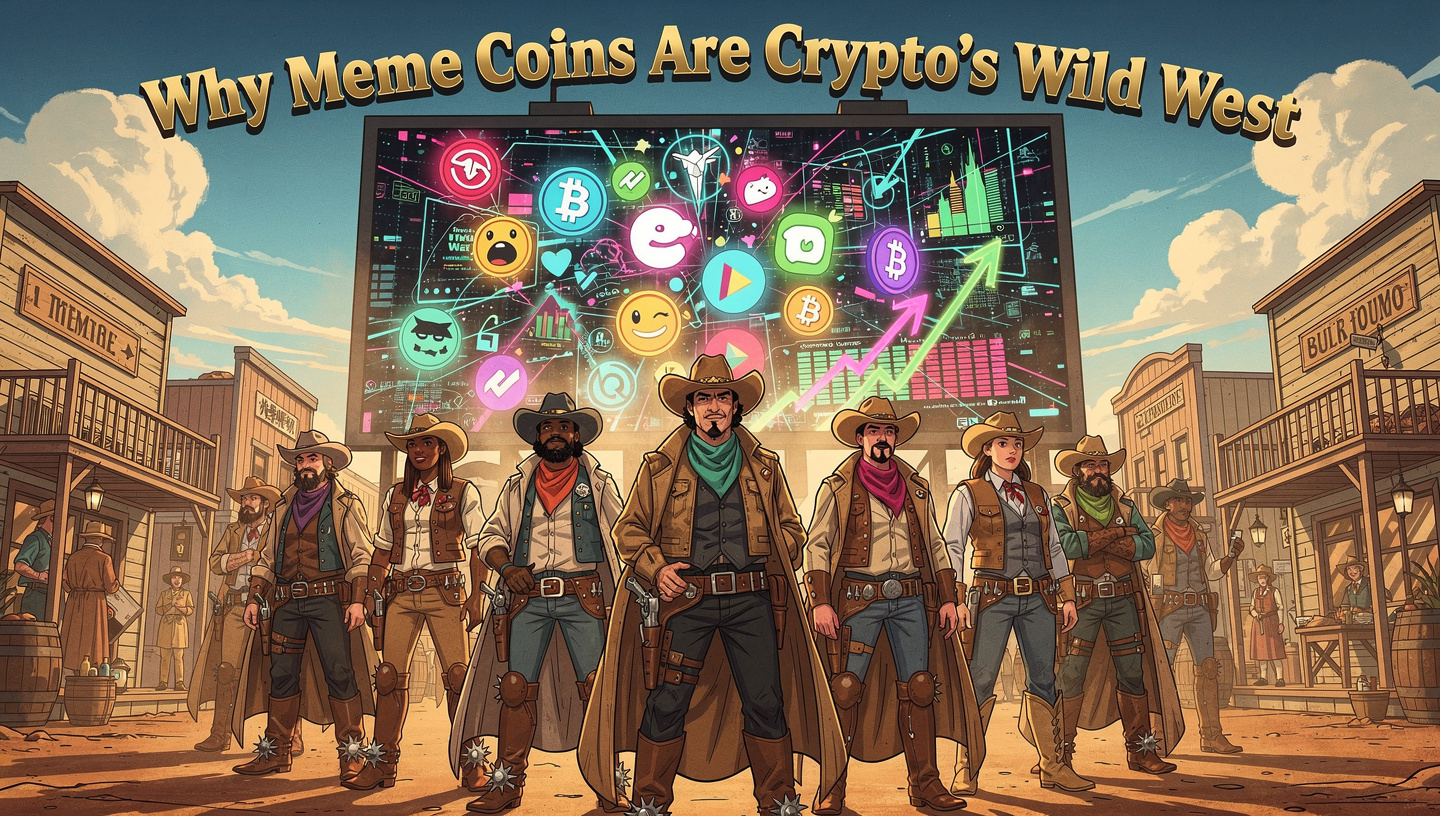
This contradiction is exactly why meme coins are crypto’s Wild West.
Not because they’re chaotic.
Because they’re lawless in a very specific way.
Meme coins are where:
- Attention becomes capital
- Culture becomes liquidity
- Community becomes price action
- And speed replaces fundamentals
There are no sheriffs here. No central authority. No meaningful investor protections. Just wallets, narratives, and reflexive feedback loops.
To understand meme coins, you don’t study technology.
You study human behavior under financial stress and dopamine incentives.
The Wild West Analogy Is Structural, Not Poetic
The American Wild West wasn’t just cowboys and shootouts.
It was:
- Rapid land grabs
- Minimal regulation
- Extreme wealth asymmetry
- Speculators arriving before infrastructure
- Opportunists moving faster than institutions
Meme coins follow the same pattern.
Every bull cycle creates a frontier:
First comes infrastructure (Layer 1s, bridges, DEXs).
Then builders.
Then VCs.
Then retail.
But meme coins skip the builder phase entirely.
They appear once liquidity is already present.
They are pure extraction vehicles.
No pretense of building rails. They simply ride them.
And just like historical frontiers:
- Early entrants win disproportionately
- Latecomers provide exit liquidity
- Scams flourish where enforcement is weak
- Reputation becomes currency
- Speed matters more than ethics
This is not accidental.
This is emergent market behavior.
Meme Coins Are Financialized Attention
Traditional assets derive value from productivity.
Meme coins derive value from visibility.
Every meme coin pump follows the same mechanics:
- Someone launches a token (often in minutes)
- Early insiders accumulate
- Social channels activate
- Influencers amplify
- Retail FOMO enters
- Liquidity spikes
- Distribution begins
Nothing magical.
Just attention converting into liquidity.
In meme coin markets, price is not determined by utility.
It’s determined by:
- How fast a narrative spreads
- How emotionally resonant the meme is
- How aggressive the early marketing push becomes
- How easily screenshots circulate
This creates a brutal reality:
The best meme coins are not the funniest.
They are the most viral.
Virality is the underlying asset.
There Is No “Fair Launch” in Practice
Meme culture loves to talk about fair launches.
In reality, almost none are truly fair.
Why?
Because information asymmetry always exists.
Someone always knows earlier:
- The deployer
- Their friends
- Their Discord
- Their Telegram
- Their sniper bots
Even in supposedly organic launches, insiders accumulate before public discovery.
This is not corruption.
This is game theory.
When assets can be created instantly and traded permissionlessly, early knowledge becomes alpha.
And because meme coins move exponentially, minutes matter.
This creates a structure where:
- Insiders harvest volatility
- Retail absorbs risk
- Late buyers subsidize early exits
Again — Wild West.
Reflexivity: Why Meme Coins Explode So Violently
George Soros’ concept of reflexivity applies perfectly here.
Price increases cause attention.
Attention causes buying.
Buying causes price increases.
Loop repeats.
No fundamentals required.
Once reflexivity starts, logic exits the system.
You don’t need conviction.
You need momentum.
That’s why meme coins can go from $1M to $500M market cap in days.
Not because they became valuable.
Because belief cascades formed.
And belief, in crypto, is leverage.
Meme Coins Are the Purest Expression of Retail Psychology
Meme coins reveal uncomfortable truths:
Retail doesn’t want slow compounding.
Retail wants asymmetry.
Retail wants narratives they understand in seconds.
Retail wants the chance — however small — of turning $200 into $200,000.
Meme coins offer:
- Low nominal prices
- Simple branding
- Social validation
- Constant stimulation
They remove cognitive friction.
No whitepapers.
No tokenomics PDFs.
No GitHub commits.
Just vibes.
This accessibility is precisely why they dominate late-cycle behavior.
When markets heat up, complexity loses.
Simplicity wins.
Builders Hate Meme Coins. Markets Don’t Care.
Developers often dismiss meme coins as parasites.
From a technical perspective, they’re right.
Meme coins rarely contribute innovation.
But markets don’t reward contribution.
They reward participation.
Meme coins onboard users faster than most serious protocols ever will.
They teach wallets.
They teach DEX usage.
They teach gas fees.
Many first-time crypto users enter via memes.
Not DeFi dashboards.
Not infrastructure plays.
Memes.
This creates a paradox:
Meme coins don’t build crypto.
But they grow crypto.
Why Regulation Can’t Tame This Frontier
Regulators operate on jurisdiction.
Crypto operates on code.
Meme coins launch globally, anonymously, and instantly.
Even if one country bans them, liquidity routes elsewhere.
Even if platforms delist, DEXs persist.
There is no centralized choke point.
And because meme coins are not companies, not securities (by traditional definition), and not commodities in practice, they exist in regulatory gray zones.
This allows:
- Rug pulls
- Insider dumping
- Wash trading
- Fake volume
- Impersonation tokens
All at scale.
Not because crypto is evil.
Because permissionless systems optimize for speed, not safety.
The Darwinian Layer: Why Most Meme Coins Die
Over 99% of meme coins go to zero.
Not eventually.
Quickly.
Reasons:
- Liquidity dries up
- Attention moves on
- Insiders exit
- No ecosystem forms
Only a microscopic minority survive long enough to become cultural artifacts (DOGE, SHIB, PEPE).
Survivors share traits:
- Simple identity
- Strong meme resonance
- Persistent communities
- Exchange listings
- Longevity through multiple cycles
They evolve from tokens into symbols.
Everything else becomes on-chain debris.
Meme Coins Are Not a Phase. They’re a Feature.
Every market cycle produces meme coins.
2013: Doge
2017: TRON memes, low-cap pumps
2021: SHIB, DOGE revival
2024–2025: Solana meme explosion
Different chains.
Same psychology.
As long as crypto remains:
- Permissionless
- Global
- Retail-driven
- Narrative-sensitive
Meme coins will exist.
They are not an anomaly.
They are the market expressing itself.
The Real Risk Isn’t Meme Coins. It’s Misunderstanding Them.
The danger isn’t that meme coins are volatile.
Volatility is obvious.
The danger is thinking they operate by traditional investment logic.
They don’t.
They operate by:
- Social momentum
- Attention velocity
- Liquidity depth
- Cultural relevance
Treating meme coins like startups leads to confusion.
They are closer to financialized internet culture.
Closer to speculative media.
Closer to decentralized casinos.
Final Thoughts: The Frontier Will Stay Wild
Meme coins represent crypto stripped of pretense.
No roadmaps.
No governance theater.
Just markets reacting to memes at machine speed.
This is uncomfortable for builders.
Terrifying for regulators.
Exhilarating for speculators.
But inevitable.
Because when anyone can mint money in minutes, the result is not order.
It’s frontier economics.
Meme coins are crypto’s Wild West because they expose the system exactly as it is:
Permissionless.
Reflexive.
Brutally efficient.
And entirely human.