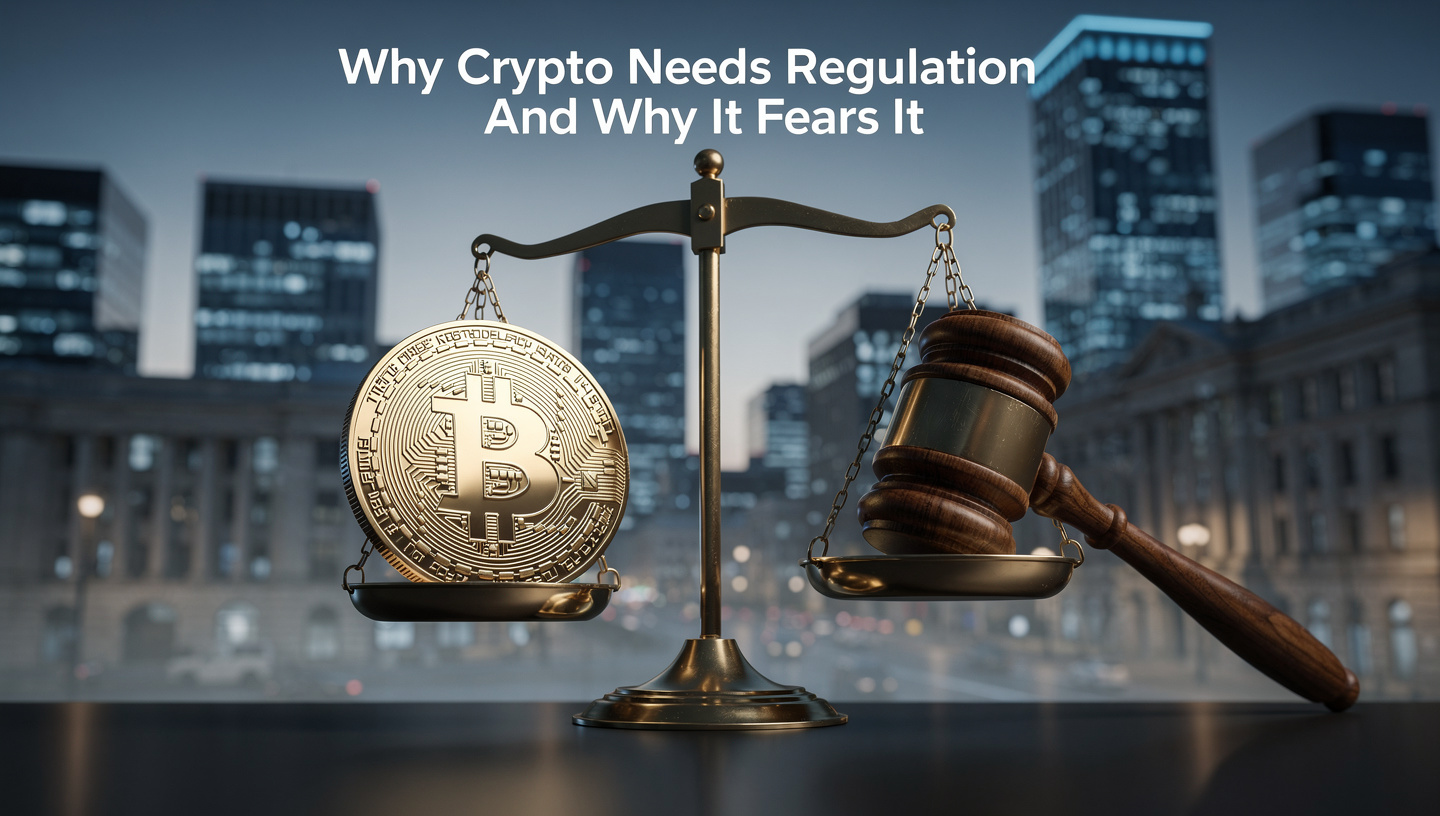
Cryptocurrency was designed to function without centralized oversight. The release of Satoshi Nakamoto’s whitepaper in 2008 introduced a system intended to operate independently of banks, governments, and intermediaries. The first block of Bitcoin embedded a political message referencing bank bailouts—an early signal that the technology was not merely financial innovation, but ideological disruption.
Yet as crypto evolved from a niche experiment into a multi-trillion-dollar asset class spanning exchanges, derivatives, stablecoins, decentralized finance, and tokenized securities, it entered a regulatory vacuum that could not persist indefinitely. Capital markets do not exist outside law. Financial infrastructure, once systemic, inevitably intersects with public policy.
This tension defines modern crypto: it requires regulation to scale responsibly, but it resists regulation because oversight challenges its foundational ethos. The industry both demands clarity and rejects control. Understanding this paradox requires examining technological design, market structure, legal doctrine, financial stability concerns, and behavioral economics.
This article provides a structured, research-oriented analysis of why crypto requires regulation—and why it simultaneously fears it.
1. The Structural Nature of Crypto Markets
1.1 From Peer-to-Peer Cash to Financial Ecosystem
Bitcoin was conceived as peer-to-peer electronic cash. However, crypto markets rapidly evolved beyond simple value transfer:
- Centralized exchanges (CEXs)
- Decentralized exchanges (DEXs)
- Stablecoins
- Lending protocols
- Derivatives markets
- Yield products
- Tokenized real-world assets
- Algorithmic monetary systems
The launch of Ethereum in 2015 accelerated this shift by introducing programmable smart contracts. These contracts enabled complex financial instruments without traditional intermediaries, birthing decentralized finance (DeFi).
By 2021, DeFi protocols collectively managed hundreds of billions in value. Stablecoins such as Tether and USD Coin became critical liquidity infrastructure for global crypto trading.
At this scale, crypto ceased to be experimental software. It became financial infrastructure.
Financial infrastructure, by definition, demands regulation.
2. Why Crypto Needs Regulation
2.1 Investor Protection
Unregulated markets amplify information asymmetry.
Crypto markets exhibit:
- Extreme volatility
- Thin liquidity in many tokens
- High retail participation
- Opaque governance structures
- Anonymous or pseudonymous founders
- Cross-border jurisdictional ambiguity
Fraud cases, exchange collapses, rug pulls, insider trading, and market manipulation have repeatedly damaged retail participants.
The collapse of FTX in 2022 illustrated systemic risk in lightly regulated exchanges. Commingling of funds, governance failures, and insufficient internal controls resulted in billions of dollars in losses.
Traditional financial markets evolved disclosure rules, audit standards, capital requirements, and custody segregation to prevent precisely these failures. Crypto markets currently lack uniform global equivalents.
Regulation introduces:
- Disclosure standards
- Custodial safeguards
- Capital adequacy rules
- Governance accountability
- Transparency obligations
Without these, retail investors operate in structurally disadvantaged conditions.
2.2 Systemic Risk Containment
Stablecoins function as shadow banks. They:
- Issue liabilities (tokens)
- Hold reserves (cash, Treasuries, commercial paper)
- Facilitate payment settlement
- Provide liquidity in trading markets
If a large stablecoin fails, the shock propagates across exchanges, DeFi protocols, and leveraged positions.
Algorithmic stablecoin collapses have demonstrated how reflexive market structures amplify panic. Liquidity cascades, liquidation spirals, and collateral devaluation can transmit risk rapidly.
When crypto integrates with traditional financial institutions—through ETFs, custodians, and derivatives—spillover risk increases.
Systemic risk requires macroprudential oversight.
2.3 Anti-Money Laundering and Financial Crime
Crypto enables borderless transfers without traditional intermediaries. This feature creates efficiency—but also exposure.
Risks include:
- Sanctions evasion
- Ransomware payments
- Terrorist financing
- Illicit marketplace transactions
- Cross-border capital flight
Regulatory frameworks impose Know-Your-Customer (KYC) and Anti-Money Laundering (AML) standards on exchanges and custodians.
While blockchain transparency aids forensic tracking, anonymity layers complicate enforcement.
Regulation balances privacy rights with national security imperatives.
2.4 Market Integrity
Unregulated crypto markets exhibit:
- Wash trading
- Pump-and-dump schemes
- Insider token allocations
- Unclear token classifications
- Conflicts of interest in exchange-token relationships
Traditional securities markets rely on strict enforcement of insider trading rules and manipulation prohibitions. Without similar frameworks, price discovery becomes distorted.
For example, the classification of tokens under securities law remains contentious. The U.S. Securities and Exchange Commission has pursued enforcement actions arguing many tokens qualify as securities under the Howey Test.
Legal clarity reduces regulatory arbitrage and increases institutional confidence.
2.5 Institutional Adoption and Capital Formation
Large asset managers, banks, and pension funds require legal certainty.
Unclear classification of digital assets as:
- Securities
- Commodities
- Payment instruments
- Property
- Derivatives
creates compliance uncertainty.
When entities like BlackRock enter crypto markets through exchange-traded products, they demand regulatory clarity.
Regulation lowers risk premiums, reduces legal ambiguity, and increases long-term capital allocation.
Without regulatory frameworks, crypto remains speculative rather than foundational.
3. Why Crypto Fears Regulation
Despite its structural need for oversight, crypto culture resists it. This resistance is ideological, technical, and economic.
3.1 Ideological Foundations: Decentralization as Doctrine
Crypto emerged in response to the 2008 financial crisis. Embedded in its origin is distrust of centralized authority.
The blockchain model eliminates:
- Central banks
- Custodial intermediaries
- Political monetary control
For many participants, regulation represents a return to the very structures crypto sought to bypass.
Decentralization is not merely architectural; it is philosophical.
State oversight appears incompatible with permissionless networks.
3.2 Fear of Overreach
Regulatory ambiguity can morph into enforcement by litigation rather than legislation.
The SEC’s approach to digital assets has often relied on case-by-case enforcement rather than comprehensive statutory reform. Industry actors argue this creates uncertainty rather than clarity.
Crypto fears:
- Retroactive classification
- Overbroad securities definitions
- Excessive compliance burdens
- Innovation flight to offshore jurisdictions
Overregulation risks pushing development into opaque markets rather than eliminating risk.
3.3 Privacy Erosion
Crypto enables pseudonymous participation.
Mandatory KYC requirements conflict with:
- Privacy maximalism
- Self-sovereign identity principles
- Resistance to surveillance
Decentralized exchanges operating purely on smart contracts cannot easily implement identity checks without altering core architecture.
Privacy-focused advocates view regulation as surveillance infrastructure expansion.
3.4 Innovation Friction
Startups in crypto iterate rapidly. Traditional regulatory processes move slowly.
Heavy compliance costs create barriers to entry, favoring incumbents over open-source communities.
Regulation may:
- Increase legal costs
- Require licensing regimes
- Demand reserve disclosures
- Impose reporting obligations
This potentially consolidates power in well-capitalized firms, undermining decentralization.
3.5 Jurisdictional Fragmentation
Crypto is global by design. Regulation is territorial.
When jurisdictions diverge—such as the European Union’s Markets in Crypto-Assets (MiCA) framework versus U.S. enforcement-based approaches—projects must navigate incompatible requirements.
Fragmentation increases complexity and compliance costs.
Crypto fears becoming Balkanized by regulatory boundaries.
4. The Regulatory Models Emerging Globally
Different jurisdictions have adopted varying approaches:
4.1 Rules-Based Comprehensive Frameworks
The European Union implemented MiCA to provide standardized requirements for crypto asset issuers and service providers.
This model emphasizes:
- Licensing
- Stablecoin reserve transparency
- Consumer disclosures
- Operational resilience
Clarity increases predictability.
4.2 Enforcement-Driven Approach
In the United States, regulatory authority is split among:
- U.S. Securities and Exchange Commission
- Commodity Futures Trading Commission
- Banking regulators
Token classification disputes persist.
The absence of comprehensive federal legislation creates regulatory uncertainty.
4.3 Sandbox Models
Some jurisdictions experiment with regulatory sandboxes that allow limited testing under supervisory oversight.
This approach balances innovation with consumer protection.
5. The Core Paradox: Trust Minimization vs Trust Substitution
Crypto claims to be “trustless.” In reality, it minimizes trust in intermediaries but does not eliminate trust entirely.
Participants still trust:
- Code audits
- Oracle systems
- Stablecoin reserves
- Governance tokens
- Off-chain custodians
- Exchange solvency
Regulation substitutes legal trust for social or reputational trust.
Where code governs protocol behavior, law governs institutional actors surrounding it.
Crypto needs regulation not to change code, but to discipline centralized chokepoints.
6. Regulation as Legitimization
Paradoxically, regulation increases legitimacy.
When ETFs tracking Bitcoin were approved, institutional access expanded. Legitimization lowers perceived legal risk and integrates crypto into traditional portfolios.
Institutional adoption requires regulatory endorsement, even if implicit.
Crypto’s long-term survival depends on integration into regulated financial systems.
7. The Economic Reality: Capital Demands Predictability
Markets price uncertainty.
Regulatory ambiguity increases:
- Volatility
- Risk premiums
- Capital flight
- Speculative behavior
Clear frameworks reduce uncertainty and encourage long-term investment horizons.
Without regulation, crypto remains dominated by short-term traders rather than capital allocators.
8. The Future: Convergence, Not Conflict
Crypto will not remain unregulated. Nor will it be fully absorbed into traditional financial structures.
The most probable outcome is layered governance:
- Protocol-level decentralization
- Regulated access points (exchanges, custodians, issuers)
- International coordination
- Stablecoin reserve oversight
- Token classification clarity
The tension between autonomy and oversight will persist, but convergence is inevitable.
Conclusion: Regulation as Evolution, Not Extinction
Crypto does not fear regulation because it rejects safety; it fears regulation because it fears loss of autonomy.
Yet autonomy without accountability creates instability. Instability undermines trust. Without trust, markets contract.
The contradiction is structural:
- Crypto requires regulatory clarity to mature.
- Crypto resists regulatory authority to preserve decentralization.
Both positions contain truth.
The next phase of digital asset evolution depends not on eliminating regulation, but on designing it intelligently—targeting centralized risk vectors without suffocating decentralized innovation.
Crypto needs regulation to survive at scale.
It fears regulation because scale changes its identity.
The resolution of this tension will define the next decade of digital finance.