Smart contracts were designed to eliminate trust from transactions. Deployed on decentralized networks such as Ethereum, they execute automatically, deterministically, and without human intervention. Code replaces discretion. Consensus replaces intermediaries. In theory, this architecture minimizes disputes.
In practice, smart contracts fail.
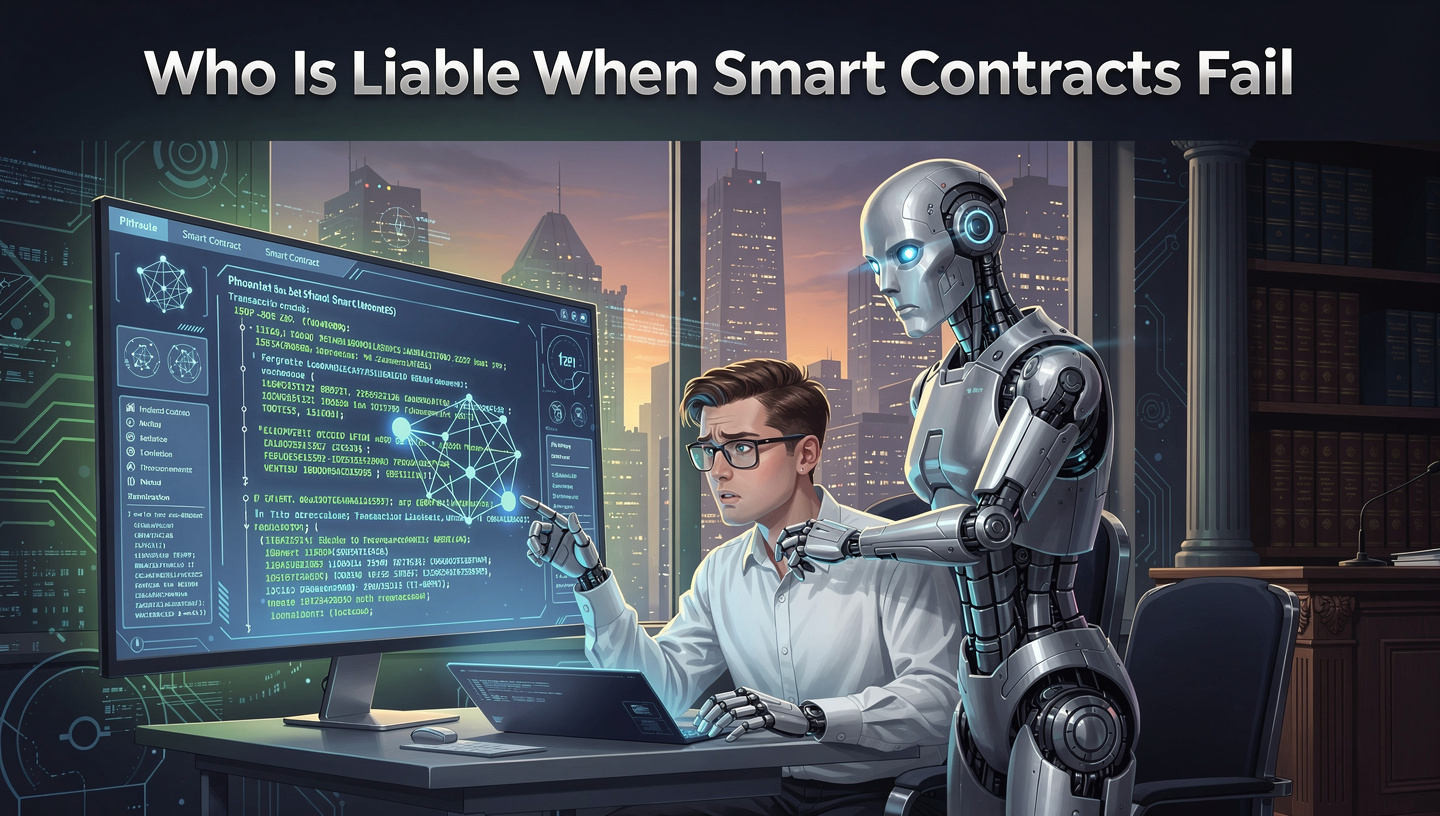
They fail because of coding defects, flawed economic design, oracle manipulation, governance exploits, malicious upgrades, and unforeseen interactions between composable protocols. When failure occurs, funds are lost, obligations are disrupted, and confidence erodes. The central legal question emerges immediately: who is liable when a smart contract fails?
This issue sits at the intersection of contract law, tort law, securities regulation, fiduciary duties, product liability, and emerging digital asset frameworks. The answer depends on facts, jurisdiction, system architecture, and the specific legal theory advanced. There is no universal rule. There is, however, a structured analytical framework.
This article provides a comprehensive legal analysis of liability in smart contract failures, examining:
- The legal characterization of smart contracts
- Categories of failure
- Potentially liable parties
- Applicable legal doctrines
- Regulatory overlays
- Case studies
- Risk mitigation strategies
The objective is clarity, not advocacy. Smart contracts do not exist outside the law. They are embedded within it.
I. What Is a Smart Contract in Legal Terms?
The term “smart contract” was introduced by Nick Szabo to describe self-executing digital agreements. On platforms such as Ethereum, these contracts are pieces of code deployed to a blockchain address that automatically execute predefined conditions.
Legally, smart contracts fall into three primary categories:
- Code as Performance Mechanism – Traditional contract exists off-chain; smart contract automates execution.
- Code as Evidence of Agreement – Code reflects parties’ agreement and serves as binding contract.
- Code as Autonomous System – No traditional bilateral agreement; protocol logic governs participation.
Each category produces different liability implications. Courts examine:
- Offer and acceptance
- Consideration
- Intent to create legal relations
- Capacity
- Clarity of terms
If the smart contract reflects a legally binding agreement, traditional contract principles apply. If it functions as a product or tool, product liability or negligence frameworks may apply.
II. Categories of Smart Contract Failure
Liability analysis begins with classification of failure. Failures are not homogeneous.
1. Coding Errors (Bugs)
Examples include arithmetic overflows, reentrancy vulnerabilities, improper access control, and logic flaws. The most cited case remains the exploit of Ethereum’s early decentralized venture fund known as The DAO.
2. Oracle Failures
Smart contracts rely on off-chain data through oracle providers. Manipulated or inaccurate price feeds can trigger liquidations or mispricing.
3. Governance Exploits
Decentralized Autonomous Organizations (DAOs) may suffer governance capture through flash loans or voting manipulation.
4. Economic Design Failures
Flaws in tokenomics or incentive design may cause systemic collapse even if the code performs as written.
5. Upgrade or Admin Key Abuse
Centralized control mechanisms can override contract logic, raising fiduciary and misrepresentation issues.
Each failure type directs liability differently.
III. Potentially Liable Parties
1. Developers
Developers may face liability under:
- Negligence (failure to exercise reasonable care in coding)
- Professional malpractice theories
- Misrepresentation
- Fraud (if intentional concealment)
The key legal question: did the developer owe a duty of care to users?
Courts evaluate:
- Foreseeability of harm
- Proximity between developer and user
- Public policy considerations
If developers publicly market a protocol, profit from it, retain control, or issue governance tokens, arguments for duty strengthen.
However, open-source publication alone does not automatically create liability. Analogies are often drawn to open-source software licenses, though blockchain contexts are more complex due to financial stakes.
2. Founders and Promoters
Founders who:
- Raise capital
- Issue tokens
- Publish whitepapers
- Control treasury funds
may incur liability under securities law, consumer protection statutes, or fraud doctrines.
In the United States, the U.S. Securities and Exchange Commission applies the test articulated in SEC v. W.J. Howey Co. to determine whether token offerings constitute securities.
If smart contracts underpin a token deemed a security, disclosure failures or misleading statements create regulatory and civil liability.
3. DAO Governance Participants
Where governance token holders vote on protocol changes, the issue becomes whether they constitute:
- A general partnership
- An unincorporated association
- A de facto joint enterprise
In some jurisdictions, unincorporated associations expose members to joint and several liability. Courts examine coordination, profit-sharing, and managerial participation.
4. Auditors
Security auditors may face liability under:
- Negligent misrepresentation
- Professional negligence
If an audit report is publicly relied upon and materially inaccurate, plaintiffs may argue foreseeable reliance.
However, disclaimers and limited scope engagements complicate recovery.
5. Oracle Providers
Oracle services supplying price feeds or external data may face:
- Contractual liability (if service agreements exist)
- Negligence claims
- Breach of implied warranty
Liability depends on whether the oracle merely relayed data or exercised discretionary control.
6. Users
In some failures, users bear risk under “code is law” arguments. Courts are unlikely to accept that doctrine categorically. However, user conduct—such as exploiting known vulnerabilities—may shift liability under unjust enrichment or fraud theories.
7. Exchanges and Custodians
If failure affects users via centralized exchanges, liability may arise under:
- Custodial duty
- Consumer protection law
- Securities regulation
Centralized intermediaries are easier defendants due to jurisdictional clarity and identifiable corporate structures.
IV. Legal Theories of Liability
A. Breach of Contract
If smart contract terms constitute enforceable agreement, plaintiffs must show:
- Valid contract
- Breach
- Damages
- Causation
Ambiguity arises when code conflicts with natural-language documentation.
Which governs? Courts may apply:
- Contra proferentem (interpretation against drafter)
- Parol evidence rules
- Trade usage
B. Negligence
Elements:
- Duty
- Breach
- Causation
- Damages
The existence of duty is the critical issue. Open-source ethos complicates the inquiry, but commercial promotion strengthens duty arguments.
C. Product Liability
Some scholars argue smart contracts function as digital products. If classified as products, strict liability frameworks could apply to defective code that causes foreseeable harm.
Jurisdictions differ on whether software constitutes a “product.”
D. Securities Law Liability
If tokens tied to smart contracts qualify as securities, liability may arise under:
- Registration violations
- Material misstatements
- Market manipulation
Enforcement actions by the U.S. Securities and Exchange Commission have emphasized substance over form.
E. Fiduciary Duties
Founders or administrators retaining discretionary authority may owe fiduciary duties. Breach claims arise if:
- Conflicts of interest exist
- Treasury funds are mismanaged
- Governance manipulation occurs
F. Unjust Enrichment
Exploiters who lawfully execute code but exploit vulnerabilities may face unjust enrichment claims if retention of funds is deemed inequitable.
V. Jurisdictional Challenges
Smart contracts are borderless. Liability is not.
Courts determine jurisdiction based on:
- Location of defendants
- Location of harm
- Targeted market
- Server or node distribution
Choice-of-law clauses embedded in terms of service may influence analysis but may not bind all participants.
Enforcement across jurisdictions introduces practical barriers even when liability is established.
VI. Case Study: The DAO
In 2016, The DAO was exploited via a reentrancy vulnerability. Approximately $60 million worth of Ether was diverted. The community initiated a hard fork of Ethereum to reverse effects.
Legal implications included:
- Potential developer negligence
- Governance participant exposure
- Securities classification analysis
Subsequently, the U.S. Securities and Exchange Commission issued a report concluding DAO tokens were securities under SEC v. W.J. Howey Co. analysis.
The incident established that decentralization does not immunize participants from regulatory scrutiny.
VII. The “Code Is Law” Argument
Some proponents argue that smart contracts’ deterministic execution precludes legal recourse. Courts reject this absolutism.
Law governs:
- Fraud
- Misrepresentation
- Coercion
- Mistake
- Public policy violations
Code may execute automatically. Legal systems evaluate human conduct behind that code.
VIII. Risk Allocation Mechanisms
Projects mitigate liability through:
- Disclaimers
- Terms of service
- Entity formation (e.g., foundation structures)
- Insurance coverage
- Audits and formal verification
- Bug bounty programs
Disclaimers reduce risk but do not eliminate liability for fraud or gross negligence.
IX. Insurance and Emerging Solutions
Smart contract insurance protocols have emerged, offering coverage for exploits. Regulatory treatment of such mechanisms remains evolving.
Traditional insurers increasingly underwrite digital asset risk, imposing underwriting standards that indirectly influence protocol design.
Conclusion
Smart contracts automate execution. They do not eliminate responsibility.
Liability when smart contracts fail depends on:
- Nature of the failure
- Degree of control retained by actors
- Representations made to users
- Regulatory classification of tokens
- Jurisdictional reach
Developers are not automatically liable. Users are not automatically without recourse. Decentralization is not immunity. Code is not a shield against negligence, fraud, or regulatory violations.
The legal system adapts by applying existing frameworks—contract law, tort law, securities regulation, fiduciary doctrine—to technologically novel architectures.
The central principle remains unchanged: where harm is caused by human decision-making embedded in code, legal accountability follows.