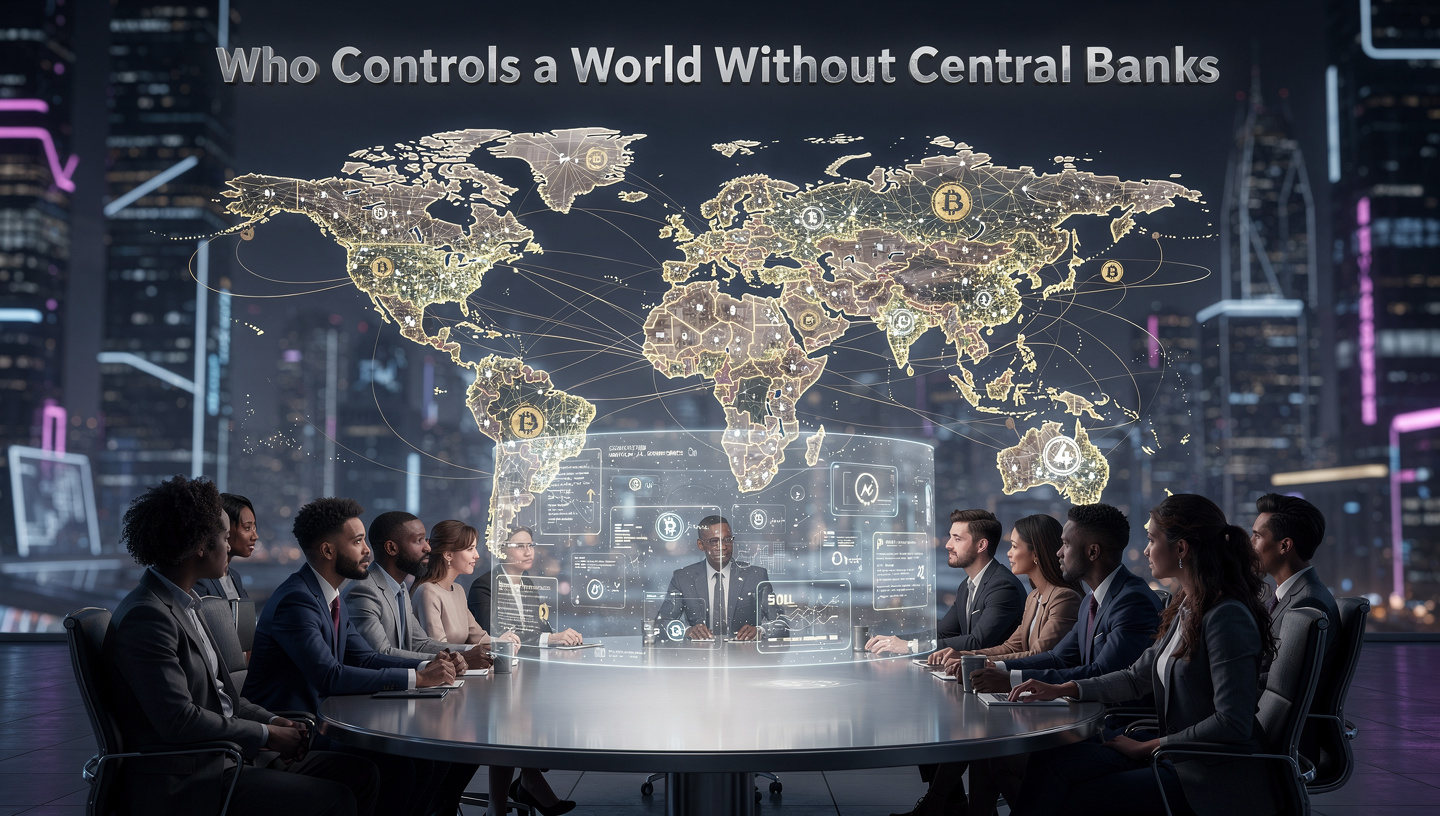
Remove the center, and the system does not collapse—it mutates.
That is the uncomfortable premise at the heart of crypto. Not “number go up,” not decentralization as a slogan, not memes about freedom. The real problem is structural: if monetary authority is no longer concentrated inside vaults, ministries, and marble buildings, then where does power actually reside? And more importantly—who exercises it?
This article treats that question seriously, as an engineering problem disguised as political economy. It explores a near-future financial architecture where central banks are obsolete, fiat settlement layers have dissolved, and programmable money coordinates most economic activity. This is science fiction in the same sense that early cybernetics was science fiction: speculative, technical, and uncomfortably plausible.
No mythology. No hero narratives. Just systems.
The Historical Default: Centralization Was Never Optional
For most of modern history, monetary control converged toward centralized institutions because complexity demanded it.
Clearing systems, interbank lending, sovereign debt markets, and liquidity backstops required a coordinating authority. That role crystallized into central banks and supranational bodies like the International Monetary Fund and the World Bank, while domestic monetary policy concentrated inside institutions such as the Federal Reserve.
This model solved three problems:
- Elastic currency issuance
- Systemic risk management
- Political accountability (at least nominally)
But it created a fourth: single points of control.
Crypto does not merely propose alternative money. It proposes removing these coordination hubs entirely.
Which brings us to the central paradox.
If no central bank exists, coordination still happens. Power does not vanish. It migrates.
The Genesis Disruption: Code as Monetary Authority
When Satoshi Nakamoto released Bitcoin, the innovation was not digital scarcity. It was automatic governance.
Bitcoin replaced discretionary monetary policy with deterministic issuance.
It replaced trusted intermediaries with cryptographic finality.
It replaced institutional authority with protocol consensus.
This was radical: monetary policy became software.
Later, Vitalik Buterin expanded the model through Ethereum, turning blockchains into generalized computation layers. Money became programmable. Agreements became executable. Entire organizations could exist as code.
At that point, the question was no longer can we remove central banks?
It became:
What replaces them?
Power Layer One: Protocol Designers
In a post-central-bank world, the first locus of authority is protocol architecture.
Who decides block size?
Who sets validator economics?
Who defines upgrade paths?
These choices are not neutral. They encode values about efficiency, decentralization, and governance.
Although networks present themselves as leaderless, their early design decisions exert long-term gravitational pull. Tokenomics, consensus mechanisms, and virtual machine constraints all shape emergent behavior decades later.
Protocol designers are not rulers—but they are constitutional authors.
Their influence resembles that of 18th-century legal framers, except their constitutions compile.
Power Layer Two: Validators and Infrastructure Operators
Decentralization does not eliminate infrastructure.
Nodes run somewhere.
Validators stake capital.
Relayers transmit data.
Oracles feed reality into contracts.
These actors form the operational substrate of crypto civilization.
Over time, this layer tends to consolidate. Professional validator firms emerge. Specialized hardware appears. Jurisdictional clustering happens due to energy prices and regulation.
Without central banks, monetary stability depends on:
- Validator honesty
- Network uptime
- Economic incentives
This is not anarchic freedom. It is mechanized trust.
The operators of that machinery become a quiet governing class.
Power Layer Three: Capital Aggregators
Even in permissionless systems, capital concentrates.
Large holders influence governance votes.
Liquidity providers shape markets.
Treasury DAOs steer development funding.
In today’s transitional phase, this already includes traditional asset managers like BlackRock, which increasingly interface with on-chain assets.
In a fully crypto-native future, these entities evolve into algorithmic capital syndicates—autonomous funds deploying billions through smart contracts, optimizing yield, governance influence, and infrastructure ownership simultaneously.
This layer functions like shadow central banking:
- It allocates liquidity.
- It stabilizes or destabilizes markets.
- It indirectly controls protocol evolution.
Except now it operates continuously, transparently, and without regulatory charters.
Power Layer Four: Smart Contract Economies
Once finance becomes composable, entire monetary systems run inside applications.
Decentralized exchanges like Uniswap define price discovery.
Credit systems like MakerDAO create synthetic currencies.
Insurance, payroll, derivatives, and identity all become modular components.
These platforms are not just services. They are micro-states:
- They set rules.
- They manage treasuries.
- They enforce outcomes through code.
Collectively, they replace the functional surface area of central banking.
Interest rates emerge from liquidity curves.
Stability comes from arbitrage.
Bailouts become automated recapitalizations.
No committee meetings. Just execution.
Power Layer Five: DAOs as Post-Nation Institutions
The most alien development is the rise of DAOs—on-chain organizations coordinating millions of participants across borders.
In this future, DAOs handle:
- Infrastructure funding
- Scientific research
- Media production
- Public goods
- Defense networks
- Space exploration
They possess treasuries larger than small countries.
They hire contributors pseudonymously.
They operate continuously across time zones.
Unlike governments, DAOs are opt-in.
Unlike corporations, they are collectively owned.
They become the primary vehicles for organized human activity.
Central banks once managed money for states.
DAOs manage money for networks.
Monetary Policy Without Policymakers
So how does monetary stability work without central banks?
It fragments into several automated mechanisms:
1. Algorithmic Issuance
Supply schedules are pre-committed. Inflation becomes predictable.
2. Market-Driven Interest Rates
Rates emerge from lending pools, not policy announcements.
3. Programmatic Stabilization
Smart contracts absorb volatility through collateralized positions.
4. Continuous Liquidation
Bad debt is resolved instantly, not socially negotiated.
This system is brutally efficient.
It does not care about employment figures.
It does not rescue failing institutions.
It does not respond to political pressure.
It simply executes.
The New Definition of Control
In a world without central banks, control is no longer vertical.
It is distributed across layers:
- Protocol authors define constraints.
- Validators enforce reality.
- Capital allocators steer liquidity.
- Applications structure daily economic life.
- DAOs coordinate collective action.
No single actor dominates.
But influence compounds.
The result is not libertarian utopia.
It is a cybernetic economy—self-regulating, opaque to outsiders, and unforgiving to mistakes.
Power exists everywhere and nowhere at once.
The Human Cost of Perfect Systems
Automation removes discretion.
That includes mercy.
When monetary policy becomes software, there are no emergency meetings. There is no lender of last resort. There are only cascading liquidations and immutable transactions.
In this future:
- Bankruptcy is instant.
- Errors are permanent.
- Inequality is mathematically enforced.
Social safety nets must be rebuilt on-chain or disappear entirely.
The system is fair in code.
It is indifferent in practice.
So Who Controls It All?
The uncomfortable answer:
Everyone who understands it.
And more precisely:
- Those who write the protocols.
- Those who operate the infrastructure.
- Those who control capital flows.
- Those who govern DAOs.
- Those who can audit smart contracts.
- Those who can navigate cryptographic identity.
This is not mass empowerment.
It is competence-weighted sovereignty.
The average person does not gain control.
They gain access.
Control accrues to technical, financial, and organizational elites—just different ones than before.
Conclusion: Central Banks Die, Power Evolves
A world without central banks is not a world without authority.
It is a world where authority is encoded, fragmented, and continuously negotiated by software.
Crypto does not eliminate hierarchy.
It replaces institutional hierarchy with protocol hierarchy.
It does not remove governance.
It hardens governance into math.
The future described here is neither dystopia nor salvation. It is a structural transformation as profound as the industrial revolution—except this time, the factory is global, the labor is digital, and the money is alive.
The real question is not who controls this world.
It is whether you understand the systems that already do.
Because in this emerging civilization, literacy is sovereignty—and everything else is just user experience.