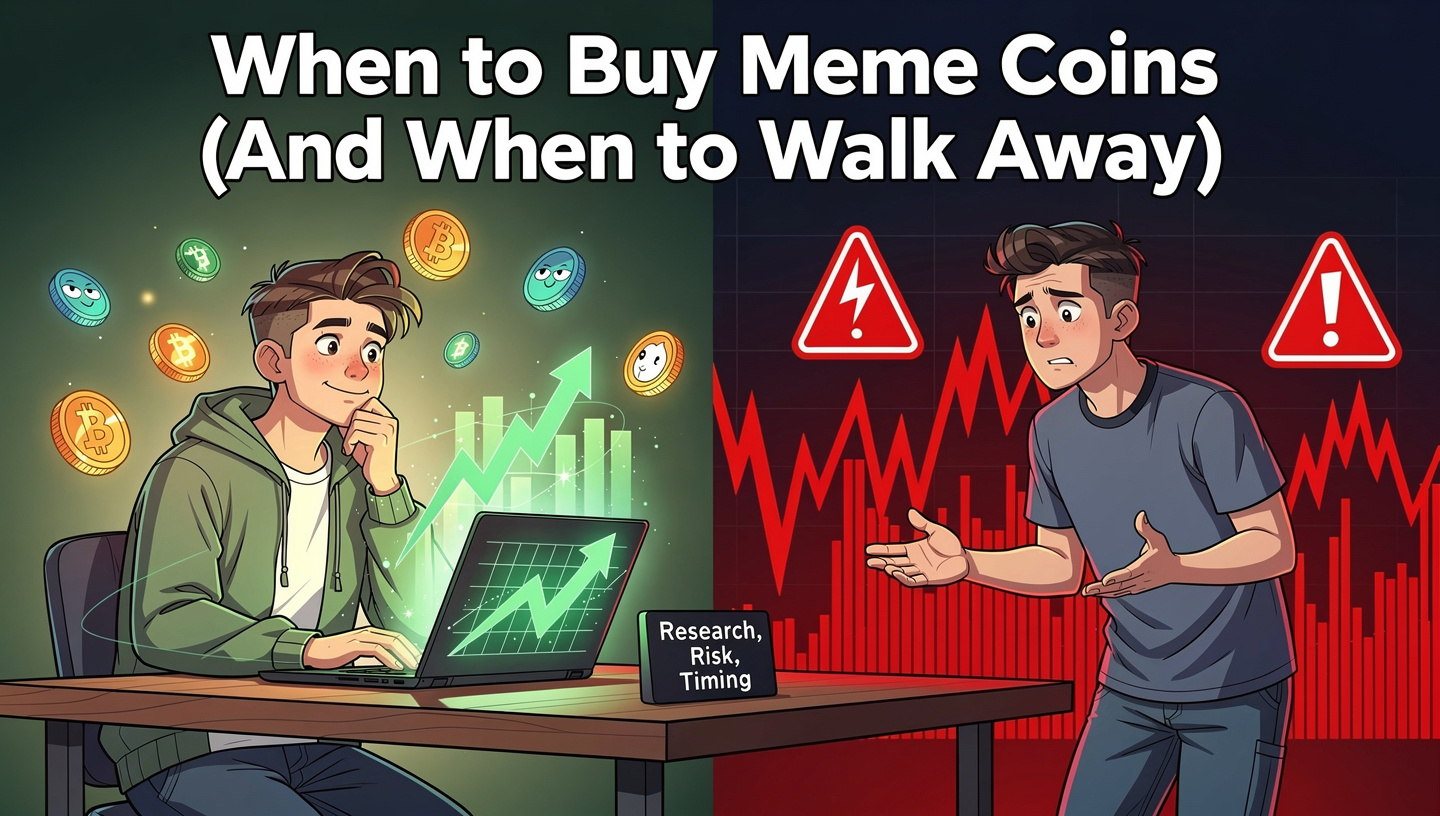
In meme coin markets, timing dominates selection. A mediocre meme bought at the correct phase can outperform a “perfect” meme bought at the wrong moment by orders of magnitude. This is not opinion; it is repeatedly observable behavior across every meme cycle from Dogecoin to PEPE to the endless graveyard of forgotten tokens.
The uncomfortable truth is that meme coins do not reward conviction.
They reward context awareness.
This article does not romanticize meme coins, nor does it moralize them. It dissects them. The goal is simple:
to define when meme coins are statistically worth engaging with, and more importantly, when walking away is the only rational trade.
Understanding the Meme Coin Market Is a Prerequisite to Timing It
Before discussing entry points, one must accept a foundational reality:
Meme coins are not valuation-driven assets. They are attention-extraction mechanisms.
They convert:
- Social energy
- Narrative momentum
- Liquidity reflexes
into price movement.
As a result, meme coin timing is less about charts and more about where the collective attention curve currently sits.
Meme Coins Move Through Predictable Phases
Despite their chaotic appearance, meme coins tend to follow a surprisingly repeatable lifecycle:
- Ignition Phase – Zero visibility, internal accumulation
- Discovery Phase – Early social traction, thin liquidity
- Acceleration Phase – Rapid inflows, viral spread
- Distribution Phase – Liquidity saturation, insider exits
- Decay Phase – Attention collapse, irreversible bleed
Buying meme coins without identifying which phase you are in is equivalent to trading blindfolded.
When Buying Meme Coins Actually Makes Sense
1. The Ignition Phase: When Information Asymmetry Exists
This is the only phase where meme coins resemble asymmetric opportunities rather than lotteries.
Key characteristics:
- Extremely low liquidity
- No mainstream influencer coverage
- Organic chatter in niche Telegrams, Discords, or on-chain explorers
- Wallet concentration is visible but not aggressively extractive
At this stage, price movement is not driven by hype but by positioning.
The risk is obvious: most tokens die here.
The reward is equally obvious: if attention later arrives, the upside is nonlinear.
Buy rationale:
You are not buying belief. You are buying optionality.
2. Early Discovery: When Attention Arrives Before Capital
This phase begins when:
- The meme gains identity (symbol, joke, cultural hook)
- Small influencers or alpha groups mention it
- Liquidity deepens slightly but remains fragile
Crucially, price has not yet outrun attention.
This is often the last rational entry for non-insiders.
What to verify before buying:
- No abnormal sell pressure from deployer wallets
- No stealth mint functions or transfer restrictions
- Liquidity not fully controlled by a single address
At this point, risk is elevated but still structured.
3. Momentum Confirmation: Buying Strength, Not Hope
Contrary to popular belief, buying meme coins after initial pumps is not inherently irrational.
What matters is how the pump behaves.
Healthy momentum includes:
- Rising volume without extreme wick rejections
- Wallet distribution slowly broadening
- Social engagement increasing faster than price
This is the phase where disciplined traders participate without emotional attachment.
Buy rationale:
You are trading reflexivity — not fundamentals.
When Buying Meme Coins Becomes a Structural Error
1. The Influencer Saturation Trap
Once a meme coin:
- Is promoted by multiple large accounts simultaneously
- Appears in YouTube thumbnails with exaggerated targets
- Becomes a “must-buy” narrative
the asymmetry is gone.
At this point, you are the exit liquidity, regardless of intent.
No amount of conviction changes this dynamic.
2. Liquidity Expansion Without Demand Growth
A subtle but fatal signal occurs when:
- Liquidity pools grow rapidly
- Market cap inflates
- But social engagement plateaus or declines
This indicates capital chasing itself, not new entrants.
Buying here is not speculative — it is mathematically unfavorable.
3. Narrative Exhaustion
Every meme has a shelf life.
Once:
- Jokes stop evolving
- Content becomes repetitive
- Engagement shifts from curiosity to defensiveness
the attention cycle has peaked.
Price may still rise briefly, but probability has flipped.
When Walking Away Is the Highest-EV Decision
Walking away is not passive. It is capital preservation.
Walk Away If Any of the Following Are True
- You feel pressure rather than clarity
- You are late but emotionally invested
- Your entry thesis depends on “just one more pump”
- Selling requires justification rather than execution
Markets do not reward stubbornness. Meme markets punish it.
The Psychological Traps That Destroy Meme Coin Timing
1. Survivorship Bias
For every viral success, thousands of meme coins quietly fail.
Your timeline only shows the winners.
This distorts perceived probability.
2. Narrative Anchoring
Traders anchor to stories rather than flows.
Once price contradicts narrative, they freeze.
3. Social Proof Illusion
High engagement does not equal sustainable demand.
Often, it signals crowded positioning.
A Practical Framework for Meme Coin Decisions
Before buying, answer these questions honestly:
- Who has informational advantage here — me or others?
- Is attention accelerating faster than price?
- Can I exit without friction if wrong?
- Would I still buy if influencers stopped posting today?
If any answer is unclear, delay the trade.
The Final Truth About Meme Coins
Meme coins are not investments.
They are timing instruments.
The winners are not the most passionate believers, nor the loudest promoters. They are the ones who understand when participation shifts from opportunity to obligation.
Knowing when not to buy is the edge most traders never develop.