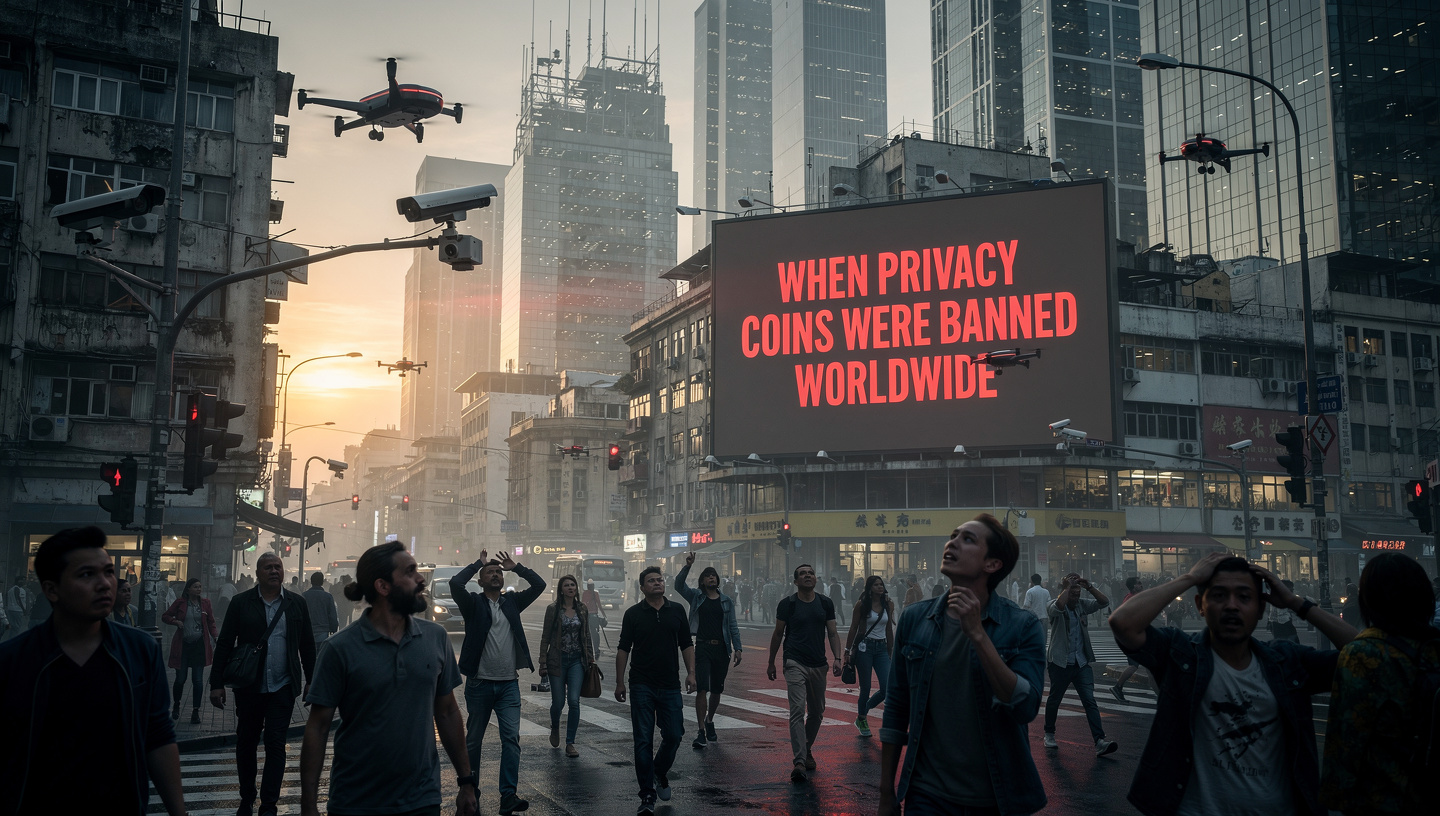
The announcement arrived without ceremony.
Within a single coordinated news cycle, regulators across North America, Europe, and Asia declared a synchronized prohibition on privacy-focused cryptocurrencies. Exchanges were ordered to delist. Banks were instructed to freeze fiat on-ramps. Infrastructure providers received compliance deadlines measured in days, not months.
It was framed as inevitable.
The justification was familiar: national security, anti–money laundering (AML), counter-terrorist financing (CTF), and consumer protection. But the reality was far more structural. This was not merely about coins. It was about redefining the acceptable boundaries of digital sovereignty.
In this fictionalized future, privacy coins were not just restricted.
They were erased from the regulated financial universe.
What follows is not a narrative story, but a research-oriented exploration of what such a world would look like—technically, economically, and socially—and why the ban itself would likely fail to achieve its stated objectives.
1. What Are “Privacy Coins,” Precisely?
Privacy coins are cryptocurrencies engineered to obscure transaction metadata—sender, receiver, and amount—by default or via opt-in mechanisms. Unlike transparent blockchains, where every transfer is publicly auditable, privacy coins embed cryptography directly into the ledger.
The most prominent examples include:
- Monero – Uses ring signatures, stealth addresses, and confidential transactions to make every transfer opaque.
- Zcash – Employs zero-knowledge proofs (zk-SNARKs) to allow shielded transactions.
- Dash – Offers optional mixing features (historically branded as PrivateSend).
By contrast, mainstream chains such as Bitcoin and Ethereum are pseudonymous, not private. Wallet addresses are visible. Transaction graphs can be analyzed. With sufficient metadata, identities are routinely deanonymized.
Privacy coins exist to close that gap.
They attempt to recreate a property physical cash already has: transactional obscurity.
2. The Regulatory Pressure Cooker
The fictional worldwide ban did not emerge spontaneously. It was the culmination of a decade-long convergence among regulators, analytics firms, and supranational bodies.
At the center was the Financial Action Task Force (FATF), whose “Travel Rule” effectively required crypto service providers to collect and transmit identity data for transactions above certain thresholds.
Once that framework existed, privacy coins became incompatible by design.
From there, enforcement accelerated:
- The European Union embedded surveillance requirements into MiCA-style digital asset regulations.
- The Internal Revenue Service expanded blockchain forensics programs.
- Europol publicly linked privacy assets to organized crime narratives.
Simultaneously, blockchain intelligence vendors such as Chainalysis supplied governments with ever-more sophisticated transaction clustering tools, reinforcing the belief that transparency equals safety.
Privacy coins were framed as untraceable threats.
Never mind that most illicit crypto activity historically occurred on transparent chains.
Narrative won.
3. The Mechanics of the Global Ban
The ban did not target protocols directly.
It targeted chokepoints.
Exchange Delistings
Centralized exchanges removed privacy assets within weeks. Liquidity collapsed overnight. Fiat pairs disappeared. Market makers withdrew.
Banking Exclusion
Crypto-friendly banks terminated accounts associated with privacy coin infrastructure. Payment processors followed.
Infrastructure Compliance
Cloud providers and API services were pressured to deny hosting to known privacy projects, citing “financial crime risk.”
Criminalization of Facilitation
Running public nodes, maintaining wallets, or providing developer tooling for privacy coins became legally ambiguous in many jurisdictions.
Crucially, ownership itself was not always illegal.
Usability was.
This mirrored historical strategies used against peer-to-peer file sharing and offshore banking: don’t ban possession—ban participation.
4. Immediate Market Consequences
The initial effects were violent.
Liquidity Shock
With regulated venues closed, price discovery fractured. OTC desks became dominant. Spreads widened dramatically.
Capital Migration
Funds flowed back into transparent chains like Bitcoin and Ethereum—not because users preferred them, but because they remained connected to fiat.
Shadow Market Formation
Decentralized exchanges and atomic swap protocols experienced explosive growth. Informal liquidity hubs emerged on encrypted messaging platforms.
Ironically, the ban pushed privacy coins further underground, reducing oversight while increasing adversarial behavior.
Exactly the opposite of regulatory intent.
5. Privacy Did Not Die. It Mutated.
Eliminating labeled “privacy coins” did not eliminate privacy.
It redistributed it.
Developers rapidly embedded privacy layers into general-purpose protocols:
- Zero-knowledge rollups on Ethereum
- Cross-chain mixers
- Peer-to-peer bridges
- Wallet-level obfuscation
Rather than using Monero or Zcash directly, users began routing Bitcoin through multi-hop, zero-knowledge-enabled pathways.
Privacy became modular.
Unlabelable.
The lesson was stark: you can ban products. You cannot ban cryptography.
6. The Myth of Criminal Exclusivity
One of the ban’s central premises was that privacy tools primarily serve criminals.
This was never empirically defensible.
Privacy coins had long been used by:
- Journalists protecting sources
- Activists operating under authoritarian regimes
- Businesses shielding supplier relationships
- Individuals avoiding mass financial profiling
In traditional finance, corporations spend billions on privacy: confidential contracts, sealed filings, private banking.
Yet when individuals sought similar protections digitally, it was framed as suspicious.
The double standard became impossible to ignore.
7. Financial Surveillance as Default Architecture
With privacy coins removed from regulated markets, transparent blockchains effectively became the default rails of global digital commerce.
This created an unprecedented condition:
Every meaningful transaction became permanently auditable.
Not just by governments.
By corporations.
By data brokers.
By anyone with sufficient compute.
Transaction histories became behavioral datasets. Spending patterns were monetized. Creditworthiness algorithms incorporated on-chain activity. Insurance premiums adjusted dynamically based on wallet behavior.
Money became a sensor network.
The financial system quietly transformed into a planetary-scale monitoring apparatus.
8. Geopolitical Fragmentation
Not every country enforced the ban equally.
Some states—particularly those outside Western regulatory blocs—continued to tolerate privacy infrastructure.
This produced:
- Crypto capital flight
- Jurisdictional arbitrage
- Emergence of “cryptographic havens”
Much like offshore banking in the 20th century, privacy assets found refuge where compliance was weakest.
The ban did not globalize control.
It Balkanized liquidity.
9. Open-Source Resilience
Privacy coin codebases did not disappear.
They forked.
Anonymous maintainers continued development via distributed version control systems and pseudonymous identities.
Academic cryptographers published new primitives.
Wallet developers integrated stealth features quietly.
The ecosystem adapted with the same pattern observed in file sharing, encryption export controls, and peer-to-peer networking:
Suppression accelerated innovation.
10. Economic Externalities No One Modeled
Regulators focused narrowly on crime metrics.
They missed second-order effects:
Reduced Market Efficiency
Without private settlement, large trades caused visible price impact.
Increased Physical Risk
High-net-worth individuals became targets once wallet balances were trivially discoverable.
Innovation Drain
Privacy-focused startups relocated or shut down.
Compliance Costs
Small exchanges collapsed under regulatory burden, consolidating power among a few large platforms.
The ban favored incumbents.
It punished experimentation.
11. The Philosophical Core: Is Privacy Optional?
At its foundation, the worldwide ban forced a civilizational question:
Is financial privacy a privilege—or a right?
Cash transactions had always been private by default.
Only in the digital era did transparency become mandatory.
The policy inversion was subtle but profound.
Citizens were expected to justify privacy.
Institutions were not.
12. The End State: A Paradoxical Outcome
Years after the ban, the landscape looked nothing like what policymakers promised.
Illicit finance still existed.
Privacy tools still existed.
But ordinary users now faced:
- Constant transaction monitoring
- Algorithmic financial profiling
- Reduced autonomy
- Increased dependence on regulated intermediaries
Meanwhile, sophisticated actors operated in bespoke cryptographic enclaves beyond reach.
The ban succeeded in one domain only:
It normalized total financial observability for everyone else.
Conclusion: You Cannot Regulate Mathematics
This speculative future illustrates a fundamental truth.
Privacy coins were never the core issue.
The issue was control over transactional visibility.
By banning explicit privacy assets, regulators attempted to impose legibility on a system built to resist it. The result was not safety—it was architectural tension between decentralized cryptography and centralized governance.
In the end, privacy did not vanish.
It simply became harder to access, more fragmented, and increasingly reserved for those with technical sophistication.
A world without privacy coins did not become more transparent.
It became more unequal.
And that may be the most realistic outcome of all.