There was a quiet inflection point in the early 21st century when money stopped behaving like money and started behaving like code.
It did not arrive with a treaty. There was no Bretton Woods–style summit. No single declaration. Instead, it crept in through whitepapers, GitHub repositories, pilot projects, and regulatory sandboxes. Central banks began hiring cryptographers. Finance ministries started speaking in the language of consensus mechanisms. Legislators debated protocol upgrades instead of interest rates.
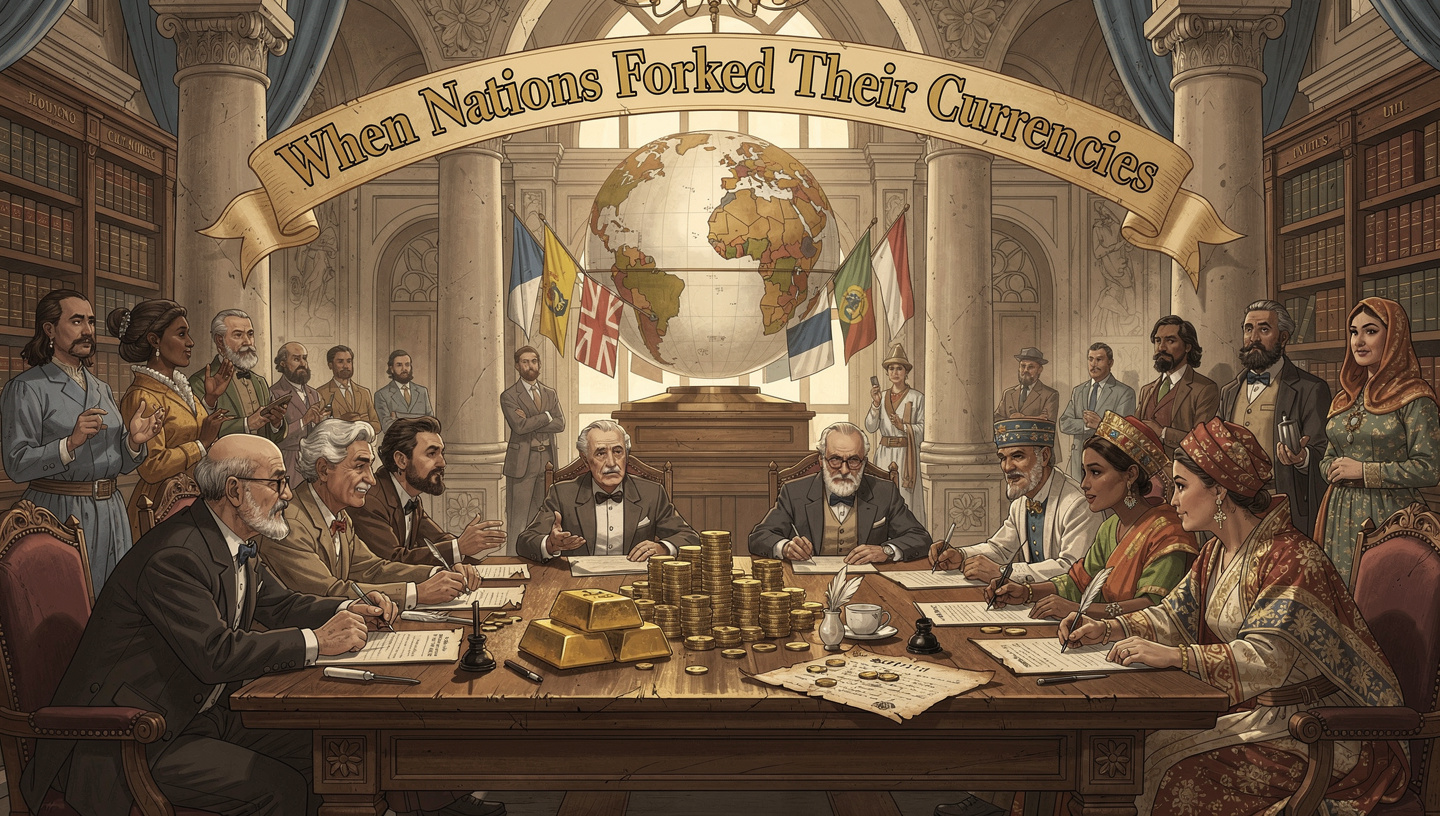
This article explores a fictional—but technically plausible—future in which sovereign states formally forked their national currencies, creating competing monetary codebases in the same way open-source communities fork software.
Not a story. A systems analysis.
A thought experiment grounded in cryptography, economics, governance, and power.
Welcome to a world where nations forked their currencies.
1. From neutral money to programmable sovereignty
The conceptual origin of this transformation traces back to Satoshi Nakamoto, whose design of Bitcoin reframed money as a distributed protocol rather than a centrally administered ledger.
Bitcoin introduced three radical ideas:
- Monetary policy could be enforced by software.
- Trust could be replaced by cryptography.
- Consensus could emerge without a sovereign issuer.
Later platforms such as Ethereum generalized this model by adding smart contracts—turning blockchains into programmable economic substrates.
In our fictional future, governments absorbed these ideas completely.
They did not merely regulate crypto.
They adopted its architecture.
Currency ceased to be a static instrument managed by central banks. It became an evolving protocol stack:
- Base layer: settlement and issuance
- Execution layer: fiscal logic and compliance
- Governance layer: upgrades, forks, and parameter changes
At that point, sovereignty itself became modular.
2. The great inversion: when states copied open-source culture
Historically, software forks emerge from disagreement:
- ideological splits
- technical roadmaps
- governance disputes
In this imagined future, states applied the same logic to money.
A “currency fork” occurred when a government cloned an existing monetary codebase—sometimes its own, sometimes another nation’s—and modified:
- inflation schedules
- privacy guarantees
- tax hooks
- identity integration
- capital controls
Each fork produced a new sovereign asset, backward-compatible with old balances but forward-incompatible with policy.
Citizens woke up to find multiple official versions of their national currency:
- a conservative fork optimized for price stability
- a growth fork with aggressive stimulus rules
- a surveillance-heavy fork designed for compliance
- a privacy-maximal fork meant to attract foreign capital
Money became a choice architecture.
And choice created competition.
3. The first domino: experimental adoption becomes doctrine
The precedent had already been set decades earlier when El Salvador adopted Bitcoin as legal tender. In our speculative timeline, that moment is later understood not as a novelty—but as the prototype for monetary pluralism.
By the 2030s, dozens of states were running pilot chains:
- retail CBDCs
- wholesale settlement networks
- tokenized treasury systems
Initially, these projects were framed as efficiency upgrades.
But gradually, governments realized something deeper:
If money is software, then monetary policy is version control.
And version control implies forks.
4. Currency as codebase: anatomy of a sovereign fork
A national fork followed a standardized process:
Step 1: Snapshot
A cryptographic snapshot of all balances at block height N.
Step 2: Parameter divergence
Key variables changed:
- issuance curve
- validator set
- compliance logic
- identity requirements
Step 3: Governance declaration
A legal instrument defined the forked chain as a legitimate continuation of the national currency.
Step 4: Market discovery
Exchanges and payment rails listed the new asset. Citizens chose which fork to hold.
Every fork represented a philosophical stance encoded in math.
Some prioritized Keynesian elasticity.
Others hard-coded Austrian scarcity.
Some embedded universal basic income directly into the protocol.
Others enforced negative interest rates via wallet logic.
Politics moved from parliaments into pull requests.
5. The collapse of monetary uniformity
Traditional fiat systems rely on a single unit of account.
Forked systems do not.
In this future, the idea of “the dollar” or “the euro” dissolved into families of related assets, each tracing lineage to a common genesis block.
Businesses began pricing goods in baskets of forks.
Payroll systems paid employees in customizable blends.
Treasuries diversified across rival versions of their own currencies.
Inflation was no longer a national statistic—it was a per-fork metric.
This shattered the illusion of monetary homogeneity.
Money became heterogeneous by design.
6. Central banks lose monopoly, gain maintainership
Institutions like the Federal Reserve, the European Central Bank, and the People’s Bank of China survived—but their role changed fundamentally.
They stopped being absolute issuers.
They became protocol maintainers.
Their responsibilities now resembled those of large open-source foundations:
- reviewing improvement proposals
- coordinating validator upgrades
- publishing security advisories
- managing fork negotiations
Interest rate announcements gave way to changelog releases.
Press conferences discussed attack surfaces instead of CPI.
7. Fiscal policy becomes executable
In forked economies, budgets were not passed.
They were deployed.
Taxation occurred at transaction time through smart-contract logic.
Stimulus packages were implemented as protocol upgrades.
Subsidies were streamed continuously to qualifying wallets.
Welfare eligibility was enforced by on-chain identity proofs.
This eliminated entire layers of bureaucracy—but also introduced new risks:
- bugs became policy failures
- exploits became fiscal crises
- governance capture became a cybersecurity problem
The line between finance ministry and DevOps disappeared.
8. Capital flight becomes code migration
Traditional capital controls fail when money is software.
In this world, wealth moved not across borders—but across forks.
Citizens dissatisfied with surveillance switched to privacy-preserving variants.
Investors fleeing inflation migrated to hard-capped forks.
Corporations optimized treasury holdings by arbitraging protocol parameters.
Governments responded by:
- blacklisting addresses
- limiting bridge contracts
- embedding geo-fencing at the wallet layer
But forks are, by nature, permissionless.
Control was always partial.
9. The new geopolitics: protocol alliances
Diplomacy reoriented around shared monetary codebases.
States formed “fork blocs”:
- interoperability treaties
- shared validator networks
- coordinated upgrade schedules
Trade agreements referenced hash power.
Defense alliances included cybersecurity clauses for monetary infrastructure.
Sanctions evolved into protocol exclusions.
The International Monetary Fund reinvented itself as a cross-chain stability coordinator, issuing liquidity bridges instead of loans.
Economic power was no longer measured solely by GDP.
It was measured by:
- transaction throughput
- validator decentralization
- developer ecosystem size
- liquidity depth across forks
10. Citizens as monetary voters
In classic democracies, people vote every few years.
In forked economies, they vote continuously—by choosing which version of money to hold.
Every transaction becomes a micro-referendum.
Every wallet balance expresses preference.
Monetary legitimacy flows from usage metrics, not decree.
This produces a brutal form of accountability:
Bad policy is abandoned instantly.
Good policy attracts capital organically.
States that fork poorly watch their currency bleed liquidity in real time.
11. The end of monetary finality
There is no longer a “final” version of money.
Every chain is provisional.
Every policy is patchable.
Every currency is an experiment running at national scale.
History becomes a branching tree of monetary commits:
- inflationary forks
- deflationary forks
- privacy forks
- compliance forks
Future economists no longer study cycles.
They study merge conflicts.
12. Structural consequences
Over decades, several irreversible shifts emerge:
Money becomes composable
Currencies interoperate through bridges and wrapped assets.
Borders lose financial meaning
Jurisdiction is defined by protocol participation, not geography.
Policy becomes transparent
Every rule is inspectable in code.
Corruption becomes harder to hide
Public ledgers expose treasury flows by default.
Crises become technical events
Recessions look like network outages.
13. The paradox of choice
Forking empowers citizens—but also overwhelms them.
Most people delegate decisions to algorithmic portfolio managers that automatically rebalance across forks based on personal values:
- privacy tolerance
- inflation sensitivity
- compliance preferences
Human agency survives—but mediated through software.
Freedom becomes a configuration setting.
14. What this future reveals about the present
This speculative world exposes a truth already visible today:
Money is migrating from institutions to infrastructure.
Once currency becomes programmable, sovereignty becomes negotiable.
Forking is not merely a technical process.
It is a political one.
It transforms governance from legislation into architecture.
It turns economics into a branch of computer science.
And it forces societies to confront a difficult question:
If citizens can exit monetary policy with a click, what does consent really mean?
Closing: the age of monetary pluralism
“When Nations Forked Their Currencies” is not a prophecy.
It is a lens.
A way of examining what happens when cryptographic systems absorb the functions of the state.
In that future, no currency is permanent.
No policy is sacred.
And no government controls money absolutely.
Instead, money behaves like software: forkable, upgradeable, and forever contested.
The quiet revolution is not about crypto.
It is about the migration of power from centralized authority to distributed protocol.
And once that migration begins, it does not reverse.
Only branches.