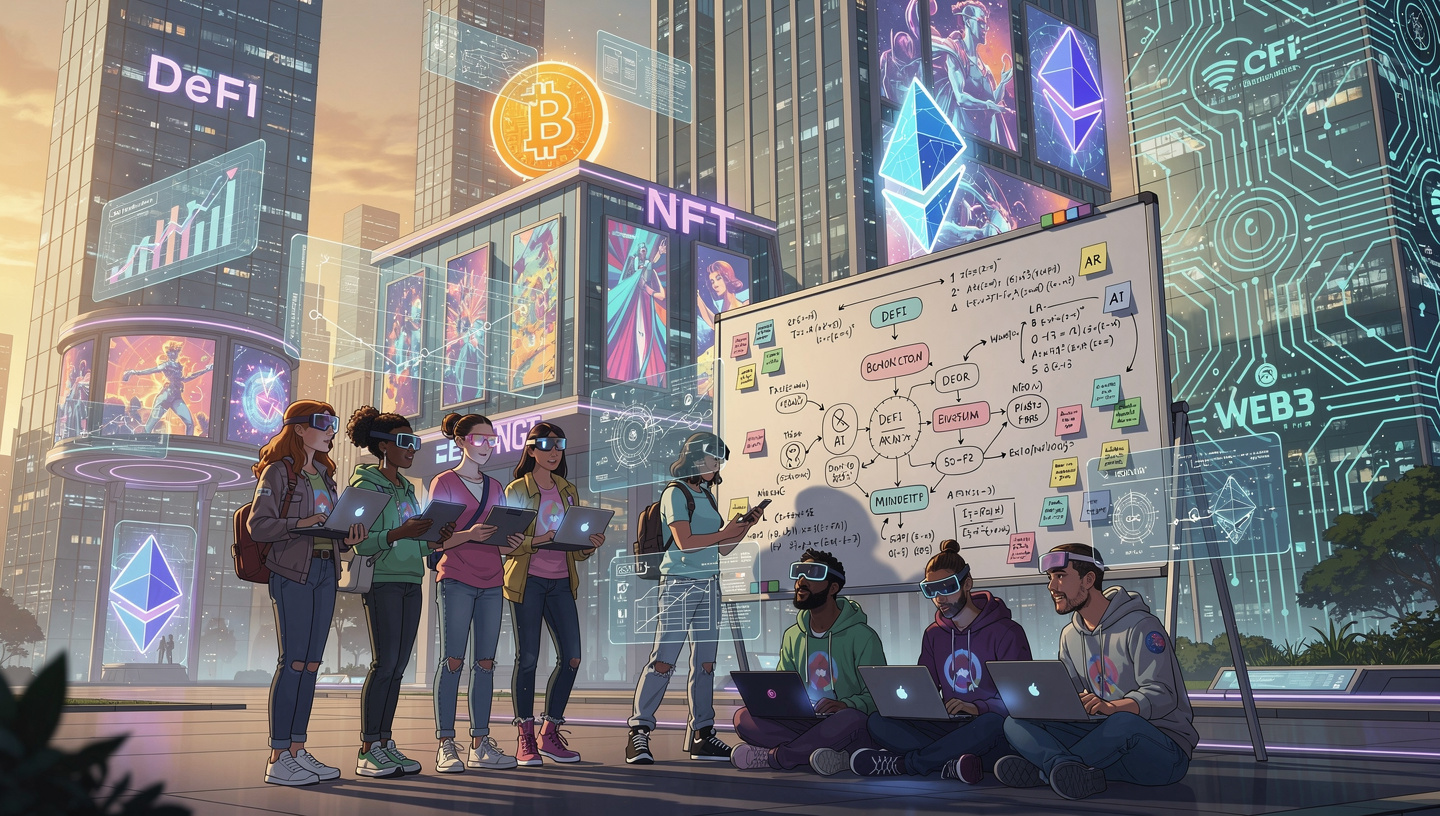
In the 20th century, schools taught students how to read books. In the 21st, they must teach them how to read systems.
Cryptocurrency is not merely a financial phenomenon; it is a technological, economic, philosophical, and political shift unfolding in real time. Yet while teenagers can explain memes, algorithms, and viral trends with fluency, many graduate without understanding what a blockchain is, how digital ownership works, or why decentralized networks are redefining trust itself.
This gap is not trivial. It is structural.
Just as industrial-age education prepared students for factories, and computer-age education prepared them for offices, the emerging decentralized era demands a new literacy: crypto literacy. The question is no longer whether schools should teach crypto—it is what they should teach, how, and why it matters beyond speculation.
This article presents a research-driven framework for crypto education designed for schools, universities, and curriculum designers. It is not about hype, trading, or price charts. It is about building intellectual infrastructure for a generation that will live inside decentralized systems.
1. Crypto Is Not Just Money — It’s Infrastructure
The first misconception education must correct is the idea that cryptocurrency equals digital money. In reality, crypto is a layered technological stack consisting of:
- Cryptography
- Distributed computing
- Game theory
- Incentive design
- Network economics
- Governance systems
Teaching crypto should therefore begin with systems thinking, not finance.
Students should learn that blockchains are essentially trust machines: networks that allow strangers to coordinate without central authority. This concept alone connects computer science, sociology, and economics in ways traditional curricula rarely do.
2. Foundational Concepts Every Student Should Understand
A modern crypto curriculum must prioritize conceptual clarity over technical jargon. Core ideas include:
2.1 What Is a Blockchain?
A blockchain is a distributed ledger maintained by many participants rather than a single institution. Schools should emphasize:
- Why decentralization matters
- How consensus replaces authority
- What immutability means in practice
Students should be able to explain blockchain in plain language before touching code.
2.2 Public vs Private Keys
Digital ownership is the defining innovation of crypto. Students must understand:
- Private keys = control
- Public keys = identity
- Loss of keys = loss of assets
This lesson extends beyond crypto into digital security literacy. It teaches responsibility, sovereignty, and risk awareness.
2.3 Consensus Mechanisms
Instead of memorizing terminology, students should compare systems:
- Proof of Work
- Proof of Stake
- Delegated models
The goal is analytical thinking:
What trade-offs exist between security, speed, and decentralization?
2.4 Tokens as Economic Primitives
Tokens are programmable incentives. Schools should frame them as:
- Digital property rights
- Coordination tools
- Access keys to networks
Understanding tokens trains students to see economics as design—not destiny.
3. The Cryptography Layer: Teaching the Mathematics of Trust
Crypto education must reconnect students with mathematics in a meaningful way.
Rather than abstract equations, teachers can show how cryptographic functions:
- Protect global commerce
- Secure communication
- Enable digital signatures
Students should explore hash functions, digital signatures, and encryption not as theory, but as mechanisms shaping everyday life.
This approach transforms math from a classroom requirement into a civilizational tool.
4. Economic Literacy Through Crypto
Traditional financial education often fails because it teaches rules instead of systems. Crypto offers a rare opportunity to reverse that.
Through blockchain simulations, students can observe:
- Supply and demand dynamics
- Monetary policy effects
- Inflation vs scarcity
- Market psychology
Instead of memorizing textbook definitions, they experience economics as an emergent system.
5. Governance and Political Philosophy
Crypto networks are living political experiments.
They force students to confront fundamental questions:
- Who should control money?
- What is legitimacy?
- Can code replace institutions?
When students analyze governance models used by decentralized networks, they naturally engage with political philosophy—often for the first time with genuine curiosity.
6. Security and Responsibility: The Ethics Curriculum Hidden Inside Crypto
Unlike banks, blockchains do not forgive mistakes. That makes them powerful teaching tools for responsibility.
Lessons schools should include:
- Phishing awareness
- Wallet security
- Social engineering risks
- Custodial vs self-custodial storage
Students quickly learn that decentralization gives freedom and accountability. This duality is a rare educational opportunity.
7. Critical Thinking Over Hype
Perhaps the most important lesson schools must teach about crypto is skepticism.
Students should analyze:
- Ponzi structures
- Pump-and-dump schemes
- Market manipulation tactics
- Misleading narratives
Case studies of real-world failures teach more than success stories. Education should produce informed skeptics, not blind believers.
8. Legal and Regulatory Context
Crypto exists within legal systems, and students must understand that interplay.
Curricula should introduce:
- The role of regulators such as the U.S. Securities and Exchange Commission
- How countries classify digital assets
- Tax implications
- Compliance requirements
Understanding regulation teaches students that innovation does not occur in a vacuum. Technology and law co-evolve.
9. The Historical Dimension
Crypto did not appear suddenly. It emerged from decades of research.
Students should study the intellectual lineage:
- Early cryptographic research
- Digital cash experiments
- Cypherpunk philosophy
- The publication of the Bitcoin white paper by Satoshi Nakamoto
This historical perspective prevents the common misconception that crypto is a fad rather than a technological milestone.
10. Programming and Building
Schools should not stop at theory. They should teach students to build.
Practical modules might include:
- Writing simple smart contracts
- Creating tokens on test networks
- Designing decentralized applications
- Auditing code for vulnerabilities
Hands-on experimentation converts abstract understanding into real competence.
11. Interdisciplinary Integration: Crypto as a Meta-Subject
The most revolutionary aspect of crypto education is that it naturally integrates multiple disciplines:
| Subject | Crypto Connection |
|---|---|
| Computer Science | Distributed systems |
| Economics | Token incentives |
| Mathematics | Cryptography |
| Law | Regulation |
| Philosophy | Decentralization |
| Psychology | Market behavior |
Few subjects unify knowledge domains this effectively. Teaching crypto is not adding a subject—it is creating a bridge between subjects.
12. Why Ignoring Crypto in Schools Is Risky
Educational institutions that exclude crypto risk producing graduates who:
- Do not understand digital ownership
- Cannot evaluate blockchain claims
- Fall for scams
- Misinterpret technological trends
History shows that education systems that lag behind technological change create generational skill gaps. Crypto literacy may soon become as fundamental as internet literacy.
13. Teaching Methodologies That Actually Work
Crypto cannot be taught effectively through lectures alone. Schools should adopt interactive approaches:
Simulation Labs
Students run nodes, validate blocks, and simulate attacks.
Debate Forums
Teams argue for or against decentralization models.
Design Challenges
Students create token economies for hypothetical communities.
Failure Analysis
Classes dissect real crypto collapses and security breaches.
Learning becomes experiential rather than theoretical.
14. Ethical Questions Students Should Debate
Crypto is a philosophical mirror. Schools should encourage discussion around questions such as:
- Should money be programmable?
- Is anonymity a right or a risk?
- Can decentralized systems replace governments?
- Should code be considered law?
These debates sharpen reasoning, rhetoric, and ethical judgment.
15. Preparing Students for Future Careers
Crypto education is not only about understanding a technology—it is about preparing for entire industries that did not exist a decade ago:
- Blockchain development
- Smart contract auditing
- Tokenomics design
- Digital asset law
- Web3 product design
Schools that incorporate crypto into curricula position students for emerging job markets rather than fading ones.
16. Misconceptions Schools Must Actively Correct
A responsible curriculum must dismantle myths, including:
Myth: Crypto is anonymous
Reality: Most blockchains are transparent.
Myth: Crypto has no real-world use
Reality: It enables decentralized finance, identity, and infrastructure.
Myth: Crypto is only for investors
Reality: It is a technological architecture.
Education should replace headlines with understanding.
17. Global Perspective
Crypto is inherently global. A student in Vietnam can transact with someone in Brazil without banks or borders.
Teaching this global dimension helps students grasp:
- Currency differences
- International markets
- Cross-border regulation
- Digital globalization
Crypto literacy therefore doubles as global literacy.
18. Psychological Intelligence and Market Behavior
Crypto markets are emotional laboratories. They reveal how humans behave under uncertainty:
- Fear cycles
- Herd mentality
- Narrative bubbles
- Risk tolerance
Analyzing these patterns strengthens students’ emotional intelligence and decision-making skills.
19. The Role of Universities vs Secondary Schools
Education should be staged:
Secondary school level
- Concepts
- Security basics
- Economic principles
University level
- Protocol design
- Cryptographic proofs
- Distributed architecture
- Advanced tokenomics
This layered approach ensures accessibility without oversimplification.
20. The Ultimate Goal: Intellectual Sovereignty
The deepest purpose of crypto education is not technical proficiency. It is intellectual independence.
Students who understand decentralized systems learn to:
- Question authority structures
- Analyze incentives
- Evaluate narratives critically
- Take responsibility for digital actions
These are not crypto skills. They are life skills.
Conclusion: Education Must Evolve Before Reality Forces It To
Every generation inherits a technological reality shaped by the previous one. Today’s students are inheriting a world where value, identity, and governance are increasingly digital—and increasingly decentralized.
If schools fail to teach crypto literacy, students will still encounter crypto. They will simply encounter it unprepared.
Education has always had two missions:
to transmit knowledge and to anticipate the future.
Teaching crypto accomplishes both.
It connects mathematics to reality, economics to incentives, philosophy to infrastructure, and technology to society. It transforms passive learners into systems thinkers. It equips students not merely to use the future—but to understand it, question it, and shape it.