Walk into almost any conversation about blockchain today and you will probably hear one word almost immediately: DeFi.
Investors are talking about it. Developers are building it. Regulators are trying to understand it. And people who have never owned a single cryptocurrency are wondering why it suddenly matters so much.
But what exactly is DeFi?
Why did it emerge?
Why are billions of dollars flowing into it?
And why are both enthusiasts and critics so loud about it?
This article breaks everything down clearly — from beginner concepts to deeper mechanics — so you can understand what DeFi really is, why it matters, and where it may be going next.
1. First Things First: What Does “DeFi” Mean?
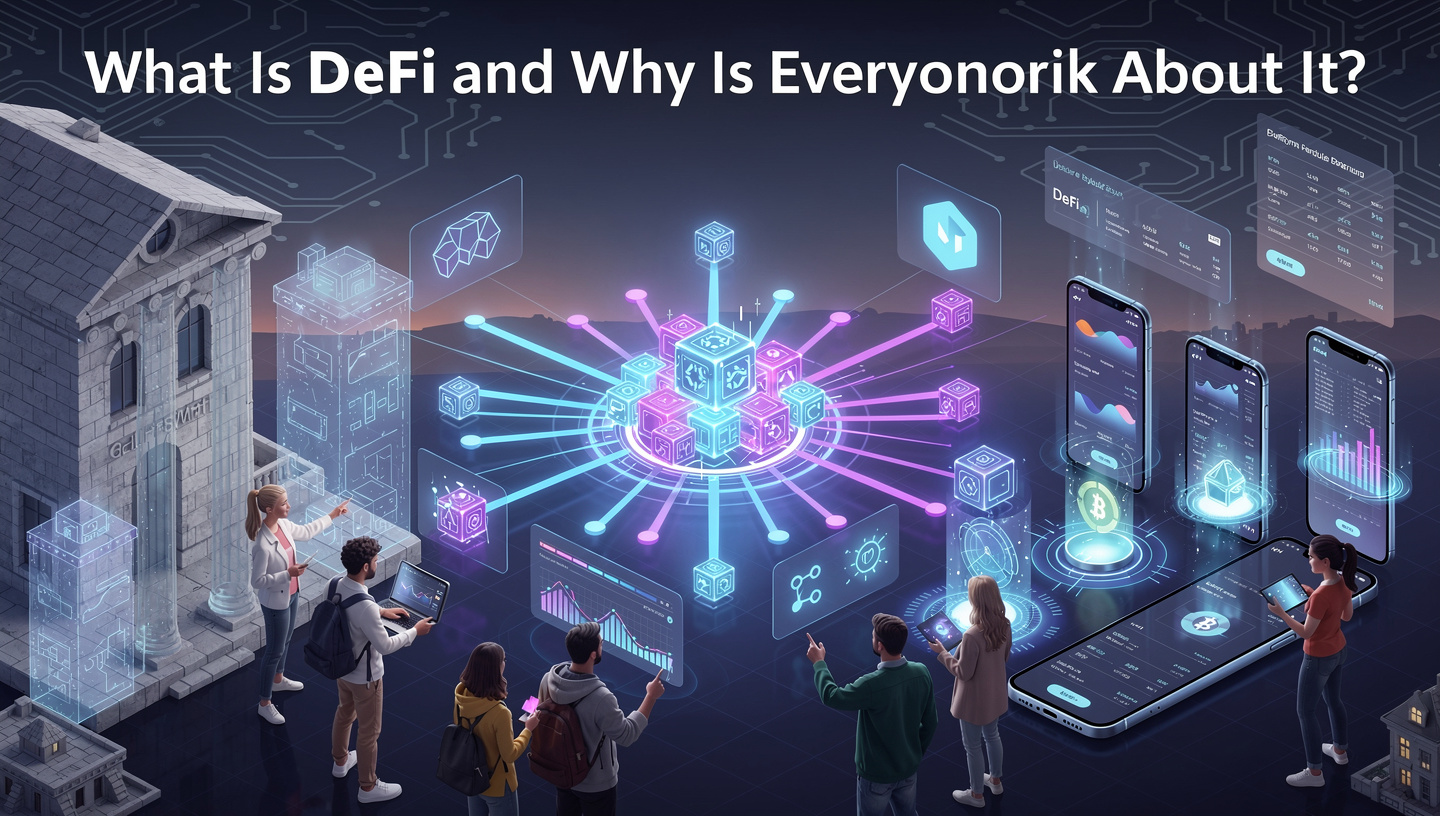
DeFi stands for Decentralized Finance.
It refers to a set of financial applications built on blockchains (most commonly Ethereum) that aim to:
- remove banks and intermediaries
- automate financial transactions using code
- give users direct control over their assets
In traditional finance — often called TradFi — institutions like banks, brokers, exchanges, and payment processors sit in the middle of everything.
In DeFi, software replaces many of those roles.
Instead of:
- a bank approving your loan
- a broker settling your trades
- a company holding your money
DeFi applications rely on smart contracts — programs that automatically execute when conditions are met.
Think of DeFi as:
Finance rebuilt from the ground up using open-source technology instead of centralized institutions.
2. How Did DeFi Start?
The foundation of DeFi was laid when Ethereum introduced smart contracts.
Bitcoin proved digital money could exist.
Ethereum proved that programmable money could exist.
Key milestones shaped DeFi’s growth:
- 2015 – Ethereum launches
- 2017 – Early decentralized exchanges appear
- 2018–2019 – Lending protocols (like Compound and Aave) take off
- 2020 – “DeFi Summer” attracts massive adoption
- 2021 onward – Billions of dollars move into DeFi ecosystems
DeFi grew rapidly because it offered something radically different from the status quo: open participation without permission.
Anyone with an internet connection could interact with financial tools traditionally restricted to banks, large investors, or approved clients.
3. What Makes DeFi Different from Traditional Finance?
Let’s compare the two systems directly.
Traditional Finance
- Gatekeepers control access
- Banks custody your funds
- Transactions can be slow and expensive
- Limited transparency
- Geographic restrictions
- Approval-based participation
Decentralized Finance
- No centralized gatekeepers
- You control your funds through your wallet
- Transactions occur on blockchain networks
- Completely transparent and auditable
- Borderless participation
- Open to anyone
In DeFi:
- Your crypto stays in your wallet
- Smart contracts move funds only when rules are met
- You do not “ask permission” to use services
That shift from permissioned finance to permissionless finance is one of the biggest transformations in modern economic history.
4. The Core Building Blocks of DeFi
To really understand DeFi, you need to know what people are actually doing with it. The ecosystem revolves around several major categories.
4.1 Decentralized Exchanges (DEXs)
Examples: Uniswap, SushiSwap, Curve
DEXs allow users to trade cryptocurrencies directly from their wallets.
There is:
- no central company holding funds
- no order books in many cases
- liquidity pools instead, supplied by users
Smart contracts execute trades automatically, and prices adjust based on supply and demand.
4.2 Lending and Borrowing Protocols
Examples: Aave, Compound, MakerDAO
Users can:
- deposit crypto to earn interest
- borrow other crypto against their deposits
There are no credit checks. Instead, loans are over-collateralized:
You lock up crypto worth more than the loan amount. If prices fall and collateral becomes insufficient, the protocol liquidates it automatically.
4.3 Stablecoins
Examples: USDC, DAI, USDT
Stablecoins are cryptocurrencies designed to maintain a stable price, usually pegged to the U.S. dollar.
They create a bridge between volatile crypto assets and everyday economic activity.
Stablecoins are crucial because they allow:
- trading
- saving
- lending
- borrowing
without constantly worrying about extreme price swings.
4.4 Yield Farming and Liquidity Mining
These strategies involve depositing tokens into protocols to:
- earn interest
- receive governance tokens
- share in transaction fees
It can be profitable, but also highly risky if users do not understand price volatility, smart-contract bugs, or protocol failures.
4.5 Derivatives and Synthetic Assets
Protocols like Synthetix or dYdX allow trading of:
- synthetic stocks
- commodities
- crypto derivatives
- leveraged positions
All executed by smart contracts, without brokers or clearinghouses.
5. Why Is Everyone Suddenly Talking About DeFi?
Several powerful trends collided to make DeFi central to the crypto discussion.
5.1 Control
Users like that DeFi eliminates dependency on centralized custodians. If an exchange collapses, your on-chain assets remain under your control.
5.2 Transparency
Everything in DeFi is public:
- transaction history
- liquidity levels
- interest rates
- governance decisions
Contrast that with opaque banking systems where users rarely see what happens behind the scenes.
5.3 Innovation
DeFi moves faster than traditional finance. Developers iterate constantly, and new models appear almost weekly.
5.4 Global Access
Anyone, anywhere, can:
- save
- trade
- earn interest
- participate in governance
without a credit score, bank account, or minimum deposit.
For many in underbanked regions, this is transformational.
6. The Real Risks: DeFi Is Not Magic
The enthusiasm is justified — but DeFi is not risk-free.
6.1 Smart Contract Bugs
Code can have vulnerabilities. Exploits have resulted in significant losses across the ecosystem.
6.2 Market Volatility
Crypto markets move quickly. Collateral values can fall rapidly, triggering liquidations.
6.3 Rug Pulls and Fraud
Some projects are poorly designed or intentionally malicious. Users must perform due diligence.
6.4 Regulatory Uncertainty
Governments globally are still shaping frameworks. Sudden policy shifts can impact platforms.
6.5 User Responsibility
Losing private keys means losing access permanently. There is no customer service department to restore accounts.
In short:
DeFi offers freedom, but with freedom comes responsibility and risk.
7. Governance: Who Controls DeFi Protocols?
Many major DeFi protocols are governed by DAOs (Decentralized Autonomous Organizations).
Token holders vote on:
- upgrades
- fee structures
- development priorities
- treasury allocations
This represents a transition from corporate boards to community-driven governance.
However:
- voter participation can be low
- whales may dominate decisions
- governance requires technical literacy
So while governance is decentralized, it is not automatically perfect.
8. Where Could DeFi Go Next?
Analysts expect several trends to accelerate.
8.1 Integration with Traditional Finance
Banks and institutional investors are increasingly exploring blockchain.
8.2 Better User Experience
Wallets, interfaces, and onboarding processes are becoming simpler.
8.3 Layer 2 Scaling
Networks designed to reduce congestion and fees make DeFi more affordable.
8.4 Institutional-Grade Compliance Tools
Expect more identity-aware protocols, designed to meet regulatory expectations while maintaining decentralization principles.
8.5 Real-World Assets on Chain
Tokenized real estate, bonds, and invoices are already emerging.
DeFi will not replace traditional finance overnight — but it will influence how financial systems evolve.
9. So… Why Is DeFi Important?
DeFi matters because it challenges assumptions we have held for centuries:
- Who should control money?
- Who should decide who gets financial services?
- Can trust be built through code instead of institutions?
It opens the door to a world where finance is:
- programmable
- globally accessible
- transparent
- user-controlled
And whether one loves or hates the idea, ignoring it is no longer possible.
Final Thoughts
DeFi is not a passing trend. It is a structural shift in how financial infrastructure can operate.
It has flaws. It carries risk. It requires education and maturity.
But it also represents one of the most ambitious financial experiments of our time — merging software engineering, economics, governance, and open networks into a single ecosystem.
Understanding DeFi today is like understanding the early internet before it transformed global communication. You do not need to become an expert or investor — but having literacy about it will increasingly matter.