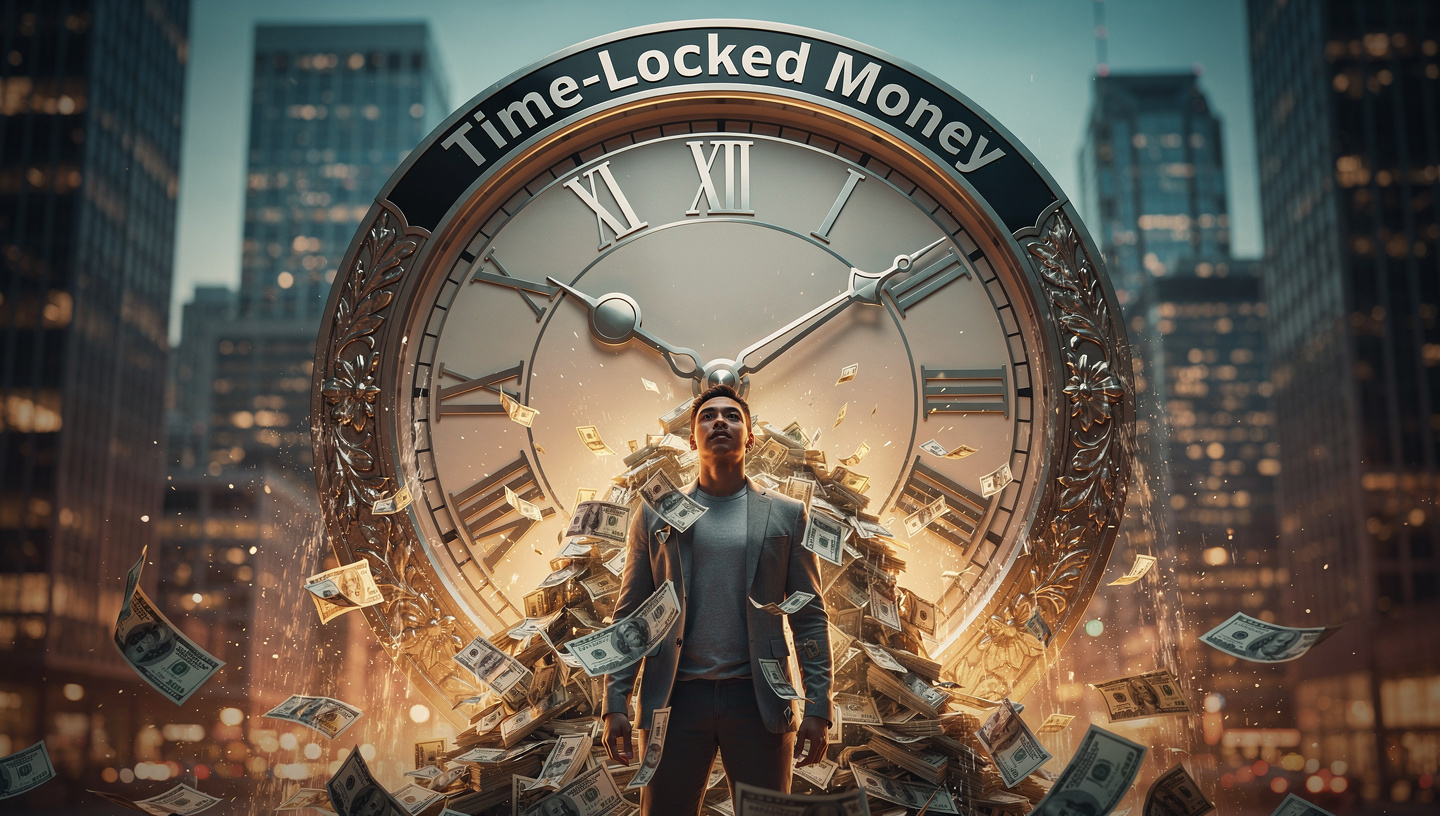
For most of history, money has been passive. You earned it, saved it, spent it, lost it. Time shaped its value through inflation and opportunity cost, but money itself did not care about time.
Now imagine a civilization where money does.
Not metaphorically. Literally.
In this speculative—but technically grounded—future, every unit of currency is bound to a clock. You cannot spend it before a certain date. You cannot move it without satisfying prewritten conditions. Your salary unlocks in phases. Your inheritance drips out over decades. Your healthcare fund activates only after biometric proof. Your retirement wallet refuses withdrawals until your seventieth birthday.
This is not fantasy finance. This is what happens when cryptographic time locks, smart contracts, and programmable assets converge into a single socio-economic substrate.
This article explores that world.
Not as a story—but as a research-oriented thought experiment: a systems-level analysis of what happens when time-locked money becomes the primary operating system of society.
1. The Technical Premise: Money That Knows When
The conceptual foundation already exists.
On blockchains like Bitcoin and Ethereum, developers have implemented primitives such as:
- Timelocks – funds are unspendable until a specific block height or timestamp
- Vesting schedules – assets unlock gradually over time
- Smart contracts – autonomous programs that enforce rules without intermediaries
- Hash Time-Locked Contracts (HTLCs) – conditional transfers tied to secrets and deadlines
These tools were originally designed for escrow, atomic swaps, and governance.
But they scale.
And when they scale to an entire economy, money stops being inert. It becomes procedural.
Instead of having money, you occupy a timeline of permissions.
2. From Ownership to Scheduling: A Structural Shift
Traditional money represents ownership.
Time-locked money represents scheduled access.
This distinction matters.
In a time-locked economy:
- Your paycheck is not paid—it is released
- Your savings account is not liquid—it is queued
- Your investments do not mature—they unlock
- Your debts do not come due—they trigger
Every financial event becomes a state transition.
Your net worth is no longer a snapshot. It is a Gantt chart.
Financial planning evolves from balance sheets to temporal graphs.
The individual becomes less like a holder of assets and more like a node inside a massive, deterministic flow system.
3. Daily Life Under Temporal Capital
Let’s ground this in practical consequences.
Salary
Employers no longer transfer full wages.
Instead, compensation arrives as a vesting stream:
- 10% immediately
- 60% over 30 days
- 30% over 12 months
Quit early? You forfeit the tail.
Loyalty becomes mathematically enforced.
Rent and Utilities
Housing contracts automatically withdraw funds every month—but only from wallets whose rent allocation has unlocked.
Miss the unlock window? Smart eviction protocols activate.
No appeals. No grace period.
Food
Food assistance is not distributed—it is time-gated.
Calories per day are pre-allocated. Excess cannot be carried forward. Black markets emerge for unlocked nutrition credits.
Hunger becomes a scheduling bug.
4. Childhood, Education, and Pre-Financed Futures
Children are born with financial timelines.
Parents allocate education wallets that unlock at predefined ages.
Governments issue “development grants” that activate only if biometric and academic conditions are met.
Drop out? The remainder reverts to the state.
Universities accept only cryptographically guaranteed tuition streams, not lump sums.
Education becomes a flow-controlled pipeline.
Potential is no longer speculative—it is escrowed.
5. Healthcare on a Clock
Medical funds are among the most aggressively time-locked assets.
Preventative care wallets unlock annually.
Emergency funds unlock instantly—but only after oracle confirmation from certified providers.
Chronic illness contracts distribute medication credits on a rolling schedule.
Miss an appointment? Your dosage allocation pauses.
In this system, compliance is not encouraged.
It is enforced.
6. Love, Marriage, and Programmable Commitment
Even relationships become financial primitives.
Marriage contracts define:
- Joint wallets
- Divorce penalty curves
- Child-support release schedules
- Fidelity clauses enforced by social oracles
Prenups are no longer documents. They are executable code.
Leaving a relationship early might cost you five years of vested equity.
Staying might unlock long-term housing rights.
Romantic decisions acquire actuarial weight.
7. Crime Without Cash
Crime adapts.
You cannot steal what is locked.
So criminals target:
- Unlock events
- Key custody
- Identity oracles
- Biometric spoofing
Ransomware evolves into unlockware: attackers delay fund releases unless paid.
Extortion becomes temporal.
The most valuable commodity is no longer money—it is access timing.
8. Markets That Anticipate You
Financial markets in this world trade future unlocks.
Derivatives are written against vesting schedules.
You can short your own retirement.
Speculators arbitrage entire populations’ future spending capacity.
Data brokers sell predictive models of mass unlock events.
Black swan moments are no longer crashes.
They are synchronization failures.
9. Government as Protocol Operator
The state transforms.
Taxation becomes automatic at unlock.
Stimulus arrives as time-phased wallets.
Welfare programs distribute conditionally unlocked assets tied to behavior metrics.
Voting eligibility might even require holding a minimum quantity of civic tokens unlocked at election time.
Policy becomes software.
Legislation becomes parameter updates.
Civil servants become protocol maintainers.
10. Inequality Hard-Coded
In classical capitalism, inequality emerges through markets.
In time-locked capitalism, inequality is embedded in schedules.
The wealthy receive:
- Faster unlocks
- Longer vesting horizons
- More flexible contract terms
The poor receive:
- Delayed access
- Rigid conditionality
- Non-transferable credits
Intergenerational wealth becomes intergenerational timelines.
Upward mobility requires not just earning more—but renegotiating your entire temporal position in the system.
Which is rarely permitted.
11. The Psychological Impact: Living in Deferred Mode
This is the quiet catastrophe.
When money is time-locked, life becomes postponed.
People stop asking, “Can I afford this?”
They ask, “Has this unlocked yet?”
Impulse disappears.
Spontaneity collapses.
Every desire queues behind cryptographic constraints.
Existence becomes anticipatory.
Depression increases—not from scarcity, but from perpetual waiting.
Hope becomes a timestamp.
12. Who Builds This World?
The intellectual lineage traces back to early blockchain pioneers like Satoshi Nakamoto and smart-contract advocates such as Vitalik Buterin.
Their original goals were decentralization and trust minimization.
But systems evolve.
What begins as empowerment infrastructure can become control architecture.
Not through malice.
Through optimization.
13. Freedom vs Determinism
Time-locked money introduces a philosophical rupture.
If your future spending is already encoded…
If your healthcare access is conditional…
If your retirement is preprogrammed…
Are you making choices?
Or merely executing a script?
Libertarians argue this increases personal responsibility.
Technocrats argue it improves efficiency.
Critics argue it replaces freedom with compliance.
All three are correct.
14. The Emergence of Temporal Resistance
Predictably, resistance forms.
People attempt to:
- Pool unlocks into collective wallets
- Trade future access for present liquidity
- Build shadow economies using untimed assets
- Revert to physical barter
“Time refugees” appear—individuals who opt out entirely, living on unprogrammable resources.
They are labeled irrational.
They call themselves free.
15. The Final Question: Is This Progress?
From a systems perspective, time-locked money solves real problems:
- Reduces fraud
- Prevents impulsive spending
- Enforces contracts without intermediaries
- Stabilizes macroeconomic planning
It is elegant.
It is efficient.
It is relentless.
But it also collapses the boundary between economic structure and personal agency.
When every dollar carries a clock, your life becomes a dependency graph.
You do not merely live in time.
You are governed by it.
Conclusion: When Money Stops Waiting for You
Time-locked money represents the ultimate abstraction of capitalism: value fully detached from human discretion and embedded directly into protocol logic.
In such a world, wealth is no longer accumulated.
It is scheduled.
Power is no longer held.
It is released.
And freedom is no longer assumed.
It is granted—temporarily, conditionally, and revocably.
The real danger is not that this system could fail.
The real danger is that it might work perfectly.
Because when money finally learns to tell time, it may also learn how to decide who gets to live in the present—and who is forever deferred into the future.