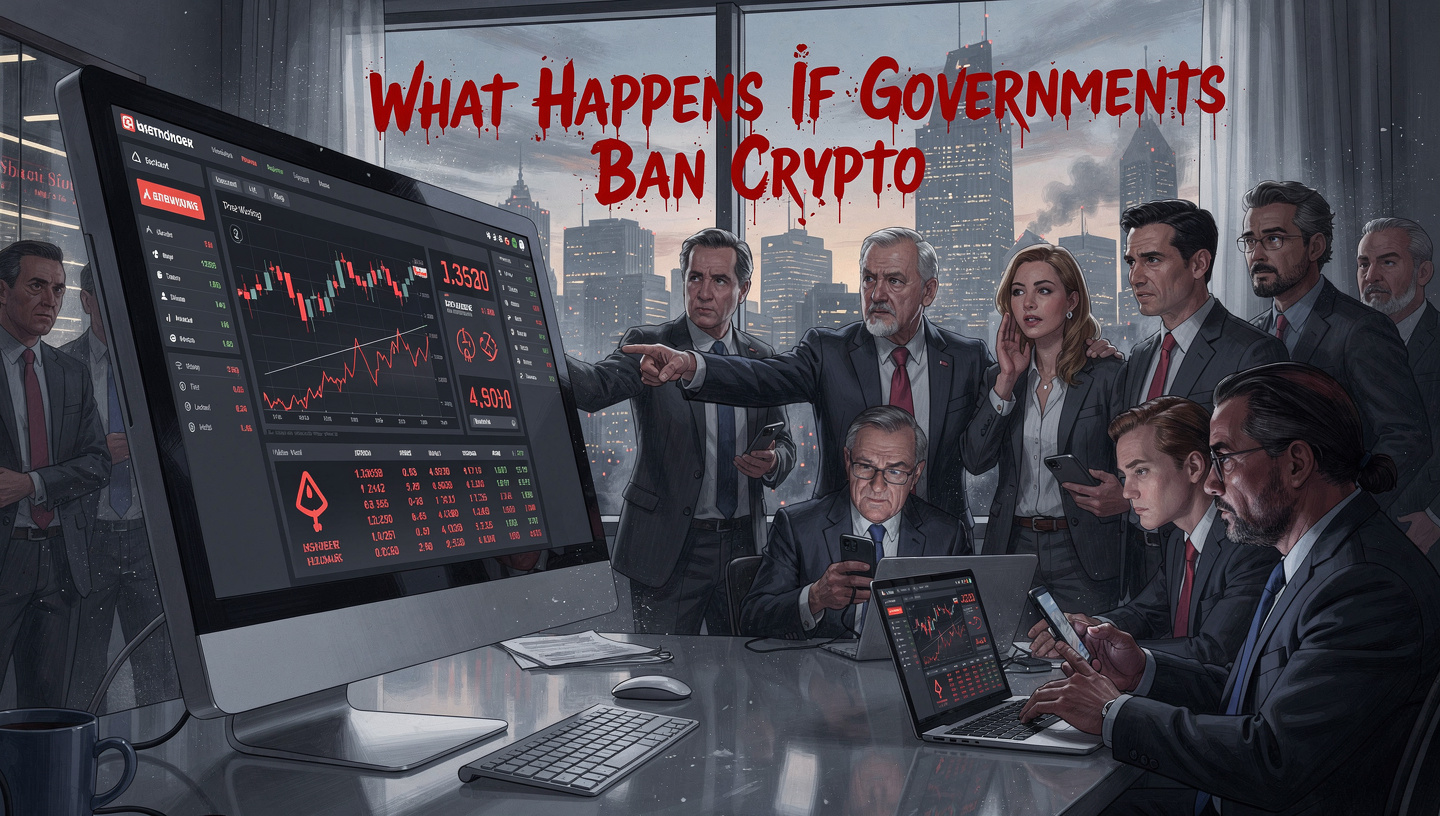
Imagine waking up one morning to a breaking news alert:
“Government Officially Bans Cryptocurrency.”
No more Bitcoin trading.
No more Ethereum wallets.
No more exchanges, no more DeFi, no more NFTs.
At first glance, it sounds like the end of crypto as we know it. Prices would crash, headlines would scream panic, and critics would declare victory: “We told you crypto was doomed.”
But would it really be over?
History, technology, and human behavior suggest a much more complex—and fascinating—story. Crypto is not just an asset class. It is an idea, a protocol, and a challenge to how power and money have worked for centuries.
So what actually happens if governments ban crypto?
Let’s explore the consequences—economically, technologically, socially, and geopolitically—without hype, without fear, and without oversimplification.
1. What Does “Banning Crypto” Really Mean?
Before diving into outcomes, we need clarity. A “crypto ban” can mean very different things depending on the country.
Types of Crypto Bans
Governments rarely ban crypto in a single, absolute way. Instead, bans usually fall into categories:
- Trading bans – Prohibiting exchanges from operating legally
- Payment bans – Disallowing crypto as a means of payment
- Mining bans – Shutting down mining operations
- Banking bans – Preventing banks from interacting with crypto businesses
- Ownership bans – Making it illegal to hold crypto (very rare)
China, for example, has banned mining and trading multiple times—but individuals still technically own crypto. India has debated bans but stopped short of full prohibition. Meanwhile, some countries ban banks from touching crypto while allowing peer-to-peer trading.
In other words, a ban is often partial, uneven, and full of loopholes.
2. The Immediate Market Reaction: Chaos First, Logic Later
If a major government—especially the U.S. or EU—announced a strict ban, the short-term impact would be brutal.
Short-Term Effects
- Prices would drop sharply
- Retail investors would panic sell
- Exchanges in that jurisdiction would shut down or relocate
- Media narratives would turn aggressively negative
Markets hate uncertainty, and bans create maximum uncertainty.
But here’s the key insight:
Crypto markets have survived worse.
Bitcoin has:
- Been declared “dead” hundreds of times
- Been banned or restricted in multiple major economies
- Survived exchange collapses, hacks, and fraud scandals
Historically, bans cause volatility, not extinction.
3. Does a Ban Actually Kill Crypto? Technology Says No
Governments are powerful—but crypto was designed specifically to not require permission.
Why Crypto Is Hard to Kill
Crypto networks are:
- Decentralized – No central server to shut down
- Global – Nodes operate across borders
- Open-source – Anyone can run the software
- Peer-to-peer – Transactions don’t need intermediaries
Banning crypto is not like banning a company. It’s more like banning math—or banning the internet in the 1990s.
Even if:
- Exchanges are shut down
- Apps are removed from app stores
- Banks refuse crypto transactions
The blockchain itself continues to run.
4. What Happens to Users? From Convenience to Resistance
A ban doesn’t erase demand—it changes behavior.
The Shift Underground
When crypto is banned:
- Users move from centralized exchanges to peer-to-peer platforms
- Wallet usage increases
- Privacy tools become more popular
- Education around self-custody accelerates
Ironically, bans often push users toward more decentralized and less controllable tools, making oversight harder—not easier.
Instead of transparent exchanges with KYC:
- Governments get dark markets
- Regulators lose visibility
- Consumers face higher risks
History shows this pattern repeatedly—from alcohol prohibition to online piracy.
5. The Rise of the Crypto “Black Market” Economy
When legal rails disappear, informal ones appear.
Parallel Financial Systems
In banned environments:
- Stablecoins replace local currencies
- Informal brokers facilitate swaps
- Cross-border remittances move entirely off-grid
- Crypto becomes a tool of necessity, not speculation
This has already happened in countries facing:
- Hyperinflation
- Capital controls
- Banking system failures
A ban doesn’t eliminate crypto—it often transforms it into financial resistance.
6. Impact on Innovation: Talent Flees, Ideas Don’t
One of the most overlooked consequences of a crypto ban is the brain drain.
Developers Follow Freedom
When governments ban crypto:
- Startups relocate
- Developers move abroad
- Venture capital follows talent
- Local innovation ecosystems collapse
This happened with:
- Crypto mining leaving China
- Tech startups leaving restrictive jurisdictions
- Fintech innovation shifting to crypto-friendly regions
The irony?
Countries that ban crypto often end up importing the technology later—at a disadvantage.
7. Winners and Losers: Who Benefits from a Ban?
Who Benefits
- Traditional financial intermediaries (short-term)
- Legacy institutions resistant to change
- Centralized power structures
Who Loses
- Retail users seeking alternatives
- Small businesses using crypto for payments
- Developers and entrepreneurs
- The unbanked and underbanked
Most importantly, governments lose leverage in the long run by pushing innovation offshore.
8. Global Fragmentation: A World of Crypto Havens and Crypto Deserts
Crypto bans don’t happen globally all at once. They create geographic arbitrage.
The New Map of Money
- Some countries ban crypto
- Others regulate it
- A few aggressively embrace it
Capital flows to friendly jurisdictions. So does influence.
This leads to:
- Competing financial systems
- Fragmented regulation
- A multipolar monetary future
In a world like this, banning crypto is not a global solution—it’s a local retreat.
9. What History Teaches Us About Bans and Technology
Every transformative technology faces resistance:
- The internet
- Encryption
- File sharing
- Online payments
Governments that tried to ban these technologies didn’t stop them—they delayed adoption and lost leadership.
Crypto is following the same pattern, but with higher stakes.
10. The Likely Outcome: Regulation, Not Prohibition
Here’s the uncomfortable truth for both extremes:
- Crypto maximalists underestimate governments
- Crypto skeptics underestimate technology
The most likely future is not a permanent ban, but:
- Heavier regulation
- Clearer tax rules
- Stricter compliance
- Legal frameworks for consumer protection
Bans are blunt tools. Regulation is more effective.
Final Thought: You Can Ban Crypto, But You Can’t Ban the Question It Asks
Crypto ultimately asks a simple, dangerous question:
Who should control money in a digital world?
Governments can ban software.
They can punish behavior.
They can restrict access.
But they cannot un-invent an idea that resonates with millions.
If governments ban crypto, the world doesn’t end.
Crypto doesn’t disappear.
And the story doesn’t stop.
It simply becomes more interesting.