Non-fungible tokens (NFTs) emerged as one of the most misunderstood innovations in the digital economy. At their peak, headlines highlighted multimillion-dollar sales of pixelated avatars and algorithmically generated art. Critics dismissed them as speculative bubbles. Enthusiasts framed them as the future of digital property.
Both sides often missed the central legal and technical question:
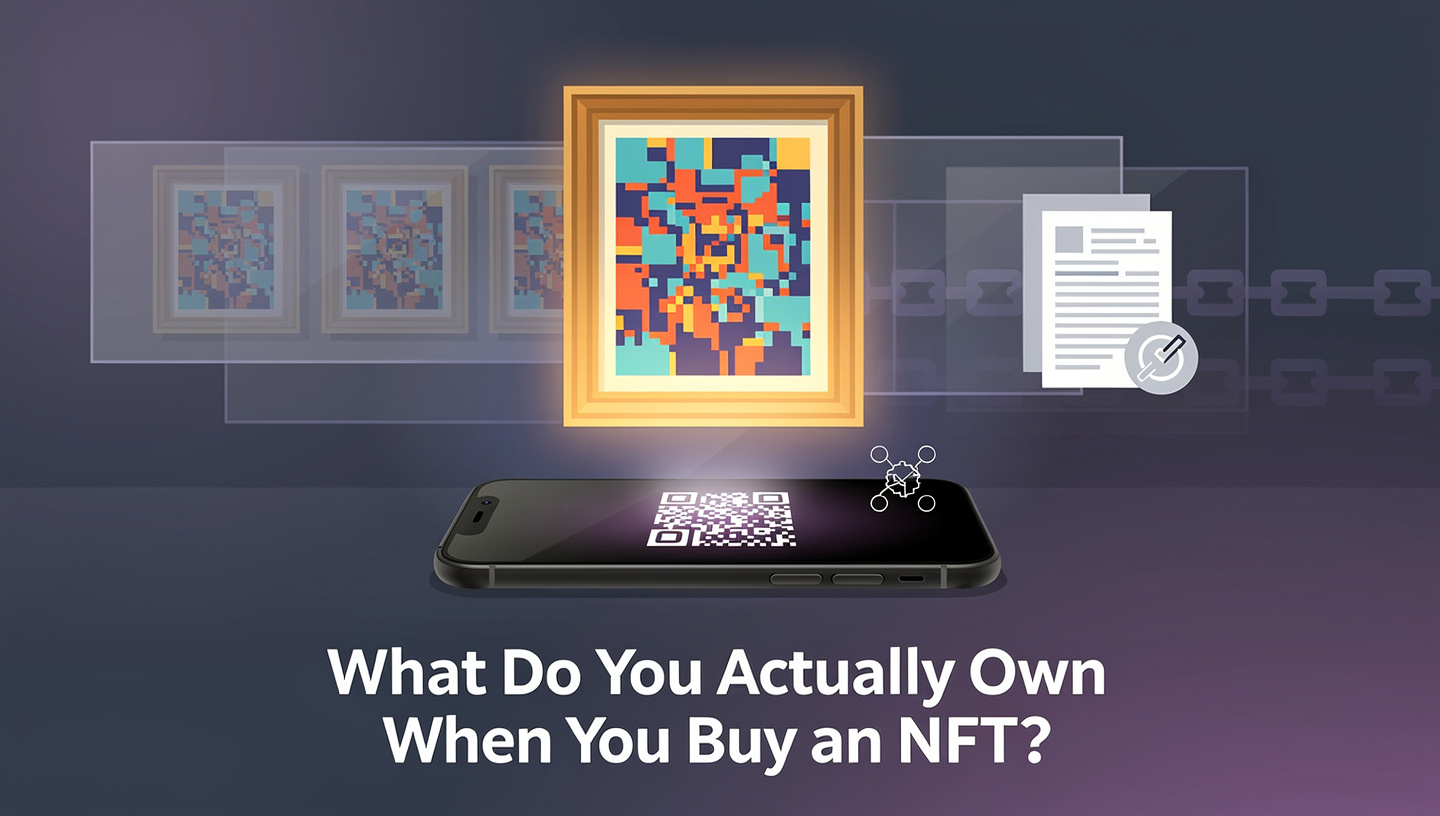
When you buy an NFT, what do you actually own?
This is not a philosophical question. It is a technical, legal, and economic one. Ownership in the blockchain context differs fundamentally from ownership in traditional legal systems. It is enforced cryptographically rather than institutionally. It is constrained by smart contract logic rather than court precedent. And in most cases, it does not automatically include copyright, intellectual property rights, or even the underlying digital file.
This article provides a rigorous, research-driven explanation of NFT ownership. It examines the blockchain mechanics behind NFTs, the role of smart contracts, the legal realities of intellectual property, the limitations of tokenized ownership, and the implications for collectors, creators, investors, and institutions.
1. Defining the NFT: What Is Being Purchased?
An NFT (non-fungible token) is a unique cryptographic token recorded on a blockchain. Unlike cryptocurrencies such as Bitcoin or Ether, which are fungible (each unit is interchangeable), NFTs are individually distinct.
Most NFTs are issued on the Ethereum blockchain and conform to standards such as ERC-721 or ERC-1155. These standards define how tokens are created, transferred, and identified.
When you purchase an NFT, you acquire:
- A unique token ID.
- A record of ownership stored on the blockchain.
- A reference (often a URI) pointing to associated metadata.
- The ability to transfer that token according to smart contract rules.
That is the technical core of NFT ownership. The NFT itself is not the image, video, or audio file. It is a token that references data, typically stored elsewhere.
2. Blockchain-Level Ownership: What the Network Recognizes
Ownership in blockchain systems is defined cryptographically.
If your private key controls a wallet address, and that wallet address holds a specific NFT token ID, the blockchain recognizes you as the owner.
This recognition is:
- Deterministic
- Publicly verifiable
- Enforced by consensus rules
- Independent of traditional legal systems
For example, if you own a token from the Ethereum network, anyone can verify that ownership by querying the blockchain ledger.
You control:
- The ability to transfer the token
- The ability to list it for sale
- The ability to send it to another address
- The ability to interact with smart contract functions (if enabled)
This is cryptographic property. It is not the same as legal property.
3. The Metadata Layer: What the Token Points To
Most NFTs do not store large media files directly on-chain. Instead, they store metadata that includes:
- A token name
- A description
- An image URL or IPFS hash
- Attributes or traits
- External links
The token typically contains a pointer to a JSON metadata file, which itself contains a link to the digital asset.
Common storage models include:
- Centralized servers
- IPFS (InterPlanetary File System)
- Arweave
- On-chain storage (rare and expensive)
If the underlying file is hosted on a centralized server, its availability depends on that server remaining operational. If the server goes offline, the NFT still exists on-chain—but the associated media may become inaccessible.
Thus, ownership of the NFT does not automatically mean ownership of the hosted file infrastructure.
4. Intellectual Property: The Critical Distinction
The most misunderstood aspect of NFTs concerns intellectual property (IP) rights.
Buying an NFT does not automatically transfer copyright.
Under copyright law in most jurisdictions:
- The creator retains copyright unless explicitly transferred.
- Copyright transfer requires clear contractual language.
- Token ownership and copyright ownership are separate legal constructs.
When you buy an NFT from a collection like Bored Ape Yacht Club, you do not inherently own the copyright to the artwork unless the issuer grants it in the license agreement.
Projects vary widely:
- Some grant full commercial rights.
- Some grant limited personal-use rights.
- Some grant no meaningful rights beyond token ownership.
The legal relationship is defined not by the blockchain, but by the licensing terms associated with the project.
5. Smart Contracts: Enforcing Digital Ownership Logic
NFT behavior is governed by smart contracts deployed on blockchains like Ethereum.
A smart contract defines:
- Token minting rules
- Transfer conditions
- Royalty structures
- Burn functions
- Access controls
For example, some NFTs embed royalty mechanisms that automatically route a percentage of secondary sales to the creator.
This logic is executed automatically by the blockchain. However:
- It does not enforce copyright.
- It does not guarantee off-chain compliance.
- It cannot prevent someone from copying the image.
Smart contracts enforce token-level ownership—not content-level exclusivity.
6. Scarcity vs. Copyability
NFTs introduce digital scarcity.
Before NFTs, digital files were infinitely replicable with no native ownership layer. NFTs attach uniqueness and transferability to a digital reference.
However:
- The associated image can still be copied.
- Screenshots remain possible.
- Downloads remain possible.
What cannot be copied is the token ID associated with a specific smart contract.
Scarcity applies to:
- The token
- The on-chain record
- The cryptographic signature
Scarcity does not apply to the file’s pixels.
7. Legal Ownership vs. Blockchain Ownership
There are two parallel systems:
Blockchain Ownership
Defined by:
- Private key control
- Token ID
- Smart contract rules
- Network consensus
Legal Ownership
Defined by:
- Copyright law
- Contract law
- Licensing agreements
- Jurisdictional enforcement
If someone hacks your wallet and transfers your NFT:
- The blockchain recognizes the new owner.
- Legal systems may recognize theft.
Blockchain systems do not reverse transactions without protocol-level intervention. Legal systems may intervene—but enforcement varies by jurisdiction.
This duality creates friction between decentralized infrastructure and traditional law.
8. What You Actually Own: A Layered Breakdown
When you buy an NFT, you own:
1. The Token
A unique entry in a smart contract’s registry.
2. The Transfer Rights
The ability to move the token to another address.
3. Associated Smart Contract Privileges
If the contract includes gated access, voting rights, or utility.
4. A License (Sometimes)
Depending on the project’s legal framework.
You do not automatically own:
- Copyright
- Trademark rights
- Patent rights
- The hosting server
- The blockchain protocol
9. NFTs as Access Credentials
Many NFTs function as access keys rather than artworks.
They may grant:
- Event entry
- Community membership
- Software access
- Governance rights
- Token airdrops
In these cases, ownership is primarily functional.
For example, NFTs can act as governance tokens in decentralized autonomous organizations (DAOs), allowing participation in voting processes tied to smart contracts on networks like Ethereum.
In such cases, what you own is a programmable credential.
10. NFT Marketplaces and Custody
NFTs are commonly traded on marketplaces that integrate directly with blockchain wallets.
These platforms:
- Do not typically hold the NFT in custody.
- Facilitate smart contract interactions.
- Display metadata.
If you control your wallet’s private key, you control the NFT.
However, if you store NFTs on custodial platforms, the platform may control the keys—meaning you do not directly control the token.
Ownership, in blockchain terms, is defined by private key control.
11. On-Chain vs. Off-Chain Risk
The durability of NFT ownership depends on:
- Blockchain longevity
- Smart contract immutability
- Metadata persistence
- File hosting reliability
Fully on-chain NFTs (where art is encoded directly into the smart contract) reduce reliance on external infrastructure.
Most NFTs depend on off-chain storage, introducing centralization risk.
Ownership of the token does not guarantee permanence of the associated content.
12. Fractional NFTs and Financialization
NFTs can be fractionalized, meaning ownership shares are tokenized into smaller units.
This introduces additional complexity:
- You may own a fraction of a token.
- Governance rights may vary.
- Liquidity may increase.
- Legal classification may change.
Fractionalization can blur the line between collectible and security, depending on jurisdiction.
13. NFTs and Securities Law
In certain contexts, NFTs may be evaluated under securities frameworks.
If an NFT:
- Is marketed as an investment
- Promises profit from managerial efforts
- Represents pooled capital
It may fall under securities regulation.
This varies by country and regulatory interpretation.
Ownership in such cases carries compliance implications beyond simple token possession.
14. NFTs in Gaming and Virtual Worlds
In gaming ecosystems, NFTs may represent:
- In-game items
- Land parcels
- Characters
- Skins
Ownership allows transfer outside the game’s internal database.
However:
- Developers can modify game mechanics.
- Utility depends on platform support.
- Servers can shut down.
Blockchain ownership does not guarantee perpetual usability within a game ecosystem.
15. NFT Royalties: Ongoing Creator Economics
Smart contracts can encode royalties.
When implemented, a percentage of each secondary sale routes to the creator’s wallet.
However:
- Enforcement depends on marketplace compliance.
- Off-market transfers may bypass royalties.
- Not all platforms honor creator royalties.
Ownership of the NFT does not imply control over royalty parameters.
16. Custody Risk and Private Key Management
If you lose your private key:
- The NFT becomes inaccessible.
- There is no password reset.
- No central authority restores access.
Blockchain ownership is absolute but unforgiving.
Security practices—hardware wallets, multisignature setups, secure backups—determine actual control.
17. NFTs and Cultural Signaling
NFT ownership often functions as:
- Social identity
- Community affiliation
- Status signal
This is economically relevant.
Scarcity combined with public verifiability enables NFTs to function as digitally native status assets.
Ownership is visible, traceable, and persistent.
18. Summary: The Exact Nature of NFT Ownership
When you purchase an NFT, you acquire:
- A unique token recorded on a blockchain.
- Cryptographic proof of control via private key.
- Transferability governed by smart contract logic.
- Potential utility defined by project design.
- A license defined by legal documentation.
You do not automatically acquire:
- Copyright.
- Exclusive control over the media file.
- Infrastructure hosting guarantees.
- Legal immunity from regulatory oversight.
NFT ownership is best understood as cryptographically enforced control over a unique token that references digital or physical assets under specified contractual conditions.
Conclusion: Ownership Redefined, Not Replicated
NFTs do not replicate traditional property structures. They redefine ownership within the constraints of decentralized systems.
They separate:
- Token ownership
- Intellectual property
- Infrastructure control
- Legal rights
Understanding these layers is essential.
NFT buyers who assume they own “the art” misunderstand the system. NFT skeptics who claim buyers own “nothing” also misunderstand it.
The reality is more precise:
You own a blockchain-recognized token, governed by smart contract rules, referencing digital content, accompanied by whatever legal rights the issuer grants.
That is the actual architecture of NFT ownership.
And in the evolving digital economy, that distinction matters.