For most of the internet’s history, we have lived inside walled gardens.
We log into Facebook, Google, YouTube, Amazon, gaming platforms, banking apps, and dozens more services every day. These platforms give us convenience, scale, and performance — but they also control the rules, own the data, and take most of the value created on their networks.
In the last decade, something new has emerged: decentralized applications, better known as dApps.
Built on blockchains rather than private company servers, dApps promise a fundamentally different internet — one where users own their data, developers cannot be arbitrarily shut down, and communities — not corporations — control platforms.
This article explains, in clear and practical terms:
- What dApps actually are
- How they work behind the scenes
- What makes them different from traditional apps
- Where they’re already being used
- Their advantages, limitations, and risks
- Why many technologists believe dApps are shaping the next phase of the internet
Let’s start at the foundation.
1. First Principles: What Is a dApp?
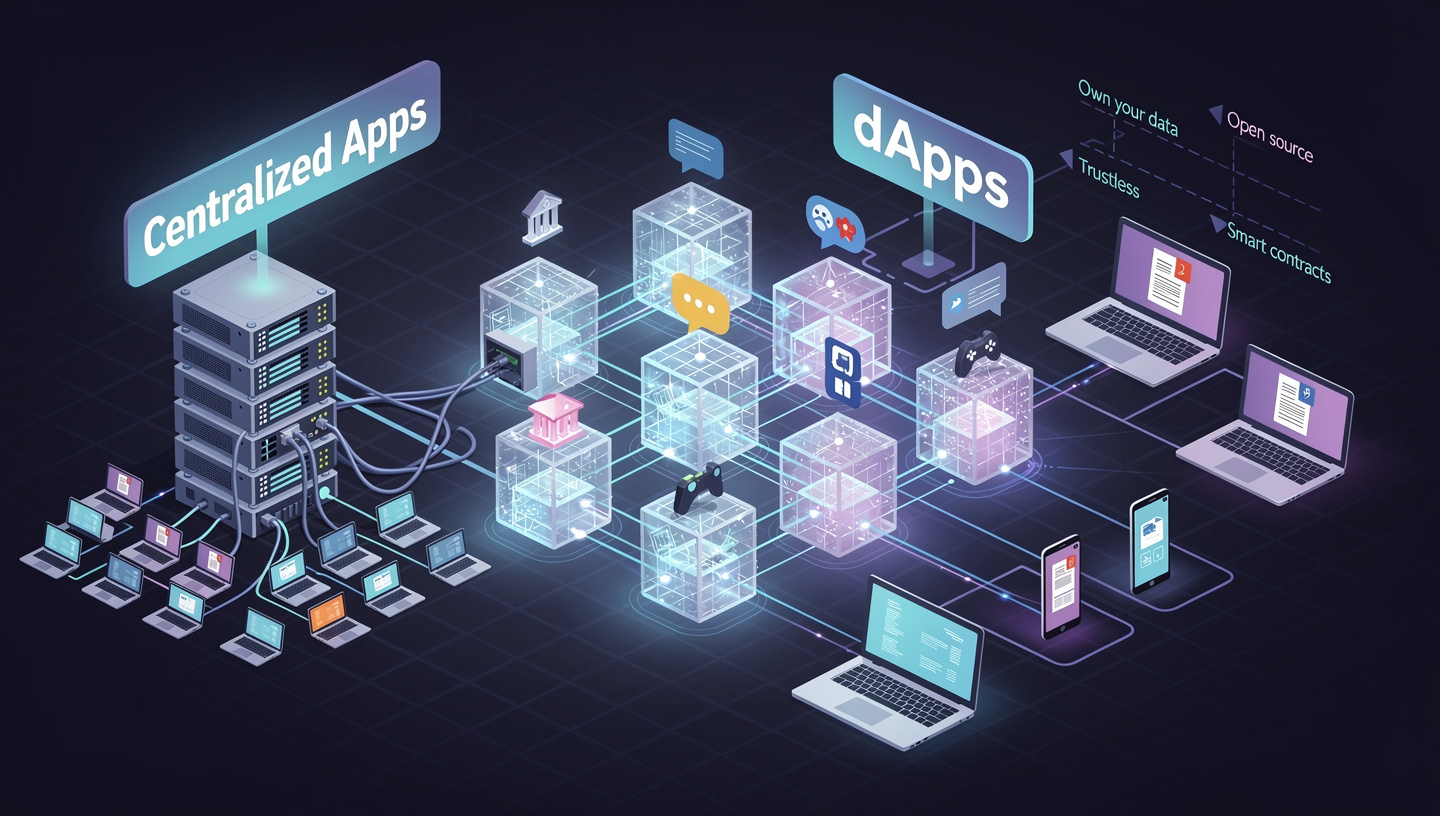
A decentralized application (dApp) is an application that runs on a blockchain instead of centralized servers.
A traditional app:
- Stores data in company databases
- Runs backend logic on corporate-owned servers
- Is controlled and updated by a single organization
A dApp:
- Stores data on a distributed network (blockchain)
- Executes logic using smart contracts
- Has no single owner that can arbitrarily change rules
Simple analogy
Think of a traditional app like a restaurant:
- One owner
- One kitchen
- One menu
- You trust the chef not to poison you, overcharge you, or change recipes without warning
Think of a dApp like a public food court:
- Many kitchens
- Shared infrastructure
- Transparent pricing posted publicly
- Anyone can open a stall
- Rules are enforced collectively, not by one owner
You don’t “trust a company” — you trust code, cryptography, and consensus.
2. The Core Components of a dApp
To understand dApps, you need to understand three pillars:
blockchains, smart contracts, and front-end interfaces.
(a) Blockchain: The Public Ledger
A blockchain is essentially a database shared across thousands of computers. Once data is recorded, it becomes extremely difficult to alter.
In dApps, the blockchain:
- Stores transactions
- Stores states (balances, ownership records, permissions)
- Ensures transparency and immutability
No company can quietly change numbers in their favor. Any change is visible to everyone.
(b) Smart Contracts: Code That Enforces Rules
Smart contracts are self-executing programs deployed to the blockchain.
They:
- Define how the app works
- Automatically enforce rules
- Handle money, permissions, and interactions
Example:
A smart contract for a decentralized exchange (DEX) might say:
“If User A sends Token X and User B sends Token Y, swap them at the agreed price.”
No bank.
No broker.
No human “approver.”
Just code.
(c) Front-End: The Part You Actually See
Even though dApps run on blockchains, users still interact with them through familiar web or mobile interfaces.
Your browser connects to:
- The blockchain (via wallets like MetaMask or Phantom)
- Off-chain APIs for convenience features
- Smart contracts for core logic
From the user’s perspective, dApps can feel similar to normal apps — but the backend is entirely different.
3. dApps vs Traditional Apps: Key Differences
Below is a structured comparison to make it concrete.
| Feature | Traditional Apps | dApps |
|---|---|---|
| Backend control | Single company | Decentralized network |
| Data storage | Centralized databases | Blockchain |
| Censorship | Platform can ban users or apps | Very difficult to censor |
| Upgrades | Company decides | Community/governance |
| Transparency | Closed systems | Open-source / auditable |
| Payments | Banks, processors | Crypto / tokens |
| Reliability | Dependent on company servers | Highly distributed |
Bottom line:
Traditional apps rely on trust in companies.
dApps rely on cryptography, incentives, and decentralized consensus.
4. Real-World Categories of dApps
dApps are not theoretical anymore. They are already operating at massive scale in multiple categories.
1. Finance (DeFi)
Decentralized finance removes banks and brokers from the middle.
Examples include:
- Decentralized exchanges (Uniswap, PancakeSwap)
- Lending platforms (Aave, Compound)
- Stablecoins
- Yield markets
Users can borrow, lend, trade, and earn interest without permission.
2. Gaming and Digital Ownership
In blockchain gaming, players truly own in-game assets.
- Skins, items, land, characters become NFTs
- Assets are portable between marketplaces
- Developers cannot confiscate assets arbitrarily
Even if a game shuts down, your on-chain assets remain yours.
3. Social and Creator Platforms
New social dApps experiment with:
- User-owned profiles
- Censorship-resistant publishing
- Monetization without intermediaries
Creators can get paid directly — not through opaque algorithms.
4. Marketplaces and Commerce
Peer-to-peer marketplaces allow:
- Transparent pricing
- Reduced fees
- Trustless trading via smart contracts
Instead of trusting eBay or Amazon, you trust verified code.
5. Infrastructure and Identity
Projects focus on:
- Decentralized storage
- Domain names on blockchain
- Digital identity and reputation
This layer is crucial for the long-term architecture of Web3.
5. Why People Are Excited About dApps
Beyond hype, there are serious structural advantages.
A. Ownership and Control
Users own:
- Private keys
- Digital assets
- Identities
- Content in some designs
Developers can deploy software that no one can arbitrarily shut down.
B. Transparency
Every transaction is:
- Public
- Traceable
- Verifiable
This forces accountability. Fraud becomes harder to hide.
C. Lower Dependence on Intermediaries
Banks, brokers, and platforms often extract high fees.
dApps replace intermediaries with:
- Open protocols
- Automated smart contracts
- Shared infrastructure
Fees exist, but economics are often fairer and more competitive.
D. Global Access
Anyone with internet access can participate.
- No bank account required
- No government approval in most cases
- 24/7, borderless applications
This inclusivity is one of the strongest arguments for dApps’ future growth.
6. The Tradeoffs — Because There Are Always Tradeoffs
It is easy to romanticize decentralization. Reality is more nuanced.
1. User Experience Friction
Today, onboarding requires:
- Wallet setup
- Private key management
- Understanding transaction fees
This is intimidating for new users.
2. Security Risks
Smart contracts can contain bugs. Mistakes may be irreversible.
There is no “forgot password” button for private keys.
3. Scalability Limitations
Blockchains process fewer transactions per second than centralized systems, though Layer 2 solutions continue improving performance.
4. Regulation and Legal Ambiguity
Governments worldwide are still determining frameworks. Businesses and users must operate carefully.
5. Decentralization is Not Binary
Many “dApps” still rely on:
- Centralized components
- Admin keys
- Off-chain servers
The path to true decentralization is gradual and complex.
7. Governance: Who Decides the Rules in dApps?
Instead of executives making decisions, many dApps use decentralized governance, usually powered by governance tokens.
Token holders can vote on:
- Feature upgrades
- Fee structures
- Partnerships
- Protocol rules
This approach is experimental and imperfect, but it represents a shift toward platform democracy rather than corporate oligarchy.
8. Are dApps Really “The Future of the Internet”?
The honest answer: They are part of it — not all of it.
dApps excel where:
- Trust needs to be minimized
- Transparency matters
- Value exchange is native
- Users require ownership
Traditional apps remain superior for:
- High performance
- Mass user experience
- Non-financial, low-risk interactions
The future likely looks hybrid:
- Core value functions decentralized
- Interfaces optimized for usability
- Interoperable systems across chains
In other words:
Not Web2 versus Web3 — but convergence.
Final Thoughts
dApps challenge the economic and power structures of today’s internet.
They propose:
- Platforms owned by communities
- Transparent, tamper-resistant systems
- Reduced dependence on powerful intermediaries
- Programmable, global financial infrastructure
- A shift from “renting” digital life to owning it
They are not perfect. They are evolving. They carry risks.
But they represent one of the most significant technological and philosophical experiments of our time.
And whether you are a developer, investor, student, or curious observer, understanding dApps means understanding where the internet — at least partly — is heading.