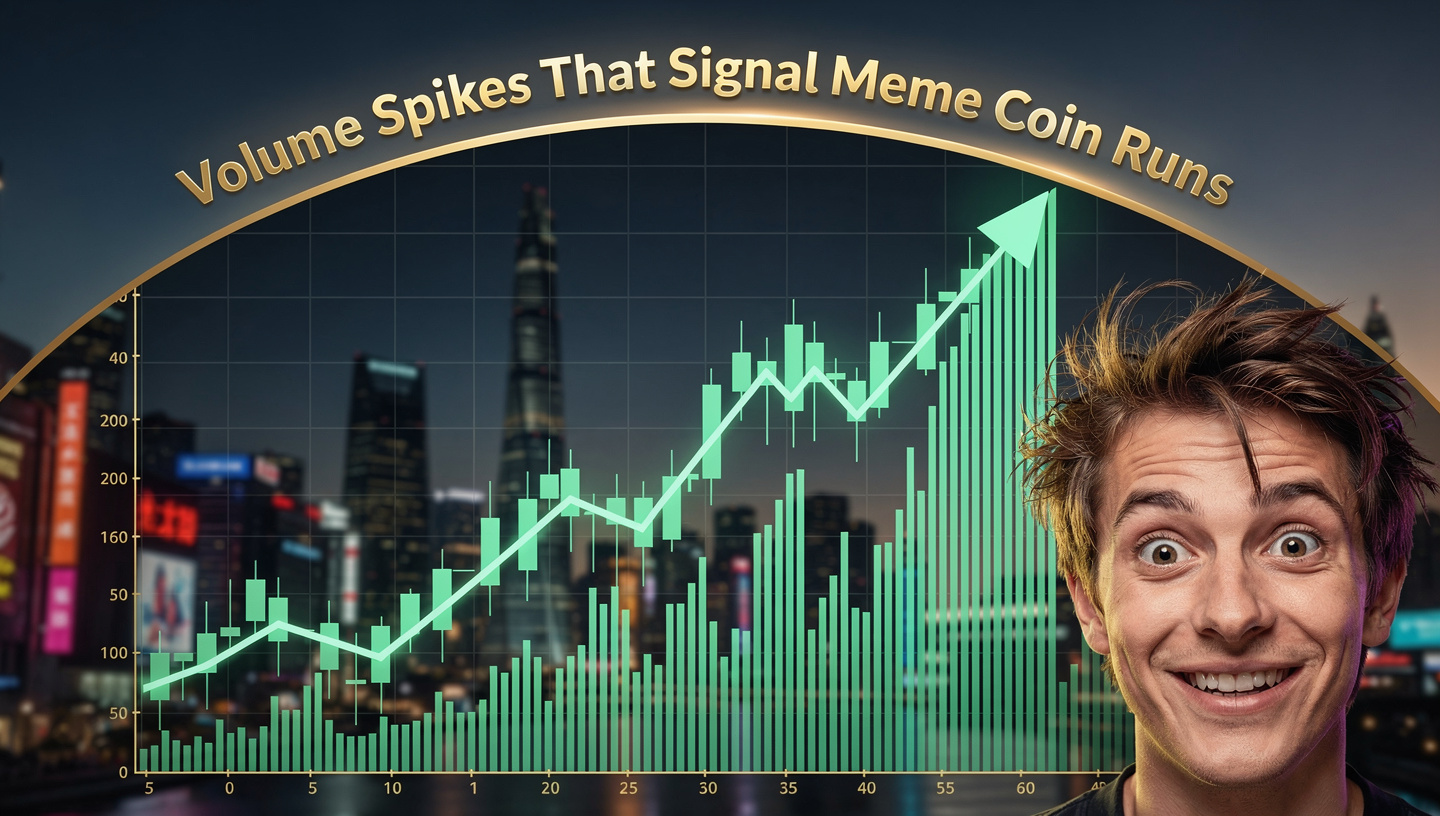
Charts are flooded with green candles that mean nothing, fake breakouts engineered by bots, and “bullish” patterns that collapse within minutes. Yet, through all the noise, one signal consistently separates organic momentum from manufactured hype: volume behavior.
Volume spikes are not inherently bullish. Most traders misunderstand this. A sudden surge in trading activity can precede explosive runs—or mark the exact moment insiders are exiting. The difference is not intuition. It is structure, sequencing, and context.
This article is not a motivational guide to “catching pumps.” It is a research-driven breakdown of how volume actually behaves during meme coin runs, how smart money positions before visible price expansion, and how retail traders misinterpret volume signals to their detriment.
If you understand volume correctly, you stop chasing. You start anticipating.
Why Volume Matters More in Meme Coins Than Any Other Asset Class
Traditional assets rely on fundamentals, cash flow expectations, or macro correlations. Meme coins rely on attention liquidity.
In this environment, volume is not merely transactional data—it is a real-time proxy for:
- Capital commitment
- Narrative adoption
- Distribution or accumulation intent
- Bot amplification vs human participation
Because meme coins lack intrinsic valuation anchors, volume becomes the primary validation mechanism. Price moves without volume are fragile. Volume without price movement is information.
This asymmetry is what creates opportunity.
Understanding the Anatomy of a Volume Spike
Not all volume spikes are equal. Treating them as such is the fastest way to become exit liquidity.
A meaningful volume spike must be analyzed across four dimensions:
- Relative magnitude
- Temporal placement
- Liquidity context
- Price reaction
Only when all four align does volume signal a potential run.
1. Relative Volume: Spikes Must Be Measured, Not Felt
The human brain overreacts to visual change. A candle that “looks big” is irrelevant without baseline comparison.
A legitimate signal typically involves:
- Volume expanding 5–15x above the recent moving average
- Sustained activity across multiple consecutive candles
- Participation from both sides of the order book
One-candle volume explosions are usually:
- Contract launches
- Influencer call-outs
- Bot-driven wash trading
These rarely sustain momentum unless followed by secondary confirmation volume.
Key principle:
Real runs are built on expanding participation, not singular events.
2. Pre-Price Volume: The Most Overlooked Signal in Meme Coins
The highest-quality meme coin runs rarely begin with price.
They begin with volume compression followed by silent expansion.
This phase is characterized by:
- Flat or slightly declining price
- Gradual increase in traded volume
- Tight candle ranges
- Increasing transaction count without volatility
This is accumulation.
Retail traders ignore this phase because it is boring. Smart money prefers it because it is efficient.
When price eventually moves, it does so violently—because the supply has already been absorbed.
3. Volume Without Price Movement Is Not Neutral
A common misconception is that volume only matters when price moves. In meme coins, the opposite is often true.
High volume + stagnant price usually means one of two things:
- Aggressive accumulation against passive sellers
- Aggressive distribution against eager buyers
The difference lies in candle structure:
- Accumulation shows long wicks, tight closes, and bid support
- Distribution shows expanding ranges, failed breakouts, and heavy sells into strength
Volume does not tell you direction.
It tells you effort. Price tells you result.
4. Breakout Volume vs Expansion Volume
Most traders buy breakouts. Professionals analyze what happens after.
A healthy meme coin run follows this sequence:
- Volume expansion precedes price breakout
- Breakout candle closes with elevated but controlled volume
- Follow-up candles maintain or increase volume
- Pullbacks occur on declining volume
If volume peaks on the breakout candle and collapses immediately after, the move is likely exhausted.
Sustainable runs are fueled by continuity, not climax.
Fake Volume: The Silent Killer of Retail Capital
Meme coin ecosystems are saturated with artificial volume generation:
- Wash trading contracts
- Bot-looped transactions
- Incentivized liquidity mining
Fake volume has distinct fingerprints:
- Perfectly uniform transaction sizes
- Repetitive wallet interactions
- High volume with minimal unique traders
- No slippage even at high turnover
Real volume is messy. It produces inefficiencies, slippage, and irregular behavior.
If volume looks too clean, it probably is.
Volume Spikes Around Narrative Catalysts
Volume does not exist in a vacuum. In meme coins, it responds to narrative ignition points:
- Token rebranding
- Community migrations
- Exchange rumors
- Influencer amplification
- Market-wide sentiment shifts
However, narrative-driven volume behaves differently:
- Initial spike is sharp and emotional
- Follow-through depends on retention volume
- Most narrative spikes fail without secondary accumulation
The market does not reward the first reaction.
It rewards sustained belief.
The Role of Liquidity Depth in Interpreting Volume
A 10x volume spike in a shallow pool is meaningless. A 3x spike in a deep pool is significant.
Always contextualize volume against:
- Liquidity pool size
- Slippage tolerance
- Bid-ask spread behavior
Volume that meaningfully moves price despite deep liquidity indicates real demand.
Volume that fails to move price despite thin liquidity suggests artificial churn.
Volume Clusters and Time-of-Day Effects
Meme coin volume is not evenly distributed.
High-probability volume spikes often occur:
- During U.S. market open overlap
- Around Asian retail trading hours
- Immediately after major social media posts
Isolated off-hour spikes are more likely manipulation.
Clusters across multiple sessions indicate global participation—an important ingredient for sustained runs.
Common Retail Misinterpretations of Volume
Retail traders consistently make the same errors:
- Buying the largest volume candle
- Ignoring declining volume on pullbacks
- Confusing transaction count with capital inflow
- Assuming all volume is organic
Volume is a diagnostic tool, not a trigger.
Those who treat it as a buy signal inevitably arrive late.
A Practical Framework for Evaluating Volume Spikes
Before considering a meme coin run legitimate, ask:
- Did volume increase before price?
- Is volume sustained across multiple candles?
- Does price respond efficiently to volume?
- Are pullbacks occurring on lower volume?
- Is liquidity depth absorbing trades naturally?
If the answer is “no” to more than one, the move is likely fragile.
Volume Is a Language, Not a Number
Most traders see volume as a statistic. It is not.
Volume is behavior. It reflects conviction, urgency, deception, and fear. In meme coins—where fundamentals are absent—volume becomes the closest thing to truth.
Understanding volume spikes does not guarantee profits. But misunderstanding them guarantees losses.
The market does not reward speed.
It rewards interpretation.
Those who learn to read volume stop reacting to pumps and start recognizing runs before they announce themselves.