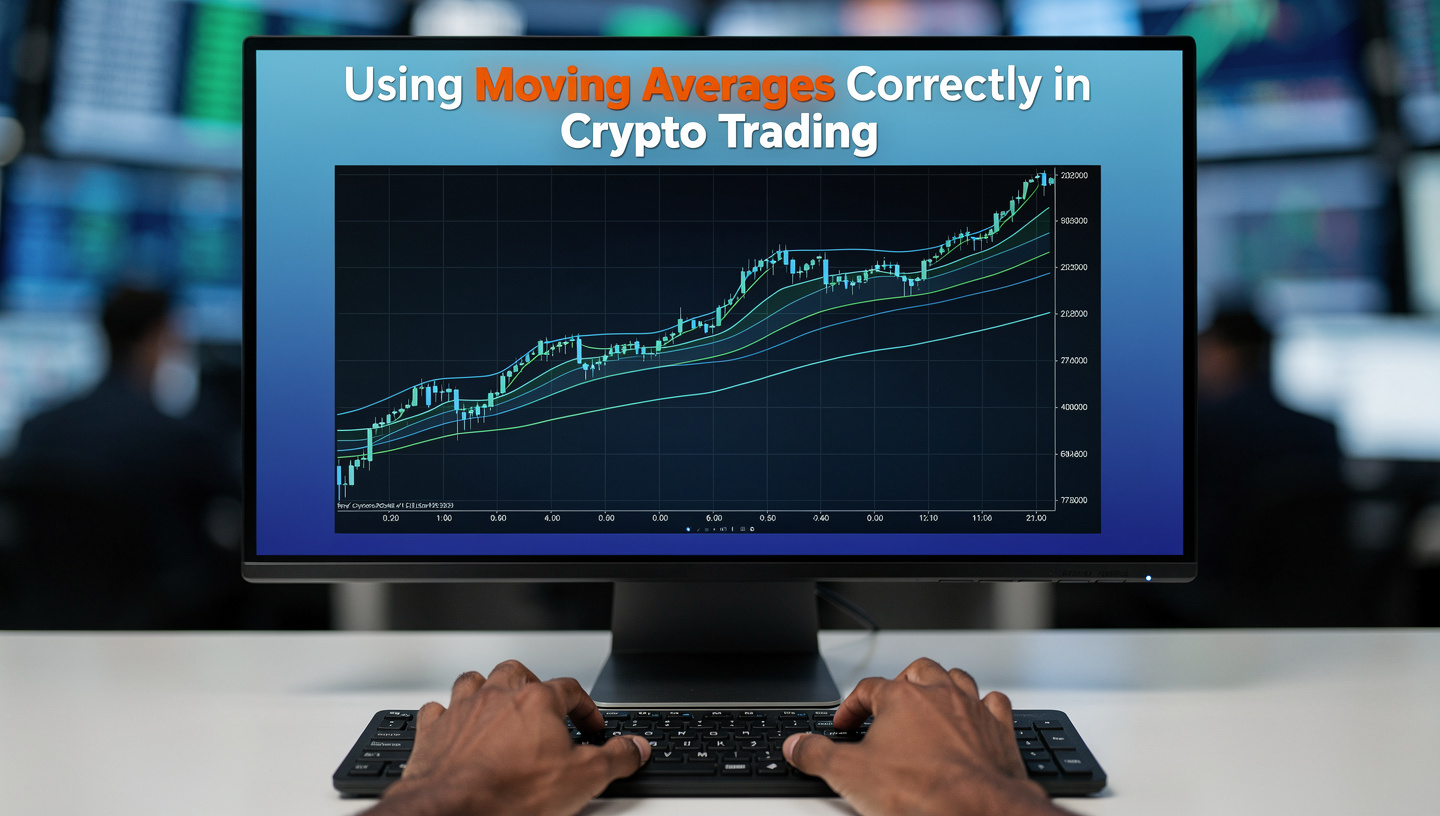
Price doesn’t move smoothly. It lurches, hesitates, traps, accelerates, and exhausts itself in cycles that punish impatience. Indicators exist to impose structure on that chaos. Moving averages are the simplest of those tools—and also the most misunderstood.
They are not magic lines. They don’t predict. They don’t “know” where price will go next.
What they do provide is something far more valuable: context.
Used correctly, moving averages reveal regime, momentum, trend health, and structural bias. Used incorrectly, they become decorative noise that encourages late entries and emotional exits.
This article is about using moving averages as professionals do: not as signals in isolation, but as components inside a disciplined trading framework.
No hype. No shortcuts. Just mechanics, logic, and application.
Why Moving Averages Still Matter in a Market Run by Algorithms
Crypto traders often dismiss moving averages as relics of traditional finance. That assumption is costly.
Moving averages persist because they solve a universal problem: they compress information over time into a readable structure.
Whether you’re trading Bitcoin, Ethereum, or illiquid altcoins on Binance or Coinbase, the underlying challenge is identical:
Raw price data is noisy.
Moving averages reduce that noise by answering four core questions:
- Is the market trending or ranging?
- In which direction is pressure dominant?
- How strong is momentum?
- Where is dynamic support or resistance likely to form?
Institutional systems still incorporate moving averages—not because they are predictive, but because they are descriptive. Algorithms use them to classify regimes. Humans should do the same.
Even high-profile technologists like Elon Musk intuitively understand this principle: abstraction precedes execution. You simplify complexity before acting on it.
Moving averages are abstraction.
The Core Types of Moving Averages (And What They Actually Do)
There are dozens of variations, but three matter in practice.
Simple Moving Average (SMA)
The arithmetic mean of price over N periods.
Characteristics
- Slow to react
- Smooth
- Filters noise well
- Lag-heavy
Use cases
- Macro trend identification
- Long-term bias
- Structural support/resistance
SMA is blunt, but reliable.
Exponential Moving Average (EMA)
Weights recent price more heavily.
Characteristics
- Faster response
- More sensitive to reversals
- More false signals in chop
Use cases
- Entry timing
- Momentum assessment
- Shorter timeframes
EMA trades smoothness for speed.
Weighted Moving Average (WMA)
Assigns linear weights to recent data.
Less common in crypto. Rarely superior to EMA in real-world conditions.
The First Rule: Moving Averages Do Not Generate Signals Alone
This is where most traders fail.
They treat crossovers as trades.
They buy when fast crosses slow.
They sell when slow crosses fast.
That is not strategy. That is pattern worship.
A moving average crossover tells you only one thing:
Momentum has shifted relative to your lookback window.
It does not tell you:
- Whether the shift is meaningful
- Whether volatility supports continuation
- Whether structure agrees
- Whether higher timeframes confirm
A crossover without context is statistical noise.
Professionals use moving averages to filter setups, not create them.
Trend Classification: The Real Purpose of Moving Averages
Before entries, before targets, before indicators—comes regime.
Ask one question:
Is price accepting above or below the moving average?
Acceptance means sustained closes, not momentary wicks.
Bullish Regime
- Price above key MA
- MA sloping upward
- Pullbacks respect MA
- Higher highs / higher lows
In this environment:
- Long setups dominate
- Shorts are countertrend scalps at best
Bearish Regime
- Price below MA
- MA sloping downward
- Rallies rejected at MA
- Lower highs / lower lows
Here:
- Shorts dominate
- Longs are mean-reversion attempts
Transitional Regime
- Flat MA
- Price crossing frequently
- No slope
This is where accounts die.
No edge exists until direction resolves.
Choosing the Right Length: Stop Copying Twitter
There is nothing sacred about the 50 or 200 period averages.
Those numbers became popular because equities used them.
Crypto volatility is different. Session structure is different. Participants are different.
Instead, choose based on timeframe intent.
Intraday Trading
- 9 EMA (micro momentum)
- 21 EMA (short trend)
- 50 EMA (intraday bias)
Swing Trading
- 20 EMA
- 50 EMA
- 100 EMA
Position Trading
- 100 SMA
- 200 SMA
These are not rules. They are starting points.
Optimize based on:
- Asset volatility
- Liquidity
- Holding period
Backtest. Measure. Adjust.
Never inherit settings blindly.
Dynamic Support and Resistance: Where Moving Averages Shine
Horizontal levels are obvious. Everyone sees them.
Moving averages create dynamic levels that shift with price.
In trending markets, pullbacks frequently stall at rising EMAs.
This provides:
- Entry zones
- Stop placement logic
- Risk compression
But this works only when:
- Trend is clean
- MA slope is clear
- Volatility supports continuation
In ranging markets, moving averages are useless for this purpose.
They will be sliced repeatedly.
Moving Average Structure > Moving Average Crossovers
Forget crosses.
Focus on structure.
Professional traders observe:
- MA slope
- Distance from price
- Compression and expansion
- Stacking order
Bullish Stack
Fast MA above medium MA above slow MA.
Momentum alignment.
Bearish Stack
Reverse order.
Compression
MAs converging = volatility contraction.
Expansion follows.
This is where breakouts originate.
Multiple Timeframe Alignment
One timeframe lies.
Three tell the truth.
If you trade on the 15-minute chart:
- Identify regime on 4H
- Time entries on 15M
- Manage risk on 5M
Moving averages must agree across frames.
If higher timeframe is bearish, lower timeframe longs are countertrend.
Treat them accordingly.
Moving Averages and Market Psychology
Every moving average is a consensus artifact.
It represents where participants agreed price should be over time.
When price deviates far from the MA, reversion pressure builds.
When price hugs the MA during trend, participation increases.
This is why pullbacks to EMAs attract buyers in bull markets.
Not because of mysticism—because that’s where perceived value meets momentum.
Common Errors That Destroy Traders
1. Chasing Price After Crossovers
By the time the crossover prints, the move is already underway.
You enter late. Risk expands. Reward contracts.
2. Using MAs in Chop
Flat averages mean no edge.
Stand aside.
3. Treating All Assets the Same
High-beta altcoins require faster averages.
Majors tolerate slower ones.
4. Ignoring Volatility
Moving averages without volatility context are blind.
Always pair with ATR or range analysis.
A Practical Framework (Minimal, Effective)
Here is a professional-grade baseline system:
Step 1: Higher Timeframe Bias
- Use 200 SMA
- Only trade in direction of slope
Step 2: Trend Confirmation
- 20 EMA + 50 EMA
- Require stacking
Step 3: Entry
- Pullback into 20 EMA
- Structure hold
- Volume confirmation
Step 4: Risk
- Stop beyond recent swing
- Fixed percentage per trade
Step 5: Exit
- Partial at 1R
- Trail behind 20 EMA
Simple. Repeatable. Measurable.
Why Most Crypto Traders Fail With Moving Averages
They want prediction.
Moving averages provide positioning.
They want certainty.
Markets offer probability.
They want mechanical signals.
Professionals build contextual frameworks.
The difference is not intelligence.
It is discipline.
Moving Averages Are Not Indicators—They Are Filters
If you take one lesson from this article, make it this:
Moving averages are not entries.
They are environmental filters.
They tell you when to press and when to step back.
They don’t create edge.
They protect it.
Final Thoughts
Crypto rewards structure. It punishes improvisation.
Moving averages endure because they impose order on volatility. Used properly, they help you:
- Define regime
- Align with momentum
- Control risk
- Avoid low-probability environments
Used improperly, they become decorative lines that justify emotional decisions.
Mastery comes from restraint, not complexity.
Strip your charts down. Learn what price does relative to its averages. Study slope, distance, and acceptance.
That’s where real skill develops.
Not in secret indicators.
Not in viral strategies.
Not in crossover fantasies.
Just structure, execution, and repetition.
That is how professionals use moving averages.
And now, so can you.