Markets do not move because people believe. Markets move because supply changes.
In crypto, few mechanisms alter supply more abruptly and more predictably than token unlock events. These are not abstract ideas. They are scheduled liquidity injections into a system that often prices scarcity as its core value proposition.
If Bitcoin taught the world that hard money is defined by constrained supply, then token unlocks represent the inverse force — a reminder that many crypto assets are not hard money at all, but engineered financial instruments with deferred dilution.
This article is a deep, structural examination of unlock events: what they are, how they work, how markets react to them, and — most importantly — how serious investors should think about them before capital is deployed.
1. What Is a Token Unlock Event?
A token unlock event occurs when previously restricted or non-circulating tokens become transferable and eligible for sale on the open market.
These tokens are typically allocated to:
- Founders and core team members
- Early investors (seed, private, strategic rounds)
- Advisors and ecosystem partners
- Foundations or treasuries
- Liquidity mining or incentive programs
Unlocks follow a vesting schedule, defined at the project’s genesis, often spanning multiple years.
Circulating Supply vs. Fully Diluted Supply
To understand unlocks, one must distinguish between:
- Circulating Supply: tokens currently available for trading
- Fully Diluted Supply (FDV): total token supply assuming all tokens are unlocked
Unlock events are the bridge between these two numbers. Each unlock moves the asset closer to its FDV — and often closer to its true market equilibrium.
2. Why Unlock Events Matter More Than Most Narratives
Crypto markets are reflexive, narrative-driven, and thinly capitalized relative to traditional markets. This makes them extremely sensitive to marginal changes in supply.
An unlock does not need to result in mass selling to impact price. It only needs to:
- Change expectations
- Increase perceived sell pressure
- Alter risk asymmetry
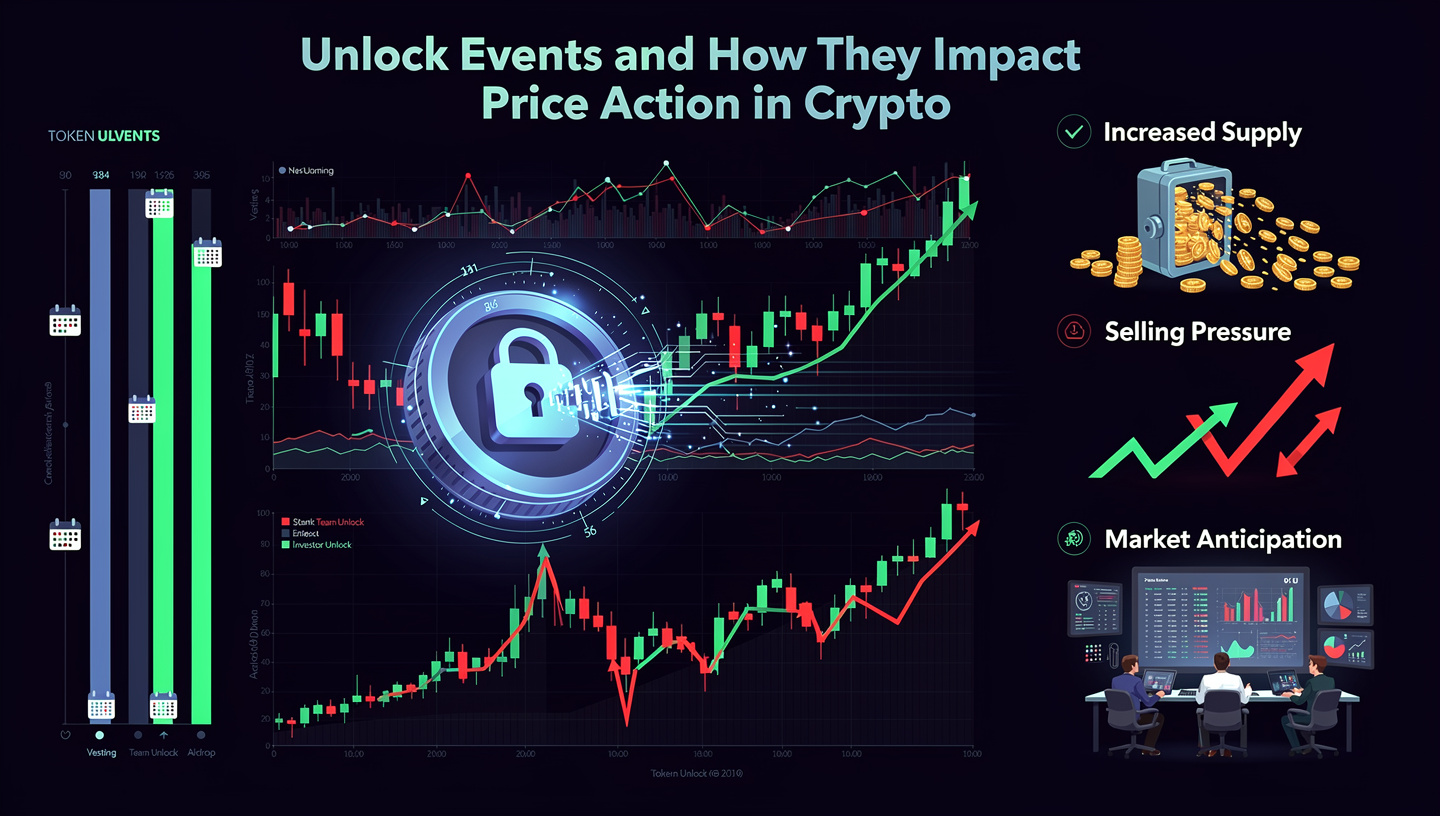
In practice, unlocks affect price action through three channels:
- Mechanical supply increase
- Psychological anticipation
- Strategic positioning by large holders
The market often reacts before the unlock happens — sometimes weeks in advance.
3. Types of Unlock Events and Their Market Significance
Not all unlocks are equal. Understanding who receives the tokens is critical.
3.1 Team and Founder Unlocks
These are the most scrutinized unlocks in the market.
Why?
- Teams have the highest cost basis advantage
- Selling pressure is perceived as loss of confidence
- Market participants fear insider exits
Even when teams publicly commit not to sell, the market often prices in the option to sell.
Key Insight:
Markets trade incentives, not promises.
3.2 Investor Unlocks (VC and Private Rounds)
Venture capital unlocks are structurally different.
VCs:
- Have fiduciary obligations
- Often rebalance portfolios
- May sell partially to de-risk
However, sophisticated funds may also:
- Hedge exposure before unlocks
- Use OTC desks instead of public markets
This creates complex, non-linear price behavior that is difficult to read without context.
3.3 Ecosystem and Incentive Unlocks
Tokens released for:
- Staking rewards
- Liquidity mining
- User incentives
These unlocks introduce continuous sell pressure, rather than sharp shocks.
Their impact is cumulative, not event-driven.
4. The Unlock–Price Relationship: What Data Actually Shows
Contrary to popular belief, unlocks do not guarantee immediate price crashes. The relationship is more nuanced.
Common Observed Patterns
- Pre-unlock sell-off
Traders front-run expected dilution - Unlock-day volatility spike
Liquidity increases, spreads tighten, volatility rises - Post-unlock stabilization or rebound
Once uncertainty clears, price may recover
The worst price action often occurs before the unlock, not after.
5. Unlock Size Matters More Than Absolute Numbers
The market does not react to token counts. It reacts to relative supply expansion.
Critical metrics include:
- Unlock as % of circulating supply
- Unlock as % of average daily volume
- Unlock value relative to market cap
A 5% circulating supply unlock in a low-liquidity asset is far more disruptive than a larger unlock in a deep market.
6. Liquidity: The Silent Variable
Unlocks are fundamentally a liquidity stress test.
Ask one question:
Can the market absorb this supply without repricing the asset?
If the answer is no, price must move.
Low-liquidity environments amplify unlock impact. This is why small-cap and mid-cap tokens experience more violent reactions than large-cap assets.
7. Unlock Events vs. Bitcoin’s Monetary Philosophy
Bitcoin has no unlocks. No vesting cliffs. No insider supply schedules.
Its supply is:
- Algorithmic
- Transparent
- Globally distributed
This is not a design accident. It is the foundation of its monetary credibility.
In contrast, many tokens function more like equity with delayed issuance, yet trade as if they were scarce commodities.
This mismatch between perceived scarcity and actual future supply is where mispricing occurs.
8. How Professional Traders Position Around Unlocks
Institutional and professional actors rarely wait for unlock day.
Common strategies include:
- Gradual de-risking weeks before unlocks
- Basis trades using derivatives
- Delta-neutral hedging
- Accumulation after forced selling concludes
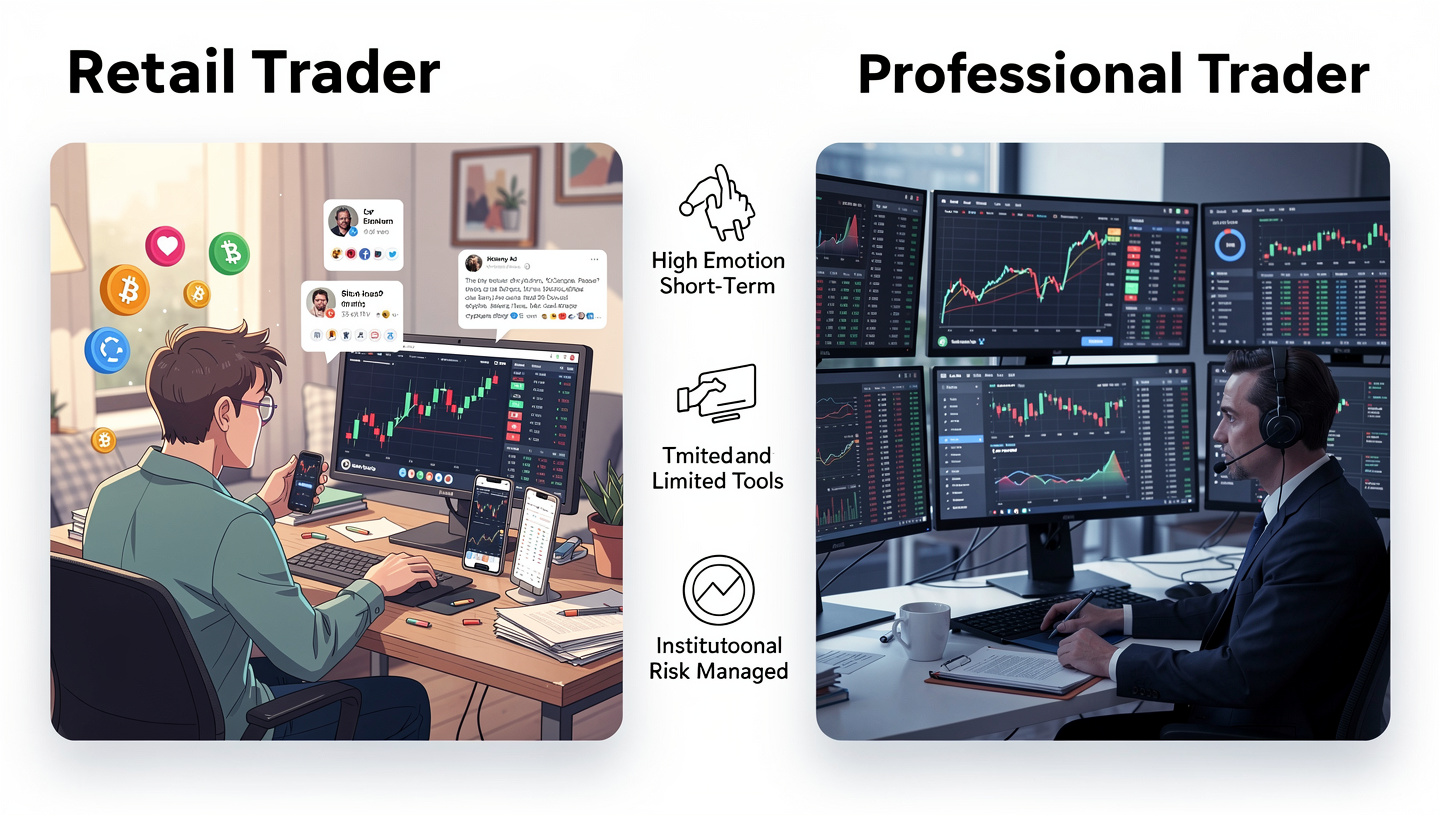
Retail traders often enter too early or panic too late.
9. Interpreting Unlocks in Bull vs. Bear Markets
Market regime matters.
In Bull Markets:
- Unlocks may be absorbed with minimal impact
- Strong demand masks dilution
- Price recovers faster
In Bear Markets:
- Unlocks exacerbate downtrends
- Liquidity is thin
- Confidence is fragile
Unlocks are trend accelerators, not trend creators.
10. Unlock Calendars: Useful, but Incomplete
Many investors rely on unlock calendars. These are necessary — but insufficient.
Calendars show when tokens unlock, not:
- Whether holders intend to sell
- How tokens are distributed
- What hedging already occurred
Unlock data must be combined with:
- On-chain flows
- Exchange balances
- Derivatives positioning
11. The Long-Term Investor’s Perspective
For long-term capital allocators, unlocks are not noise — they are valuation events.
They force the investor to confront questions such as:
- Is the current valuation justified post-dilution?
- Does demand grow faster than supply?
- Are incentives aligned after vesting completes?
Projects that survive full vesting often emerge stronger. Projects that do not were never investable to begin with.
Final Synthesis: Unlocks Reveal the Truth Beneath the Narrative
Token unlock events strip away illusion.
They expose:
- Real incentive structures
- True supply dynamics
- Market depth and conviction
Price action around unlocks is not random. It is the market’s way of repricing reality.
In a space obsessed with stories, unlocks are one of the few moments where math overrules mythology.
The disciplined investor does not fear unlocks.
They study them.
They model them.
They respect them.
Because in the end, scarcity is not what you say — it is what survives dilution.