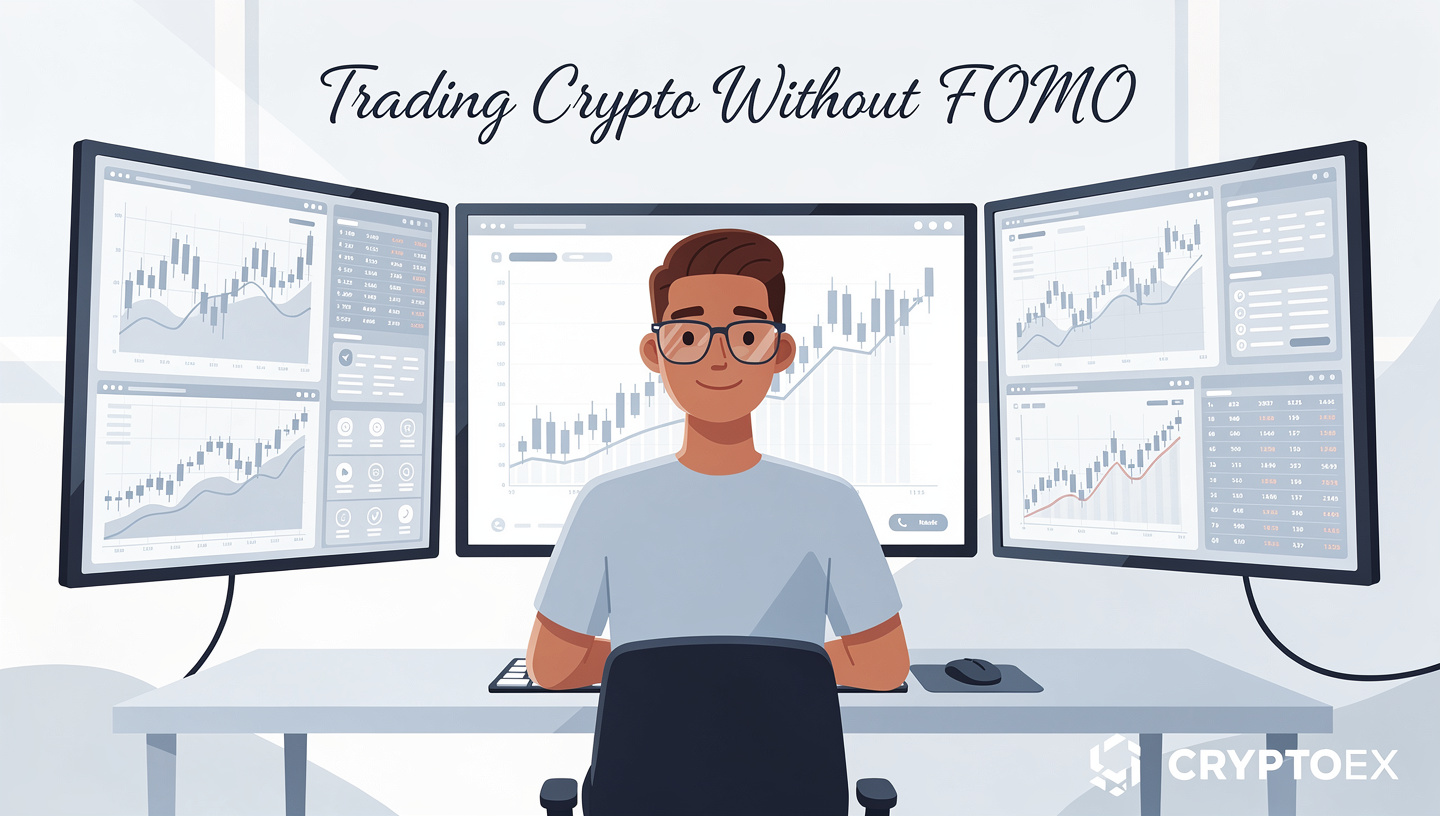
Every candle is a collective reflex: anticipation colliding with fear, greed wrestling with regret. Crypto simply compresses this psychological theater into shorter timeframes and higher volatility. What traditional finance stretches over quarters, crypto executes in minutes. That compression is why FOMO—fear of missing out—feels louder here than anywhere else.
If you trade crypto long enough, you discover an uncomfortable truth: price is rarely your biggest enemy. Your nervous system is.
This article is about building immunity to that reflex. Not through platitudes. Through structure, data, and deliberate process.
What FOMO Actually Is (And Why Crypto Amplifies It)
FOMO is not just emotional weakness. It is a hard-wired survival heuristic.
Your brain evolved to respond to scarcity and momentum. When something appears to be escaping you, the limbic system overrides the prefrontal cortex. In markets, this manifests as:
- Entering late into extended moves
- Oversizing positions after confirmation candles
- Abandoning risk management because “this one feels different”
- Chasing green after weeks of discipline
Crypto amplifies this because of four structural characteristics:
- 24/7 trading – no closing bell to cool off
- Extreme convexity – small coins can move 30–100% in days
- Narrative velocity – social media propagates hype instantly
- Low friction access – one tap on an exchange, and you’re in
Traditional equities at least slow you down. Crypto does not.
Retail traders often encounter this environment through platforms like Binance or Coinbase, where execution is immediate and leverage is readily available. That convenience is a double-edged sword.
Speed magnifies impulsivity.
The Myth of the Perfect Entry
Most FOMO begins with a false premise: that there exists a perfect entry you must capture.
There isn’t.
Professional traders think in ranges, distributions, and expectancy, not magic prices. They accept that:
- You will miss moves
- You will enter imperfectly
- You will sometimes watch price run without you
None of these invalidate your strategy.
Retail traders, by contrast, anchor emotionally to candles they didn’t buy.
That anchoring becomes the seed of revenge trading.
You see a breakout. You hesitate. Price runs. Dopamine spikes. Suddenly your brain reframes the market as something that owes you participation. This is where discipline collapses.
The antidote is simple but uncomfortable:
Your job is not to catch moves. Your job is to execute a system.
FOMO Is a Process Failure, Not an Emotional One
People frame FOMO as a feeling. It isn’t.
It’s the absence of pre-commitment.
When you don’t define your rules ahead of time, emotions fill the vacuum. Every impulsive entry is evidence that:
- Your setup criteria are vague
- Your position sizing is discretionary
- Your invalidation levels are negotiable
A trader with a written playbook does not ask:
“Should I buy this?”
They ask:
“Does this meet conditions A, B, and C?”
If it doesn’t, they stand down—regardless of what Twitter is screaming.
Structure removes temptation.
The Hidden Cost of Chasing
Late entries don’t just reduce profit. They destroy risk asymmetry.
Consider a typical FOMO scenario:
- Price has already moved 20–40%
- Volatility has expanded
- Funding rates are elevated
- Social sentiment is euphoric
You enter here.
Your upside is capped because much of the move is already priced in. Your downside is enlarged because pullbacks are now statistically more likely. You have inverted your reward-to-risk profile.
This is why FOMO trades feel stressful even when they’re green.
You subconsciously know the edge is gone.
Narrative Traps and Celebrity Gravity
Crypto is uniquely susceptible to narrative contagion.
A single tweet from someone like Elon Musk can ignite speculative flows within seconds. Retail traders often mistake this attention spike for fundamental value.
They are not the same.
Narratives are accelerants, not foundations. They bring liquidity and volatility—but they do not guarantee sustainability.
If your trading thesis depends on social momentum alone, you are not trading markets. You are trading psychology at scale.
That is an unstable game.
Building a FOMO-Resistant Trading Framework
Let’s move from diagnosis to construction.
This is the core architecture used by consistently profitable crypto traders.
1. Define Your Market Regime
Every strategy only works in specific conditions:
- Trend-following performs in expansion phases
- Mean reversion works in ranges
- Breakout strategies require volatility compression
Before any trade, classify the environment:
- Is this trending or ranging?
- Is volatility expanding or contracting?
- Is liquidity deep or thin?
If you cannot answer these, you have no business entering.
2. Trade Levels, Not Candles
FOMO lives inside candles.
Professionals trade levels:
- Prior highs/lows
- Volume nodes
- VWAP bands
- Daily and weekly closes
Levels provide context. Candles provoke reaction.
Mark your zones in advance. Wait for price to come to you.
3. Pre-Define Risk Before Entry
Every trade should be fully specified before execution:
- Entry zone
- Invalidation level
- Position size
- Target structure
If any of these are missing, you are gambling.
Risk comes first. Profit is a byproduct.
4. Use Fixed Position Sizing
Variable sizing based on conviction is emotional leakage.
Adopt a fixed risk model:
- 0.5%–1% account risk per trade for active strategies
- Smaller for high-volatility alts
This ensures no single impulse can materially damage your equity curve.
Why Most Traders Overtrade
Overtrading is rarely greed. It is boredom combined with uncertainty.
Crypto’s constant motion creates the illusion that opportunity is always present. It isn’t.
Professional traders may take only 2–5 high-quality setups per week. Retail traders often take 5 per day.
More trades do not equal more profit. They equal more exposure to randomness.
Your edge exists only in specific conditions. Outside those conditions, you are just paying fees.
Journaling: The Most Ignored Alpha
If you are not journaling your trades, you are operating blind.
A proper trading journal tracks:
- Setup type
- Entry rationale
- Emotional state
- Execution quality
- Post-trade analysis
Patterns emerge quickly:
- You’ll see which setups perform
- You’ll identify recurring mistakes
- You’ll quantify how FOMO impacts results
This is how you convert subjective experience into objective feedback.
Without this loop, improvement is accidental.
The Institutional Mindset Gap
Retail traders chase excitement.
Institutions manage risk.
Public companies like MicroStrategy accumulate crypto using structured treasury strategies, not impulse buys. Regulators such as the U.S. Securities and Exchange Commission focus on custody, disclosures, and compliance—because survivability matters more than upside.
The contrast is instructive.
Long-term winners optimize for staying power.
Short-term speculators optimize for dopamine.
Choose your category.
Practical Anti-FOMO Protocols
Here are operational techniques used by disciplined traders:
Hard Entry Rules
No market orders. Ever. Use limit entries at predefined levels.
Cooldown Periods
After any impulsive urge, wait 15 minutes. Most bad trades die in that window.
Maximum Trades Per Day
Set a hard cap. When it’s reached, you’re done.
Red Day Lockout
If you hit your daily loss limit, stop trading. Protect mental capital.
Scheduled Market Scans
Scan at fixed times. Do not react continuously.
These constraints create friction. Friction creates discipline.
Why Missing a Move Is a Feature
This will sound counterintuitive:
Missing trades is essential.
It forces selectivity. It reinforces patience. It preserves emotional neutrality.
The market offers infinite opportunities over time. Your capital—and your focus—are finite.
Every move you skip is energy saved for the one that fits your model.
The Endgame: Process Over Outcome
Traders who escape FOMO do not become emotionless. They become procedural.
They judge themselves by:
- Did I follow my rules?
- Did I size correctly?
- Did I respect invalidation?
They do not judge themselves by P&L on any single trade.
This is the shift from amateur to professional.
Once you internalize this, FOMO loses its grip.
Price can run without you.
You will still be here tomorrow.
Final Thoughts
Crypto rewards preparation and punishes impulsivity with ruthless efficiency.
FOMO thrives in ambiguity. It dissolves under structure.
If you want longevity in this market, stop chasing candles. Build systems. Define risk. Accept missed opportunities as part of the business. Let others react to noise while you operate from framework.
The goal is not to catch every move.
The goal is to survive long enough to compound the good ones.
That is how you trade crypto without FOMO.