Decentralized systems are often presented as purely technical artifacts: cryptographic primitives, consensus mechanisms, incentive models, and governance frameworks. Yet anyone who has spent time inside crypto-native communities knows this is only half the picture.
The other half is myth.
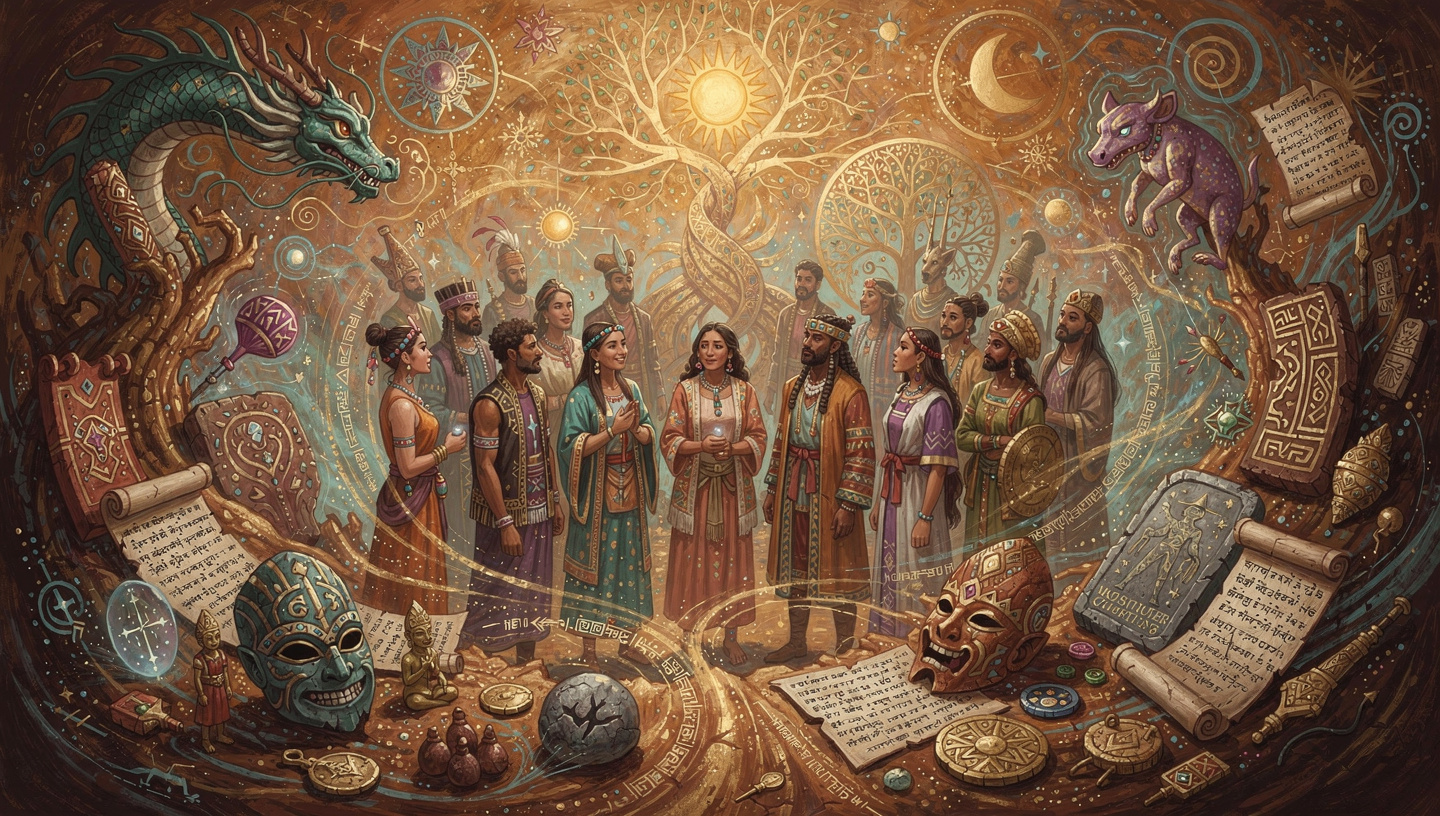
Not myth in the sense of falsehood—but myth as a meaning-making substrate. Shared origin stories. Hero figures. Sacred texts (whitepapers). Ritualized events (forks, halvings, upgrades). Moral archetypes (builders vs. rent-seekers). These narrative structures operate beneath the code, shaping collective behavior, identity, and long-term cohesion.
In worldbuilding terms, decentralized cultures are not just economies. They are civilizations in miniature.
This article examines how myth functions inside crypto ecosystems: why it emerges, what forms it takes, how it governs behavior without coercion, and what this implies for designing future decentralized societies. We will move across anthropology, sociology, protocol design, and cultural theory to understand how belief systems arise in stateless digital worlds—and why they matter more than most engineers realize.
Myth as Infrastructure
Traditional states rely on formal institutions: courts, police, legislatures, taxation. Decentralized networks lack these centralized enforcement mechanisms. Instead, they depend on voluntary participation and emergent coordination.
Myth fills the gap.
In anthropology, myth is not entertainment—it is infrastructure. It encodes values, legitimizes authority, and establishes boundaries of acceptable behavior. As articulated by Joseph Campbell, myths provide a symbolic framework through which communities interpret their place in the world.
Crypto communities independently reinvent this dynamic.
A protocol may define transaction validity. Myth defines purpose.
A blockchain may enforce rules. Myth explains why those rules matter.
Without shared narratives, decentralized systems degrade into purely transactional networks—liquid, efficient, and culturally hollow. With myth, they become civilizations.
The Founding Myth: Disappearance as Authority
Every decentralized culture begins with an origin story.
Crypto’s most powerful founding myth centers on Satoshi Nakamoto.
The creator appears, releases a protocol, communicates briefly, then vanishes.
This absence is not incidental—it is foundational.
By removing themselves, Satoshi created a vacuum where no central figure could claim ownership. The protocol was orphaned into the commons. Authority became embedded in code rather than personality.
From a mythic perspective, this mirrors ancient archetypes: the lawgiver who ascends the mountain and never returns; the divine messenger who delivers fire and disappears.
The disappearance establishes legitimacy precisely because it prevents capture.
In decentralized cultures, absence becomes sovereignty.
This pattern repeats across ecosystems. Projects with visible, charismatic founders tend to centralize socially even if they decentralize technically. Projects whose creators recede allow the network to mythologize the protocol itself.
The lesson for worldbuilders is direct: if you want durable decentralization, design for founder disappearance.
Whitepapers as Sacred Texts
Every civilization has canonical documents.
Crypto has whitepapers.
These texts function as more than technical specifications. They are interpreted, debated, quoted, and referenced as moral authority. Disagreements over protocol direction often become hermeneutic exercises: what did the original text mean?
This mirrors religious exegesis.
In decentralized cultures, whitepapers serve three roles:
- Cosmology – explaining how the system works.
- Ethics – defining what the system values.
- Legitimacy – anchoring future decisions to an origin narrative.
Over time, secondary literature emerges: blog posts, improvement proposals, and community commentary. These resemble commentaries layered atop scripture.
The technical surface is thin. The symbolic depth is immense.
Forks as Schisms
When centralized organizations fracture, they reorganize.
When decentralized protocols fracture, they fork.
Forks are not merely software events. They are cultural schisms.
Each side claims continuity with the original vision. Each develops its own mythology. Over time, diverging histories solidify into separate identities.
This mirrors religious splits: shared origins, incompatible interpretations.
Importantly, forks externalize disagreement. Instead of forcing consensus, decentralized systems allow communities to separate peacefully, each carrying its version of the myth forward.
From a governance standpoint, this is radical.
Rather than suppress dissent, crypto encodes exit.
Myth provides the narrative justification for which fork is “true.” Code merely executes the separation.
Decentralized Organizations and the Problem of Meaning
Structures like The DAO attempted to formalize governance through smart contracts alone. The experiment demonstrated a critical limitation: code cannot replace culture.
Purely algorithmic coordination lacks symbolic grounding.
After The DAO collapse, communities began embedding richer narratives into governance frameworks—mission statements, value declarations, social norms, and cultural rituals. Technical design alone proved insufficient.
Later institutions, supported by groups such as the Ethereum Foundation, invested heavily in narrative coherence: emphasizing openness, experimentation, and long-term stewardship.
The shift was subtle but decisive.
Decentralization without myth produces brittle systems.
Decentralization with myth produces societies.
Archetypes in Crypto Culture
Decentralized ecosystems consistently reproduce recognizable archetypes:
- The Builder – creates tools, protocols, and infrastructure.
- The Maximalist – defends a single chain as ultimate truth.
- The Evangelist – spreads adoption through narrative.
- The Skeptic – challenges assumptions and exposes flaws.
- The Speculator – extracts value without cultural attachment.
These roles are not assigned. They emerge organically.
Each archetype serves a functional purpose. Builders advance capability. Skeptics prevent stagnation. Evangelists grow networks. Even speculators provide liquidity.
Myth organizes these roles into moral hierarchies. Builders are praised. Parasites are condemned. Narratives reward behaviors aligned with the collective future.
This moral economy substitutes for centralized enforcement.
Symbolism and Visual Identity
Logos, mascots, memes, and iconography form a decentralized heraldry.
These symbols perform three functions:
- Recognition – signaling group membership.
- Compression – encoding complex ideology into simple visuals.
- Transmission – spreading values virally across platforms.
Memes are not trivial artifacts. They are high-bandwidth cultural packets.
A successful meme can propagate governance philosophy faster than any formal document.
Worldbuilders should treat symbolic design as first-class infrastructure.
Myth as Economic Coordination Layer
Token incentives explain how value moves.
Myth explains why participants care.
People hold volatile assets not purely for rational reasons, but because they believe in futures articulated through narrative: financial sovereignty, censorship resistance, open access, or post-national identity.
This belief converts speculation into participation.
It also stabilizes communities during downturns. Markets crash; myths persist.
In this sense, myth functions as an economic shock absorber.
Without it, decentralized systems would collapse under volatility.
Decentralized Time: Rituals and Cycles
Crypto cultures mark time differently.
Events like halvings, upgrades, and conferences act as calendrical anchors. Communities gather virtually or physically, reaffirming shared identity.
These rituals mirror agricultural festivals or religious holidays—periodic reinforcement of collective memory.
They also synchronize expectations.
Ritualized time creates predictability in otherwise chaotic systems.
Designing Myth Intentionally
Most crypto myths emerge accidentally.
Future decentralized civilizations will design them deliberately.
Key principles:
1. Encode Values Early
Narratives solidify quickly. Establish core ethics at genesis.
2. Minimize Personal Centrality
Myth should orbit protocols, not personalities.
3. Allow Interpretive Flexibility
Rigid doctrine fractures communities. Leave space for evolution.
4. Build Ritual into Architecture
Governance cycles, upgrade ceremonies, and community milestones should be structural, not ad hoc.
5. Respect Symbolic Layering
Technical primitives need cultural counterparts.
Worldbuilding Implications: Toward Post-State Societies
Crypto is not merely financial infrastructure. It is a laboratory for stateless civilization.
As nation-states lose monopoly over identity and coordination, decentralized cultures will increasingly compete with traditional political structures. Their success will hinge less on throughput and more on mythic coherence.
Future worlds may not pledge allegiance to flags, but to protocols.
Citizenship may be defined by wallet signatures.
Law may emerge from smart contracts.
But meaning will still require stories.
The next generation of worldbuilders—protocol architects, DAO designers, cultural engineers—must recognize this.
You are not just shipping software.
You are founding civilizations.
Conclusion: Myth Is the Missing Layer
Decentralization removes central authority.
Myth replaces it.
In crypto-native cultures, myth performs the work once handled by states: legitimizing power, coordinating behavior, preserving identity across generations of users.
Ignoring this layer leads to fragile systems. Embracing it enables resilient, value-aligned networks capable of surviving market cycles, governance crises, and technological upheaval.
The future of decentralized society will not be determined solely by cryptography.
It will be determined by the stories we choose to tell—and believe.