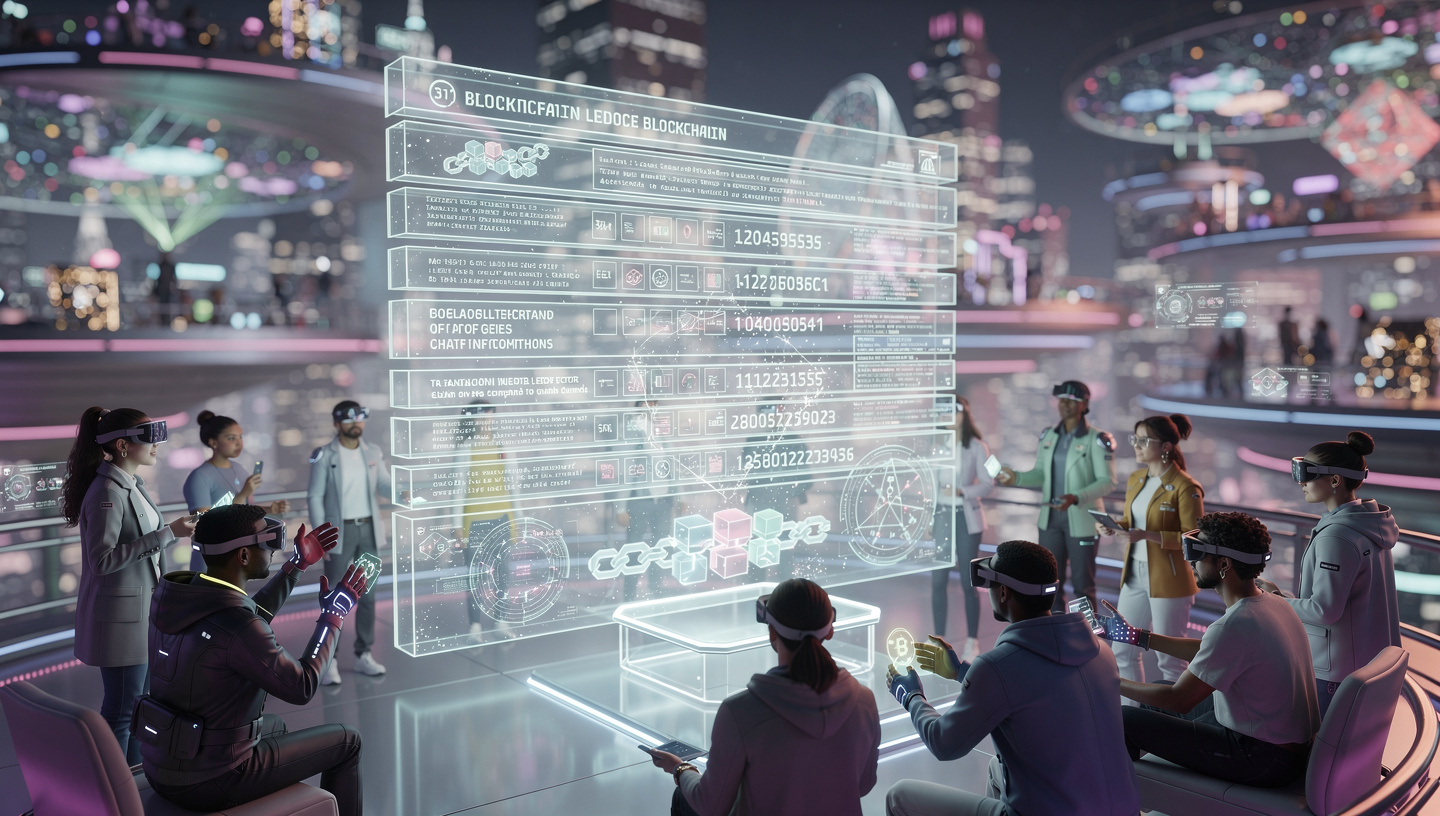
When people hear the word metaverse, they often imagine flashy VR headsets, cartoon avatars, and virtual real estate selling for absurd prices. But beneath the hype and spectacle lies a deeper truth:
The metaverse is not just a visual experience. It is an economic, social, and technological system.
And like any functioning system—especially one that aims to host millions or even billions of users—it requires something far more fundamental than immersive graphics:
It needs trust, ownership, and coordination at scale.
This is where blockchain enters the picture.
Blockchain is not merely an add-on to the metaverse. It is rapidly becoming the structural backbone that allows digital worlds to function as open, persistent, and user-owned environments rather than closed, corporate-controlled platforms.
In this article, we will explore:
- Why the metaverse cannot reach its full potential without blockchain
- How blockchain enables true digital ownership
- The economic, social, and governance layers blockchain introduces
- Real-world use cases already shaping virtual worlds
- The challenges and unresolved tensions ahead
Together, these elements reveal something profound:
Blockchain is not just powering the metaverse — it is redefining what digital civilization can look like.
1. The Core Problem of the Metaverse: Who Owns the Digital World?
Before blockchain, most digital environments followed a familiar pattern:
- Platforms own the data
- Platforms control the rules
- Users rent access
- Digital assets can disappear overnight
Whether it was social media, online games, or virtual communities, ownership was always centralized.
If a company shut down a server:
- Your items vanished
- Your progress disappeared
- Your digital identity was erased
This model works for entertainment, but it fails catastrophically for a metaverse that claims to be:
- Persistent
- Interoperable
- Economically meaningful
A true metaverse cannot be built on temporary permissions.
It requires:
- Verifiable ownership
- Persistent identity
- Transferable value
Blockchain provides exactly these primitives.
2. Blockchain as the Ledger of Digital Reality
At its core, blockchain is a shared, tamper-resistant ledger.
In the context of the metaverse, this ledger becomes something far more powerful:
A global record of who owns what, who did what, and what rules apply — without relying on a single authority.
What Blockchain Records in the Metaverse
- Ownership of virtual land and objects
- Transaction history of digital assets
- Identity credentials and reputation
- Governance decisions and voting outcomes
Instead of trusting a platform’s internal database, users can verify everything independently.
This shift transforms the metaverse from a service into a shared reality.
3. Digital Ownership: From Licenses to Property
Perhaps the most revolutionary contribution of blockchain to the metaverse is true digital ownership.
NFTs as Property Rights
Non-fungible tokens (NFTs) represent unique digital assets stored on a blockchain. In the metaverse, NFTs can represent:
- Virtual land parcels
- Avatars and skins
- Wearables and tools
- Art, music, and experiences
Unlike traditional in-game items:
- NFTs are owned by users, not platforms
- They can be sold, traded, or transferred freely
- Ownership persists even if a platform disappears
This is not cosmetic ownership — it is property law for digital space.
Why This Matters
Ownership changes behavior:
- Users invest time and creativity
- Communities build long-term value
- Economies become sustainable
The metaverse stops being a playground and starts becoming a place.
4. Interoperability: Assets That Travel Between Worlds
One of the most powerful promises of the metaverse is interoperability — the ability to move assets and identity across platforms.
Blockchain enables this by making assets:
- Platform-agnostic
- Universally verifiable
- Programmable
Imagine:
- Wearing the same digital jacket across multiple virtual worlds
- Using a single avatar identity in different environments
- Carrying reputation and credentials wherever you go
While full interoperability is still a work in progress, blockchain is the only realistic infrastructure capable of supporting it at scale.
5. The Metaverse Economy: Programmable Money and Digital Labor
A metaverse without an economy is just a simulation.
Blockchain introduces native economic systems that are:
- Borderless
- Permissionless
- Programmable
Cryptocurrencies as Metaverse Money
Crypto tokens serve as:
- Mediums of exchange
- Stores of value
- Incentive mechanisms
They allow:
- Instant global payments
- Microtransactions
- Creator monetization without intermediaries
Smart Contracts: Economic Logic in Code
Smart contracts automate:
- Royalties for creators
- Rent for virtual land
- Revenue sharing
- Employment agreements
This allows the emergence of:
- Virtual businesses
- Digital freelancers
- Entire metaverse-native industries
The line between “game” and “job” begins to blur.
6. Identity and Reputation: Who Are You in the Metaverse?
In a decentralized metaverse, identity cannot rely on email addresses and passwords alone.
Blockchain enables self-sovereign identity, where users control:
- Their credentials
- Their history
- Their reputation
Decentralized Identity (DID)
Instead of a single login owned by a platform:
- Identity lives on the blockchain
- Credentials can be selectively shared
- Privacy is preserved
Reputation becomes portable:
- Artists carry their portfolios
- Builders carry their achievements
- Communities recognize contribution across worlds
This is the foundation for trust in open virtual societies.
7. Governance: Decentralized Worlds Need New Rules
Who makes the rules in the metaverse?
Without blockchain, governance defaults to corporations.
With blockchain, new models emerge:
- DAOs (Decentralized Autonomous Organizations)
- Token-based voting
- Community proposals
On-Chain Governance
Blockchain allows:
- Transparent rule-making
- Auditable decisions
- Collective ownership of platforms
Virtual worlds can become:
- Digital city-states
- Cooperative economies
- Self-governing communities
This is not just technical innovation — it is political experimentation in code.
8. Creativity Unleashed: The Creator Economy in the Metaverse
Blockchain empowers creators by removing traditional gatekeepers.
Artists, designers, musicians, and developers can:
- Mint their work as NFTs
- Earn automatic royalties
- Build direct relationships with audiences
In the metaverse:
- Experiences become products
- Creativity becomes capital
- Communities become markets
This creates a cultural shift:
Value flows to those who create, not just those who distribute.
9. Challenges and Unresolved Tensions
Despite its promise, blockchain-powered metaverses face real obstacles.
Scalability
- High transaction costs
- Network congestion
- Limited throughput
Layer-2 solutions and alternative chains are helping, but the problem is not fully solved.
User Experience
- Wallet complexity
- Security risks
- Steep learning curves
Mass adoption requires abstraction without sacrificing control.
Speculation vs Utility
- Asset bubbles
- Short-term hype
- Misaligned incentives
A sustainable metaverse must prioritize usefulness over speculation.
Conclusion: The Metaverse Will Be Owned — The Question Is By Whom
The future of the metaverse is not guaranteed.
It could become:
- A network of corporate theme parks
- Closed ecosystems with rented identities
Or it could become:
- An open digital commons
- A user-owned civilization
Blockchain does not guarantee the second outcome — but without it, the first is almost inevitable.
As virtual worlds grow more important to how we work, socialize, and create, the role of blockchain will only expand.
Not as hype.
Not as speculation.
But as the invisible infrastructure that makes digital freedom possible.
The metaverse is not just about escaping reality.
With blockchain, it may become a place where we finally redesign it.