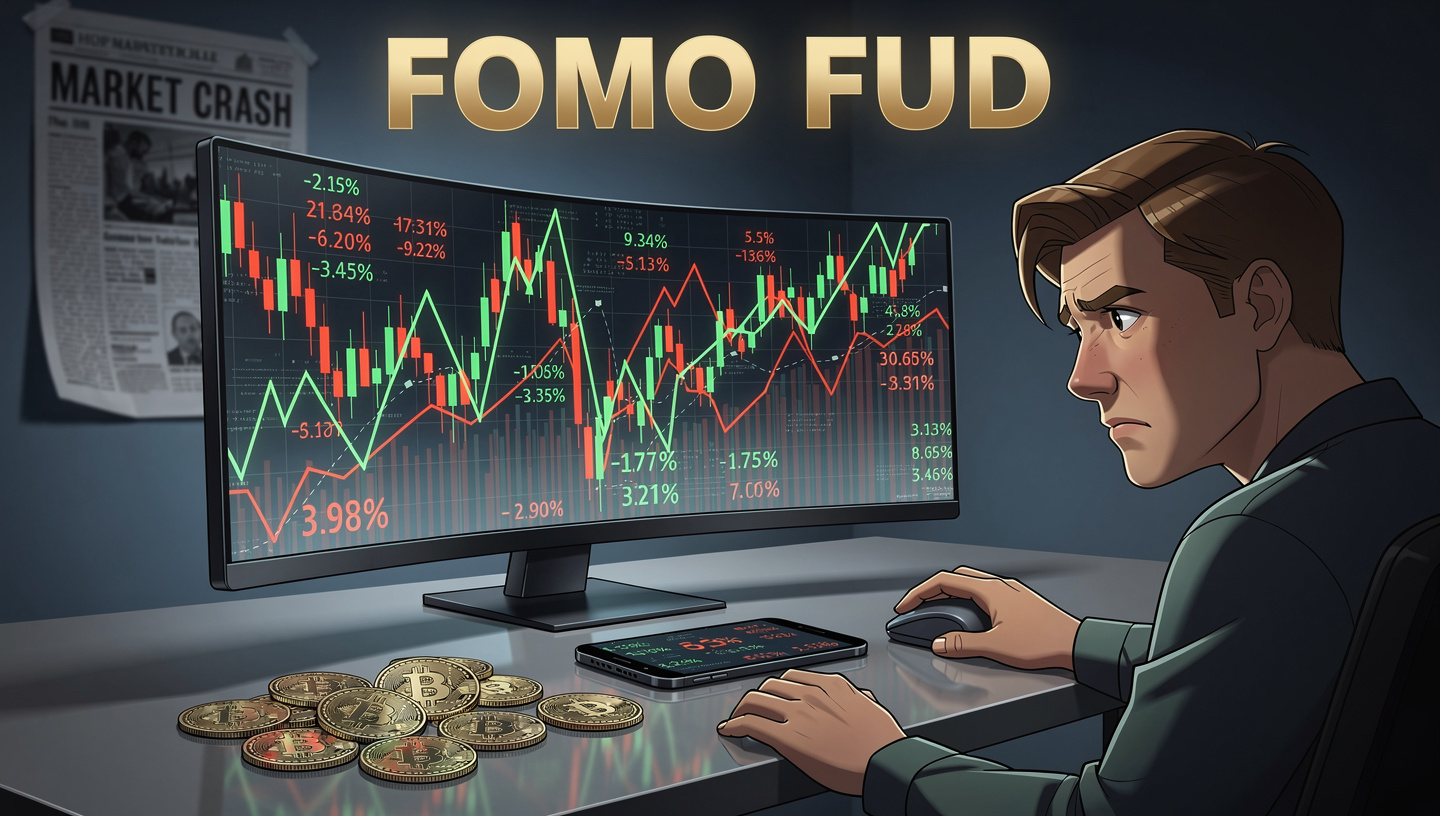
The crypto market doesn’t just trade coins.
It trades emotions.
Every green candle is a dopamine hit.
Every red candle is a punch to the gut.
Every tweet, rumor, hack, regulation headline, or “insider leak” is a psychological weapon.
And at the center of this emotional battlefield are two forces that quietly control millions of decisions every single day:
FOMO — Fear of Missing Out
FUD — Fear, Uncertainty, and Doubt
They are not bugs in the system.
They are the system.
If you want to survive — and eventually thrive — in crypto, you must understand not charts first, but your own mind.
This article is not about “just don’t FOMO” or “ignore the noise.”
That advice is useless.
This is about why FOMO and FUD exist, how they hijack your brain, who benefits from them, and how professionals use psychology against retail traders — often without ever touching a chart.
1. Crypto Is a Perfect Psychological Trap
Crypto markets are uniquely designed to amplify human emotion.
Think about it:
- Trades 24/7 — no closing bell to cool down
- Extreme volatility — life-changing gains and losses in days
- Low barriers to entry — anyone with a phone and emotions can trade
- Constant information flow — Twitter, Telegram, Discord, YouTube
- No central authority — uncertainty is baked in
Traditional markets move slowly.
Crypto moves at the speed of panic and greed.
And your brain?
It evolved to survive lions on the savanna — not 5-minute candles.
2. The Ancient Brain vs the Modern Market
Your brain has two systems constantly fighting each other:
System 1: Fast, Emotional, Reactive
- Seeks pleasure
- Avoids pain
- Reacts instantly
- Hates uncertainty
System 2: Slow, Rational, Analytical
- Plans long-term
- Evaluates probabilities
- Thinks logically
- Requires effort and energy
Crypto markets are designed to overload System 1.
When price is exploding upward, your emotional brain screams:
“BUY NOW OR YOU’LL REGRET THIS FOREVER.”
When price collapses, it whispers:
“GET OUT. SOMETHING IS WRONG. SAVE YOURSELF.”
FOMO and FUD are not weaknesses.
They are default survival responses.
3. FOMO: The Addiction of Almost Being Rich
FOMO is not just fear.
It is anticipated regret.
You don’t buy because you believe.
You buy because you imagine a future where you didn’t buy — and it hurts.
The Core Thought Behind FOMO
“Everyone else is getting rich except me.”
This is incredibly powerful because it attacks identity, not logic.
FOMO tells you:
- You are late
- You are behind
- You are missing your chance
And crypto feeds this narrative perfectly:
- “Early investors”
- “Generational wealth”
- “Once-in-a-lifetime opportunity”
Your brain fills in the rest.
4. Why Green Candles Are More Dangerous Than Red Ones
Most people fear crashes.
Professionals fear euphoria.
Why?
Because green candles shut down critical thinking.
During rapid price increases:
- Risk perception drops
- Overconfidence rises
- Probability is ignored
- Narratives replace facts
You stop asking:
- “What is the downside?”
- “Who is selling to me?”
- “What has changed fundamentally?”
Instead, you ask:
- “How high can this go?”
- “What if this is the next Bitcoin?”
This is not analysis.
This is dopamine chasing.
5. Social Proof: The Loudest Psychological Weapon
Humans are social creatures.
If many people believe something, your brain assumes it must be safe.
Crypto exploits this brutally.
You see:
- Influencers posting screenshots
- Telegram groups celebrating “100x”
- Twitter timelines full of rockets and emojis
- Friends suddenly “crypto experts”
Your brain thinks:
“So many people can’t be wrong.”
But markets don’t work on democracy.
They work on liquidity.
When everyone is buying, someone smarter is selling.
6. FUD: Fear Is Louder Than Logic
If FOMO pushes you into bad entries, FUD pushes you into bad exits.
FUD is not always fake.
That’s what makes it dangerous.
It usually starts with:
- A real problem
- A partial truth
- An ambiguous event
Then it spreads emotionally.
Fear travels faster than hope.
7. Why Losses Hurt More Than Gains Feel Good
This is called loss aversion.
Psychologically:
- Losing $1,000 hurts about twice as much
- As gaining $1,000 feels good
This creates a deadly loop:
- You hold losses too long
- You sell winners too early
- You panic sell bottoms
- You hesitate at perfect entries
FUD doesn’t need to convince you the asset is worthless.
It just needs to make you uncomfortable.
8. Uncertainty Is the Real Enemy
Markets don’t move on facts alone.
They move on confidence vs uncertainty.
When uncertainty spikes:
- People seek safety
- Rational thinking collapses
- Short-term decisions dominate
Crypto has endless uncertainty:
- Regulations
- Hacks
- Founder drama
- Smart contract risks
- Macro conditions
FUD thrives not on bad news — but unclear news.
9. Who Benefits From Your FOMO and FUD?
This is uncomfortable but important.
Every emotional trade has a counterparty.
When you buy in panic:
- Someone planned that exit weeks ago
When you sell in fear:
- Someone patiently waited for that discount
Large players understand psychology better than charts.
They know:
- Where retail panics
- Where retail gets greedy
- Where stop losses cluster
- Where narratives peak
Markets are not evil.
But they are indifferent to your feelings.
10. Narratives: The Storytelling Layer of Psychology
Humans think in stories, not statistics.
Crypto narratives are psychological shortcuts:
- “This is the next Ethereum”
- “Institutional adoption is coming”
- “This time is different”
- “They don’t want you to know this”
Narratives simplify complexity.
They make uncertainty tolerable.
But narratives peak at tops — and collapse at bottoms.
Price leads narrative, not the other way around.
11. The Media’s Role in Amplifying Emotion
Crypto media doesn’t sell truth.
It sells attention.
Fear and greed get clicks.
Notice the pattern:
- Bull markets → “Why This Coin Could Go 10x”
- Bear markets → “Is Crypto Dead Forever?”
The same asset.
Different emotional framing.
Your brain reacts to headlines faster than it reads whitepapers.
12. Why “Strong Hands” Are Rare
Everyone wants to be a long-term holder.
Until volatility shows up.
Strong hands are not about conviction.
They are about emotional regulation.
They:
- Pre-decide risk
- Accept drawdowns
- Ignore noise
- Think in probabilities, not certainties
Weak hands react.
Strong hands respond.
13. How Professionals Immunize Themselves
Professionals don’t eliminate emotion.
They structure around it.
They use:
- Position sizing
- Predefined exits
- Time horizons
- Rules, not feelings
They assume:
“I will feel fear and greed.
So I design a system that doesn’t need my emotions.”
Retail traders assume:
“I will control myself this time.”
That’s the difference.
14. The Illusion of Control
One of the most dangerous beliefs in crypto:
“I understand the market now.”
The more confident you feel, the more vulnerable you are.
Markets punish certainty.
They reward humility.
15. Mastery Is Boring — And That’s the Point
FOMO and FUD thrive on excitement.
Professional behavior looks boring:
- No chasing pumps
- No panic selling
- No emotional tweets
- No obsession with every candle
Boring is stable.
Boring survives.
16. A New Relationship With the Market
You don’t need to conquer FOMO and FUD.
You need to recognize them without obeying them.
When you feel FOMO, ask:
- “What am I afraid of missing?”
- “Is this urgency real or emotional?”
When you feel FUD, ask:
- “What has objectively changed?”
- “Would I buy here if I had no position?”
Emotion is information — not instruction.
17. The Final Truth Most People Avoid
Crypto is not a technical game first.
It is a psychological endurance test.
Most people don’t lose money because they lack intelligence.
They lose because they:
- Enter too late
- Exit too early
- Overtrade
- Underestimate themselves
The market doesn’t need to trick you.
Your own brain does that for free.
Closing Thoughts: The Real Alpha
The greatest edge in crypto is not:
- Faster news
- Better indicators
- Secret groups
It is self-awareness.
When you understand FOMO and FUD, you stop being prey.
You stop donating liquidity.
You stop chasing ghosts.
You trade less.
You think more.
You survive long enough to matter.
And in crypto, survival is alpha.