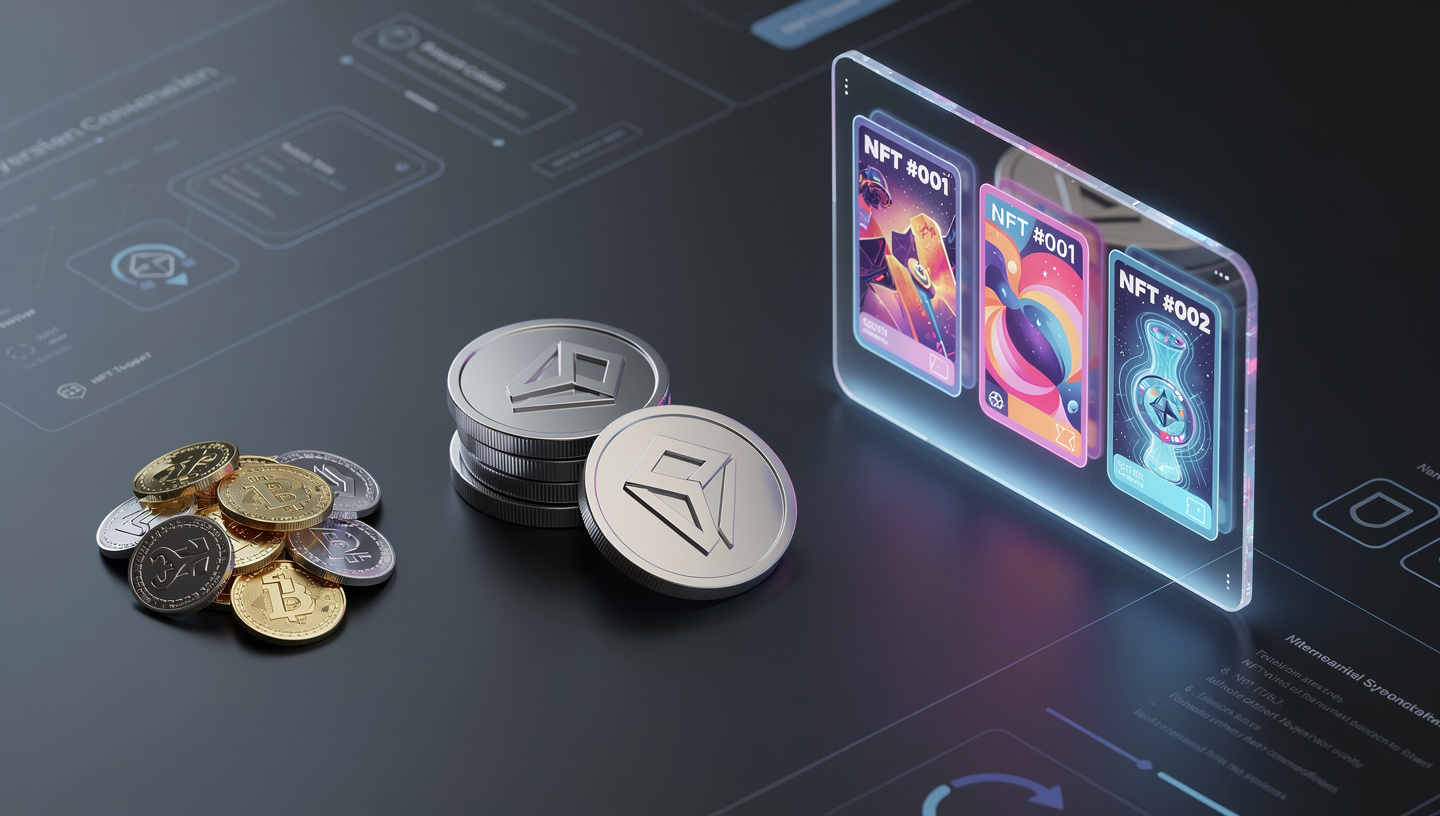
If you’ve spent more than five minutes in the crypto space, you’ve probably heard people casually throw around words like coin, token, and NFT—sometimes even using them interchangeably. And at first glance, it’s easy to see why. They all live on blockchains. They all can have prices. They all can be bought, sold, and owned.
But under the surface, these three things are fundamentally different creatures.
Understanding the difference between coins, tokens, and NFTs isn’t just crypto trivia. It’s the difference between understanding money vs infrastructure, ownership vs access, and fungibility vs uniqueness. It’s the difference between knowing what you’re actually holding and blindly following a ticker symbol.
This article will break it all down—from first principles to real-world examples—so that by the end, you’ll never confuse these concepts again.
1. Start With the Blockchain: The Ground Everything Stands On
Before we define coins, tokens, or NFTs, we need to understand where they live.
A blockchain is not just a database—it’s a sovereign system. It defines:
- How transactions are validated
- Who can participate
- What assets can exist
- What rules those assets must obey
Some blockchains are like entire countries with their own currencies and laws. Others are more like operating systems that allow thousands of applications to run on top of them.
This distinction is critical—because coins belong to blockchains, while tokens and NFTs are created on blockchains.
That single sentence already hints at the core difference.
2. What Is a Coin?
The Native Money of a Blockchain
A coin is the native asset of a blockchain.
It is not built on the blockchain—it is built into the blockchain.
Key Characteristics of Coins
- They have their own blockchain
- They are used to pay transaction fees
- They often act as money within that ecosystem
- They are essential for network security
Real Examples
- Bitcoin (BTC) → Native coin of the Bitcoin blockchain
- Ether (ETH) → Native coin of Ethereum
- Solana (SOL) → Native coin of Solana
- BNB → Native coin of BNB Chain
You cannot use Ethereum without ETH. You cannot move Bitcoin without BTC. These coins are the fuel that keeps the network alive.
What Coins Actually Do
Coins typically serve four main roles:
- Medium of exchange – used to transfer value
- Gas or fees – pay validators or miners
- Security – incentivize honest behavior
- Store of value – sometimes (but not always)
Think of a coin like a country’s national currency. You can build businesses, services, and markets on top of that country—but the currency itself belongs to the nation.
3. What Is a Token?
Assets Built on Someone Else’s Blockchain
If coins are native citizens, tokens are immigrants—fully legal, incredibly useful, but dependent on the host country’s infrastructure.
A token is a digital asset created on top of an existing blockchain using smart contracts.
Key Characteristics of Tokens
- They do not have their own blockchain
- They rely on another blockchain’s security
- They follow standardized rules (like ERC-20)
- They can represent almost anything
Common Token Standards
- ERC-20 (Ethereum) – fungible tokens
- BEP-20 (BNB Chain)
- SPL (Solana)
These standards define how tokens behave: how they’re transferred, how balances are tracked, and how other apps interact with them.
Real Examples
- USDT, USDC – stablecoins
- UNI – governance token
- LINK – utility token
- AAVE – protocol token
None of these have their own blockchain. If Ethereum goes down, ERC-20 tokens go down with it.
What Tokens Are Used For
Tokens are insanely flexible. They can represent:
- Governance power (voting rights)
- Utility (access to services)
- Stable value (pegged currencies)
- Rewards and incentives
- Shares of a protocol’s revenue
If coins are the soil, tokens are the plants—each with different purposes, lifecycles, and economics.
4. Fungibility: The Invisible Line Between Tokens and NFTs
To understand NFTs, we need one crucial concept:
Fungibility
An asset is fungible if:
- Every unit is identical
- One unit can be replaced by another without loss of value
Examples:
- 1 BTC = 1 BTC
- 1 USDT = 1 USDT
- 1 ETH = 1 ETH
Tokens and coins are fungible by default.
NFTs are not.
5. What Is an NFT?
Ownership of Something That Cannot Be Replaced
An NFT (Non-Fungible Token) is a token that represents something unique.
Even though it uses the word “token,” an NFT behaves very differently from an ERC-20 token.
Key Characteristics of NFTs
- Each NFT is one-of-a-kind
- They have unique identifiers
- They cannot be swapped 1:1
- They often carry metadata
Common NFT Standards
- ERC-721 – fully unique tokens
- ERC-1155 – semi-fungible / hybrid tokens
Real Examples
- Digital art pieces
- Game characters or items
- Domain names (ENS)
- Event tickets
- On-chain credentials
Owning an NFT is not about owning “a token.” It’s about owning a specific token with a specific identity.
6. NFTs Are Not Just JPEGs (And Never Were)
The biggest misconception about NFTs is that they’re “just pictures.”
In reality, an NFT is closer to:
- A digital property deed
- A certificate of authenticity
- A programmable ownership record
The image is just the surface. The real value lies in:
- Provenance (who owned it)
- Scarcity (how many exist)
- Utility (what it unlocks)
- Composability (how it integrates elsewhere)
An NFT can grant:
- Access to private communities
- In-game powers
- Royalties to creators
- Identity and reputation
The JPEG is just the cover of the book.
7. Coins vs Tokens vs NFTs: A Clear Comparison
| Feature | Coins | Tokens | NFTs |
|---|---|---|---|
| Own blockchain | Yes | No | No |
| Fungible | Yes | Yes | No |
| Used for gas | Yes | No | No |
| Represent uniqueness | No | No | Yes |
| Smart contract-based | No (native) | Yes | Yes |
8. Why This Distinction Actually Matters
Understanding these differences isn’t academic—it’s practical.
For Investors
- Coins often reflect network-level value
- Tokens reflect application-level value
- NFTs reflect cultural, social, or utility value
Each follows different risk models.
For Builders
- Coins require building a blockchain
- Tokens require designing incentives
- NFTs require designing meaning
For Users
- Coins pay fees
- Tokens unlock features
- NFTs define ownership
When people say “this project’s token has no utility,” what they really mean is: the token’s role isn’t clearly defined.
9. A Mental Model That Finally Makes It Click
Think of crypto like a city:
- Coins are the city’s official currency
- Tokens are businesses, memberships, and services
- NFTs are property titles, IDs, and collectibles
You don’t pay rent with a house deed.
You don’t vote in a DAO with ETH gas.
You don’t buy coffee with a concert ticket.
Each asset exists for a different purpose.
Final Thoughts: Crypto Is Not One Thing—and That’s the Point
Coins, tokens, and NFTs are not competing ideas. They are complementary primitives—each solving a different problem of digital value.
Coins answer: How do we create neutral, global money?
Tokens answer: How do we coordinate humans and software?
NFTs answer: How do we own unique things in a digital world?
Once you see crypto through this lens, the noise fades—and the architecture becomes beautifully clear.
If crypto is building a new civilization online, then coins are its currency, tokens are its economy, and NFTs are its culture.
And now—you finally know the difference.