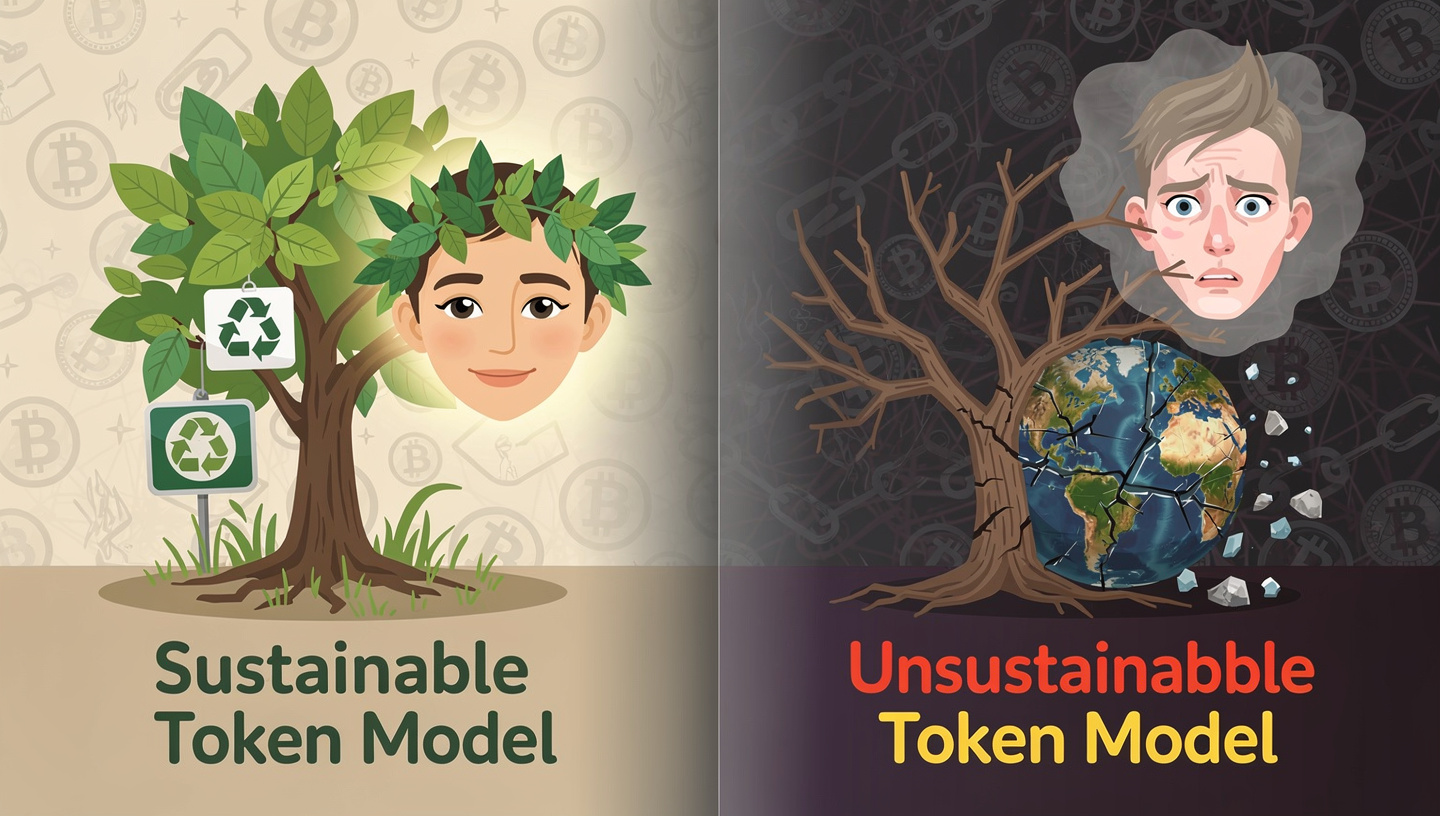
Crypto investors do not lose money because markets are volatile. They lose money because they misunderstand what a token is.
A token is not a stock.
It is not equity.
It is not inherently a store of value.
A token is a monetary system encoded in software, governed by incentives, constrained by issuance rules, and sustained—or destroyed—by human behavior over time.
This distinction is where nearly all market failures begin.
In traditional finance, unsustainable businesses eventually collapse under cash-flow pressure. In crypto, unsustainable token models collapse under economic entropy. They do not fail suddenly; they decay. Emissions dilute value. Incentives drift. Demand weakens. Reflexive narratives attempt to compensate. Eventually, price follows fundamentals.
This article provides a rigorous framework to distinguish sustainable token models from unsustainable ones, not by hype, branding, or short-term performance, but by first principles: monetary design, incentive alignment, demand durability, and resistance to entropy.
1. What Is a Token Model, Really?
A token model is the complete economic architecture governing how a digital unit:
- Is created (issuance, emissions, minting)
- Is distributed (allocations, vesting, incentives)
- Is used (utility, settlement, collateral, governance)
- Is destroyed or locked (burns, sinks, staking, bonding)
- Accrues or leaks value over time
At its core, every token model answers one question:
Why should this token be worth more tomorrow than today?
If that question does not have a structural, non-reflexive answer, the model is unsustainable—regardless of TVL, users, or narrative strength.
2. Sustainability in Crypto Is an Economic Property, Not a Moral One
“Sustainable” does not mean:
- Environmentally friendly
- Ethically superior
- Popular with institutions
- Long-lived in marketing terms
In crypto, sustainability means economic self-preservation under stress.
A sustainable token model must survive:
- Market drawdowns
- User churn
- Narrative decay
- Capital rotation
- Regulatory pressure
- Reduced speculative inflows
If a system requires constant new buyers to function, it is not sustainable. It is reflexive leverage disguised as innovation.
3. The Core Failure Pattern of Unsustainable Token Models
Most unsustainable token models share a common structure:
3.1 Emissions-Driven Growth
Tokens are printed to:
- Incentivize users
- Bootstrap liquidity
- Reward validators
- Fund ecosystem development
Emissions are not inherently bad. Unbounded or unjustified emissions are fatal.
If new tokens are issued faster than organic demand grows, dilution becomes inevitable.
Price may rise temporarily, but value per unit declines.
3.2 Circular Demand
Unsustainable models often rely on internal demand loops, such as:
- Token required to farm more of the same token
- Token staked to earn emissions paid in the same token
- Governance tokens with no economic rights
This creates activity without external value capture.
Circular demand feels productive. It is not.
3.3 Narrative Substitution
When fundamentals weaken, unsustainable projects compensate with:
- Rebranding
- New verticals
- Roadmap extensions
- “v2” tokenomics
- Metaverse / AI / RWA pivots
Narrative does not fix broken economics. It delays recognition.
4. Sustainable Token Models: First-Principle Characteristics
A sustainable token model is not defined by low volatility or constant price appreciation. It is defined by structural resilience.
Below are the non-negotiable properties.
4.1 Supply Discipline and Monetary Credibility
The strongest token models exhibit one or more of the following:
- Hard or asymptotically capped supply
- Predictable issuance schedule
- Emissions that decline over time
- Issuance directly tied to provable economic output
Monetary credibility is psychological and mathematical.
If market participants cannot reasonably model future supply, they will discount the asset indefinitely.
4.2 External Demand Anchors
Sustainable tokens have demand that originates outside the token itself, such as:
- Settlement of valuable transactions
- Payment for scarce blockspace
- Collateral for credit systems
- Access to non-replicable infrastructure
- Final settlement of economic activity
If demand disappears when incentives stop, it was never demand.
4.3 Value Capture, Not Just Value Flow
Many protocols generate fees. Fewer tokens capture them.
Sustainable models answer:
- Where does economic value accumulate?
- Who benefits from protocol success?
- How does success reduce circulating supply or increase utility?
Without a credible value capture mechanism, tokens become donation receipts.
4.4 Incentive Alignment Across Time Horizons
Unsustainable models reward:
- Early insiders disproportionately
- Short-term liquidity mercenaries
- Governance theater over accountability
Sustainable models align:
- Long-term holders
- Network security participants
- Capital providers with lockups
- Users who create real economic throughput
Time alignment matters more than yield.
5. Token Model Archetypes: A Comparative Analysis
5.1 Pure Monetary Assets
Characteristics:
- No issuer discretion
- No central emissions authority
- Primary function: store of value and settlement
Strengths:
- High monetary credibility
- Minimal governance attack surface
- Strong long-term holder alignment
Weaknesses:
- Limited expressive utility
- Slower innovation layers
These models survive because they minimize entropy vectors.
5.2 Utility Tokens with Fee Capture
Characteristics:
- Token required for protocol usage
- Fees paid in token
- Partial burn or redistribution
Strengths:
- Clear demand link
- Measurable cash-flow analogs
Risks:
- Overestimated usage
- Fee leakage to other layers
- Governance dilution
Sustainability depends entirely on real usage density, not projections.
5.3 Governance-Only Tokens (High Failure Rate)
Characteristics:
- Voting rights without economic rights
- Heavy emissions
- Narrative-driven valuation
Structural Problem:
Governance without ownership is not capital. It is labor without wages.
Most of these tokens trend asymptotically toward zero.
5.4 Yield Tokens and Synthetic Incentives
Characteristics:
- High APY
- Emissions-based rewards
- Complex token sinks
Outcome:
If yield is not funded by external revenue, it is dilution with a delay.
Mathematics always wins.
6. Token Velocity: The Silent Killer
High velocity destroys value.
If a token is:
- Earned quickly
- Sold immediately
- Rarely held
- Poorly collateralized
Then no amount of utility will preserve price.
Sustainable models intentionally slow velocity through:
- Staking with opportunity cost
- Long lockups
- Collateral utility
- Strategic illiquidity
Liquidity is not always a virtue.
7. Treasury Management and the Illusion of Runway
Projects often claim sustainability because they have:
- Large treasuries
- Long runways
- Diversified assets
This is corporate thinking applied to monetary systems.
A token model is not sustainable because the company can survive.
It is sustainable only if the token can survive without intervention.
Treasuries delay failure; they do not prevent it.
8. Evaluating Token Sustainability: A Practical Framework
Before allocating capital, ask:
- What irreducible economic function does this token serve?
- Would demand exist without incentives?
- How does supply change over 5–10 years?
- Who benefits most if the protocol succeeds?
- What happens in a prolonged bear market?
- Is value captured at the token level—or elsewhere?
If answers rely on future narratives, integrations, or “once adoption comes,” sustainability is unproven.
9. The Long Arc: Why Most Tokens Will Fail
Crypto does not fail because it is early.
It fails because economic reality is unforgiving.
History suggests:
- Most tokens trend toward zero
- A small minority capture durable value
- Survivors optimize for robustness, not excitement
Sustainable token models are boring by design. They trade optionality for certainty, leverage for resilience, and growth-at-all-costs for survivability.
Conclusion: Sustainability Is the Ultimate Alpha
In crypto, alpha is not speed.
It is not information.
It is not access.
Alpha is structural correctness.
A sustainable token model does not need constant explanation. It does not require defensive threads. It does not depend on emissions to justify existence.
It compounds quietly, resists entropy, and outlives cycles.
In the long run, markets do not reward creativity.
They reward economic truth encoded in software.
That truth is merciless.