For most of industrial history, supply chains have operated in shadows.
Raw materials moved through opaque broker networks. Factories transformed inputs behind closed doors. Distributors aggregated inventory using proprietary systems. Retailers sold finished goods with little verifiable provenance. Consumers trusted labels. Regulators trusted paperwork. Auditors trusted samples.
Trust was assumed because verifying everything was impossible.
That assumption is collapsing.
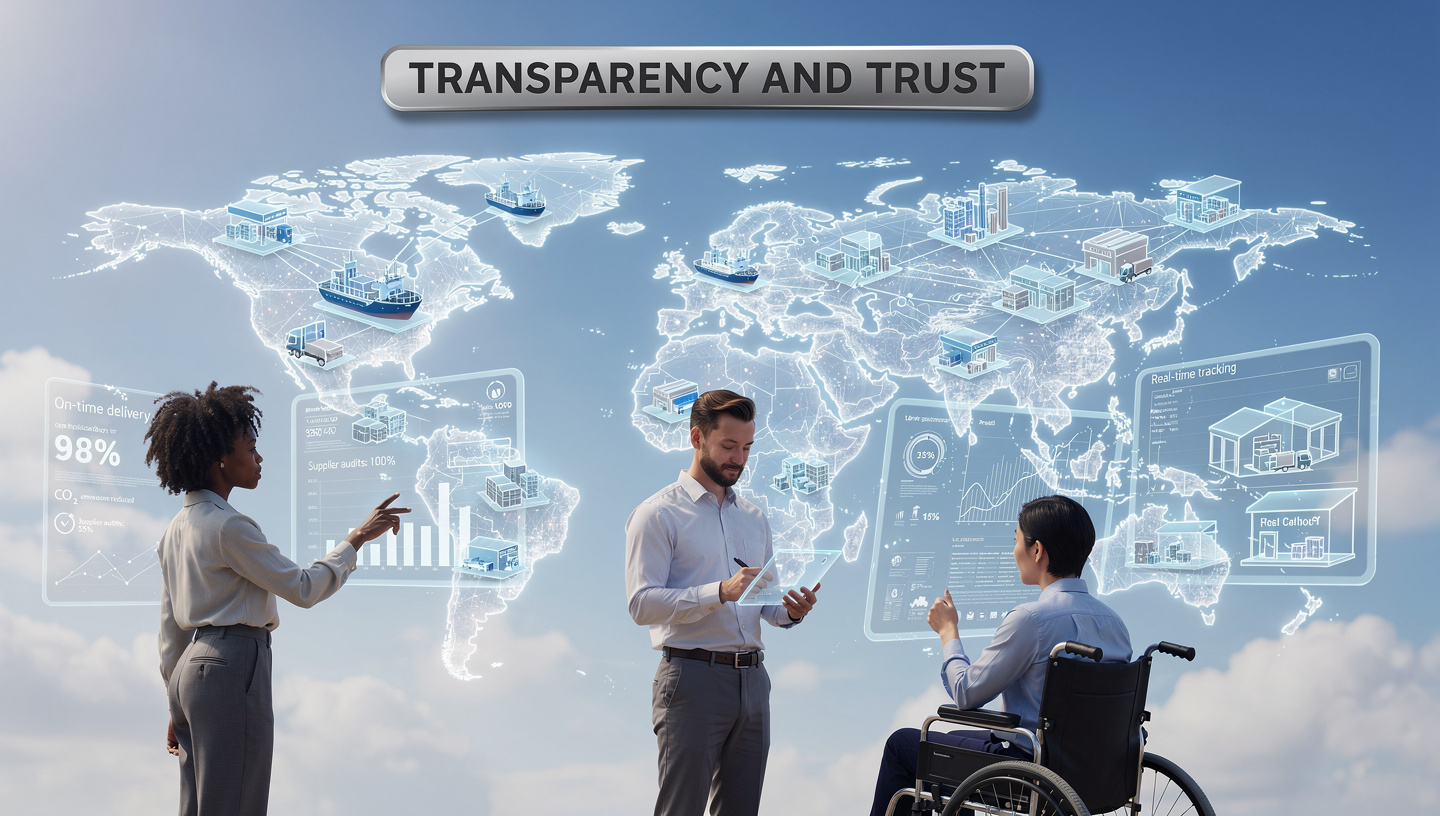
Cryptographic networks now make it technically feasible to record every transfer of value, custody, and transformation in a shared, tamper-resistant ledger. In a fully transparent world, every shipment has a cryptographic fingerprint. Every component has a lineage. Every delay leaves a trail. Every environmental externality can be priced. Every lie becomes expensive.
This is not incremental optimization. It is a structural rewrite of how global commerce coordinates.
This article examines what supply chains become when transparency is native—when blockchains are not accessories to logistics, but the substrate on which logistics itself runs.
We will move from primitives to systems: identity, tracking, incentives, governance, risk, labor, energy, and geopolitics. This is worldbuilding grounded in real cryptographic mechanics.
1. The Core Shift: From Institutional Trust to Machine Verifiability
Traditional supply chains rely on institutional trust:
- Contracts enforced by courts
- Certifications issued by authorities
- Records stored in siloed databases
- Audits performed periodically
These mechanisms are slow, expensive, and inherently lossy. They produce snapshots, not continuous truth.
Blockchain systems replace this with machine verifiability.
Instead of asking:
“Do we trust this supplier?”
the system asks:
“Can this claim be cryptographically proven?”
Distributed ledgers pioneered by networks like Bitcoin and Ethereum introduced three properties that reshape logistics at planetary scale:
- Immutability – once written, records cannot be altered retroactively
- Global consensus – all participants see the same state
- Programmable logic – smart contracts automate enforcement
Applied to supply chains, this means:
- Ownership transfers become atomic transactions
- Certifications become on-chain attestations
- Payments trigger automatically upon delivery confirmation
- Disputes reference shared data, not competing spreadsheets
The result is not “better tracking.”
It is continuous, executable accountability.
2. The Transparent Supply Chain Stack
A fully transparent supply chain is not a single blockchain application. It is a layered system.
2.1 Physical Layer: Sensors, Tags, and Reality Anchors
Transparency begins in the physical world:
- RFID and NFC tags on pallets and products
- GPS trackers on vehicles
- Temperature and humidity sensors for perishables
- Optical scanners and computer vision for package integrity
These devices act as oracles—bridges between atoms and bits.
Each sensor event is hashed and signed, then committed on-chain. Over time, a product accumulates a cryptographic biography: where it was mined, assembled, shipped, stored, inspected, and sold.
Tampering becomes detectable. Substitution becomes costly.
2.2 Identity Layer: Who Did What
Every participant—miner, farmer, factory, carrier, warehouse, retailer—operates through a cryptographic identity.
These identities:
- Hold reputational history
- Accumulate performance metrics
- Are slashed economically for fraud or negligence
Unlike traditional vendor records, they are portable across ecosystems and visible to all counterparties.
Reputation becomes composable infrastructure.
2.3 Asset Layer: Tokenized Goods
Physical goods are mirrored by digital twins: tokens representing custody and ownership.
A container of lithium concentrate becomes an on-chain asset. A batch of antibiotics becomes an NFT-like unit with embedded compliance data.
These tokens:
- Move instantly across borders
- Can be collateralized for financing
- Carry embedded regulatory constraints
- Trigger insurance and settlement automatically
Trade finance collapses from months to minutes.
2.4 Logic Layer: Smart Contract Logistics
Routing, pricing, penalties, and bonuses are encoded directly into smart contracts:
- Late delivery reduces payment
- Temperature breaches void insurance
- Carbon thresholds apply automatic fees
- Quality inspections release escrow
Human discretion gives way to deterministic execution.
3. Radical Visibility: What Happens When Everyone Can See Everything
Transparency rewires incentives.
3.1 Price Discovery Becomes Real-Time
Today’s supply chains operate with delayed signals. Inventory data is fragmented. Demand forecasts lag reality.
On-chain logistics exposes:
- Live production rates
- Transit delays
- Warehouse capacity
- Regional shortages
Markets respond instantly. Arbitrage compresses. Hoarding becomes visible. Panic buying loses leverage.
Volatility does not disappear—but it becomes legible.
3.2 Fraud Collapses in Entire Categories
Counterfeit pharmaceuticals, fake organic labels, conflict minerals—these thrive in opacity.
In a transparent system:
- Each transformation requires cryptographic continuity
- Each certification is publicly auditable
- Each substitution breaks the chain
Fraud does not vanish. It becomes localized and provable.
Insurance premiums drop. Compliance overhead shrinks. Trust shifts from branding to math.
3.3 ESG Stops Being Marketing
Environmental, social, and governance metrics stop being annual reports and become continuous streams:
- Carbon emitted per unit
- Water usage per batch
- Labor hours per product
These are not PDFs. They are signed data feeds.
Investors allocate capital algorithmically. Consumers filter products programmatically. Regulators monitor systems live.
“Sustainable” becomes a measurable state, not a slogan.
4. Autonomous Commerce: When Supply Chains Pay Themselves
The most underestimated change is financial automation.
In a transparent world:
- Goods negotiate shipping rates
- Warehouses auction storage capacity
- Trucks bid on delivery routes
- Payments clear instantly on arrival
Inventory becomes economically active.
A pallet of electronics can:
- Borrow against itself
- Pay for its own transport
- Hedge its currency exposure
- Pre-sell downstream demand
Supply chains evolve into self-settling economic organisms.
Human operators move upstream into strategy and governance.
5. Labor in a Verifiable Economy
Transparency does not only affect goods—it transforms work.
5.1 Skill as a Cryptographic Asset
Workers carry verifiable credentials:
- Certifications
- Performance history
- Safety records
These credentials travel across employers and borders.
Hiring becomes faster. Credential fraud collapses. Informal labor markets formalize.
5.2 Micropayments Replace Payroll Cycles
Instead of biweekly wages, workers receive continuous compensation:
- Per unit assembled
- Per kilometer driven
- Per inspection completed
Cash flow stabilizes at the individual level. Financial inclusion expands organically.
6. Governance Without Central Command
Traditional supply chains are governed hierarchically: lead firms dictate standards.
Transparent supply chains operate through protocol governance.
Rules are encoded. Updates are voted. Disputes reference on-chain evidence.
Decentralized consortia already experiment with this model—companies like IBM, Walmart, and platforms such as Hyperledger and VeChain have demonstrated early production systems.
These are prototypes.
In a mature transparent world, governance resembles open-source software more than corporate bureaucracy.
Forks replace lawsuits. Consensus replaces coercion.
7. Energy and Infrastructure: The Physical Cost of Transparency
This world is not free.
Running global cryptographic infrastructure requires energy, hardware, and connectivity.
But transparency also optimizes:
- Routing efficiency
- Inventory buffers
- Overproduction
- Spoilage
Waste collapses faster than compute rises.
Energy usage shifts from redundant safety stock to verifiable flow.
8. Geopolitics in an Open Ledger Era
Nation-states lose informational asymmetry.
Tariffs become programmable. Sanctions become automatic. Trade flows become visible in real time.
This creates new power dynamics:
- Resource-rich regions gain leverage through provable reserves
- Manufacturing hubs compete on measurable reliability
- Shipping corridors become economically instrumented
Logistics ceases to be a black box and becomes a strategic surface.
Global trade does not fragment—it becomes hyper-legible.
9. Failure Modes: Transparency Is Not Utopia
A fully transparent supply chain introduces new risks:
- Privacy erosion for small suppliers
- Algorithmic exclusion from automated markets
- Sensor spoofing at physical edges
- Governance capture by token-rich actors
These are not theoretical. They require architectural countermeasures:
- Zero-knowledge proofs for selective disclosure
- Decentralized identity with consent layers
- Redundant oracle networks
- Constitutional constraints baked into protocols
Transparency must be designed, not assumed.
10. The End State: Commerce as a Living System
In the mature phase, supply chains no longer feel like linear pipelines.
They behave like ecosystems.
Goods flow along incentive gradients. Capital allocates itself toward reliability. Energy prices shape routing. Reputation determines access. Risk is continuously priced. Waste is algorithmically penalized.
There is no single owner of the system.
There is only shared state.
Factories publish output. Ports publish congestion. Retailers publish demand. Smart contracts reconcile everything in near real time.
This is not central planning.
It is cryptographic coordination.
Closing: From Blind Trust to Visible Reality
Supply chains have always been the nervous system of civilization.
What changes in a fully transparent world is not that we move more goods—but that we finally see them.
We see where value is created.
We see where labor is exploited.
We see where carbon leaks.
We see where bottlenecks form.
And because the system is programmable, seeing is acting.
Transparency converts observation into execution.
The age of opaque logistics is ending. In its place emerges a world where every product tells its story, every transaction carries proof, and every participant operates inside a shared, immutable record.
Supply chains stop being hidden infrastructure.
They become public, living systems—auditable by anyone, enforced by code, and shaped by collective incentives.
That is what it means to build commerce on cryptographic rails.
Not efficiency.
Not digitization.
Legibility at planetary scale.