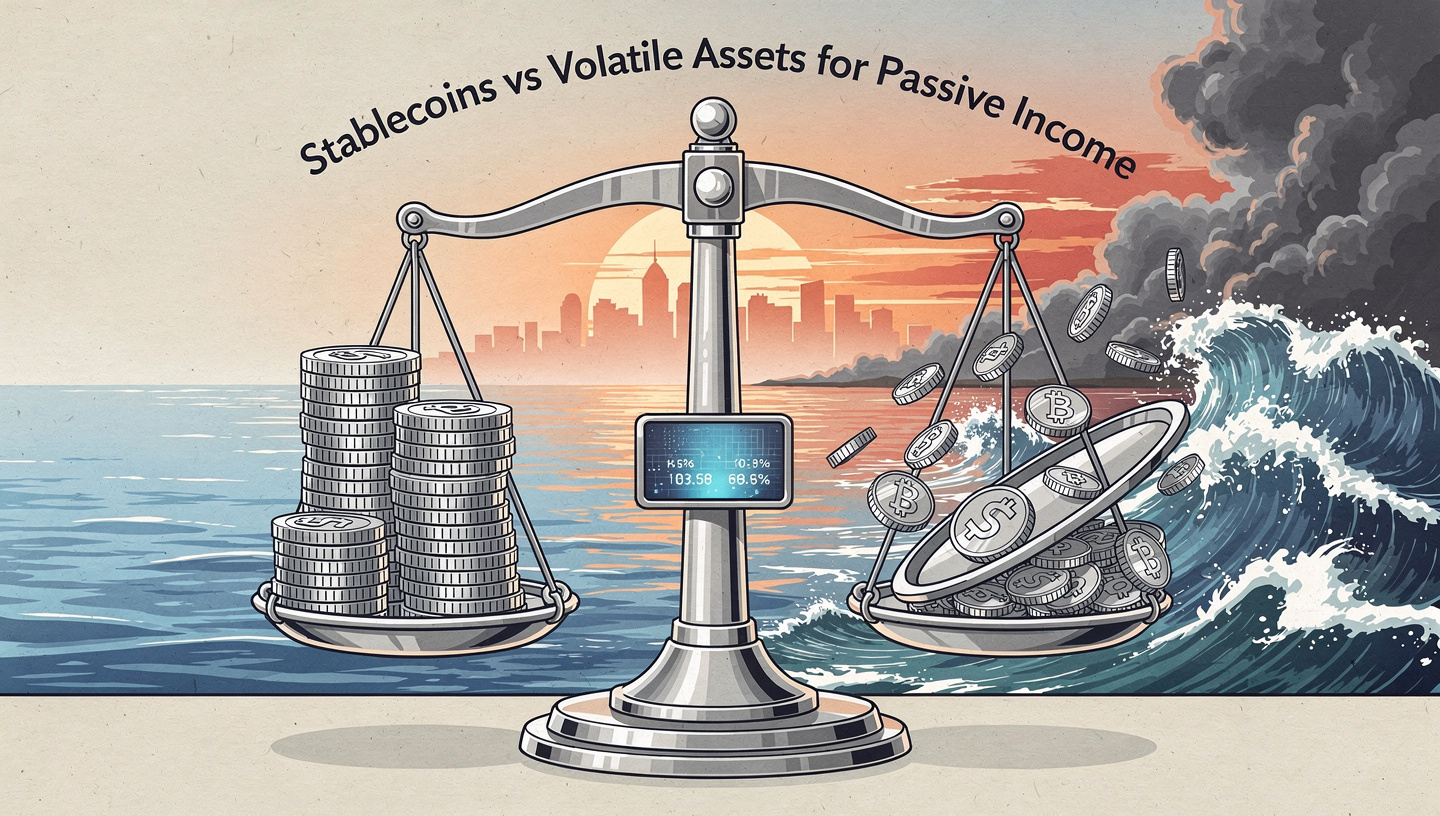
Markets reward patience, not adrenaline.
In crypto, that truth gets buried under yield screenshots, overnight millionaires, and aggressive APY banners flashing triple digits. But if your objective is passive income that survives reality, then volatility is not your friend — and neither is blind conservatism.
The real question is not:
“Which earns more?”
It is:
Which survives longer while compounding consistently?
That is the same framework Warren Buffett applies to equities:
- Not maximum upside
- Not short-term performance
- But durable cash flow under uncertainty
Crypto is no different.
When you strip away hype, passive income in digital assets reduces to two fundamental categories:
- Stablecoins – engineered for price stability
- Volatile assets – BTC, ETH, altcoins, governance tokens
Each behaves differently under stress. Each compounds differently. Each carries radically different hidden risks.
This article dissects both with a practical, investor-grade lens.
No fantasies. No influencer math.
Only capital efficiency, risk-adjusted yield, and long-term survivability.
Section 1 — What “Passive Income” Actually Means in Crypto
Before comparing asset classes, definitions matter.
Crypto passive income generally comes from:
- Lending
- Staking
- Liquidity provision
- Yield farming
- Structured products
- Delta-neutral strategies
Regardless of method, returns originate from:
- Borrow demand
- Network emissions
- Trading fees
- Arbitrage spreads
- Risk premiums
Nothing appears from thin air.
Every yield is paid by someone — directly or indirectly.
That leads to the first principle:
Yield is compensation for risk.
Stablecoins and volatile assets simply price that risk differently.
Section 2 — Stablecoins: Financial Gravity in a Chaotic Market
Stablecoins (USDC, USDT, DAI, FRAX, etc.) are designed to maintain purchasing power relative to fiat currencies.
Their role in crypto mirrors cash in traditional portfolios.
Not exciting.
Extremely functional.
Why Stablecoins Generate Yield
Stablecoin income primarily comes from:
1. Lending Markets
Platforms like Aave, Compound, Spark, Morpho:
Borrowers pay interest to leverage trades or finance operations.
Typical APY:
- 3%–12% in normal markets
- 15%–30% during stress events
This is pure interest income.
No price exposure.
2. Liquidity Provision (Stable Pools)
Examples:
- Curve
- Balancer
- Uniswap stable pairs
Returns come from swap fees and protocol incentives.
Impermanent loss is minimal when both sides are stable.
3. Real Yield Protocols
Treasury-backed or RWA protocols increasingly offer:
- T-bill exposure
- Invoice financing
- On-chain bonds
Yield is derived from off-chain economic activity.
This is closest to traditional fixed income.
The Strategic Advantages of Stablecoins
Capital Predictability
You know exactly how much principal you will have tomorrow.
That enables:
- Accurate compounding models
- Reliable cash flow planning
- Risk budgeting
Volatile assets cannot offer this.
Psychological Stability
Most investors underestimate this.
Stablecoins remove emotional decision-making from the equation.
You are not reacting to price candles.
You are executing process.
Faster Compounding
With volatility removed, returns stack linearly.
10% on $100k becomes $110k.
Not $85k or $130k depending on market mood.
That matters over years.
But Stablecoins Are Not Risk-Free
They carry structural risks, not market risks.
Depeg Risk
Algorithmic designs have failed catastrophically.
Centralized issuers rely on reserves and regulation.
Diversification is mandatory.
Never hold one stablecoin exclusively.
Smart Contract Risk
DeFi protocols fail.
Audits reduce risk — they do not eliminate it.
Platform Risk
CeFi collapses (BlockFi, Celsius) proved custody matters.
Self-custody with audited protocols is the baseline.
Section 3 — Volatile Assets: High Return Potential, High Friction Compounding
Volatile crypto assets generate income through:
- Staking (ETH, SOL, AVAX)
- LP farming
- Token emissions
- Covered call strategies
- Restaking
The yield often looks superior.
But surface APY hides deeper mechanics.
The Illusion of High APY
A token yielding 20% annually sounds attractive.
But if the token loses 40% in price, your “income” becomes irrelevant.
Volatile asset yield is inseparable from market direction.
That creates asymmetric outcomes:
- Bull markets exaggerate returns
- Bear markets destroy compounding
This is not passive income.
This is directional speculation with yield attached.
Impermanent Loss: The Silent Performance Killer
Liquidity providers in volatile pairs face impermanent loss.
In simple terms:
If price moves significantly, you end up with fewer valuable tokens.
Even with high fees, long-term returns often underperform holding.
Most retail LP strategies lose money.
Not sometimes.
Consistently.
Staking Inflation
Many staking rewards are paid via token emissions.
This dilutes supply.
You are not earning yield.
You are maintaining percentage ownership while price absorbs dilution.
True income only exists if:
- Network usage grows faster than inflation
- Or token appreciates significantly
Neither is guaranteed.
Section 4 — Risk-Adjusted Return: The Metric That Actually Matters
Professional investors do not chase raw APY.
They evaluate:
- Volatility
- Drawdown
- Correlation
- Tail risk
Stablecoins dominate on risk-adjusted metrics.
Example:
| Asset Type | Typical APY | Max Drawdown |
|---|---|---|
| Stablecoins | 6–12% | 1–5% |
| ETH Staking | 4–8% | 50%+ |
| Altcoin Farming | 30–200% | 80–95% |
Which compounds better over five years?
Not the flashy one.
The one that stays alive.
Section 5 — Portfolio Construction: The Rational Hybrid Model
The optimal strategy is not either/or.
It is allocation.
A disciplined framework:
Conservative Base (50–70%)
Stablecoins deployed across:
- Lending
- Stable LP
- RWA yield
Objective:
Capital preservation + predictable income.
Growth Layer (20–40%)
BTC / ETH staking or low-leverage strategies.
Objective:
Long-term appreciation.
Speculative Sleeve (0–10%)
High-risk alt yield.
Objective:
Optional upside.
This mirrors Buffett’s structure:
- Core businesses
- Growth equities
- Small speculative positions
Crypto investors rarely structure portfolios this way.
They chase everything.
That is why most fail.
Section 6 — Behavioral Reality: Why Most Investors Choose Volatility
Humans are wired for excitement.
Stablecoin yield feels boring.
Volatile assets provide dopamine.
But investing is not entertainment.
Passive income requires:
- Repetition
- Discipline
- Boredom tolerance
The quiet strategies win.
Always.
Section 7 — Market Cycles Change the Equation
During bull markets:
Volatile assets outperform dramatically.
During sideways markets:
Stablecoins dominate.
During bear markets:
Stablecoins preserve optionality.
You cannot predict cycles.
You can prepare for them.
Stablecoins give you dry powder.
Volatile assets do not.
Final Thoughts: Income Is a Process, Not a Prediction
Stablecoins are not designed to make you rich.
They are designed to keep you solvent.
Volatile assets are not designed to provide income.
They are designed to provide exposure.
Confusing the two leads to broken portfolios.
The investor who survives longest compounds the most.
Not the one with the highest screenshot APY.
If you want crypto passive income that endures:
- Anchor with stablecoins
- Allocate selectively to volatility
- Rebalance mechanically
- Respect risk
That is not exciting.
It is effective.
And in investing, effectiveness beats excitement every time.