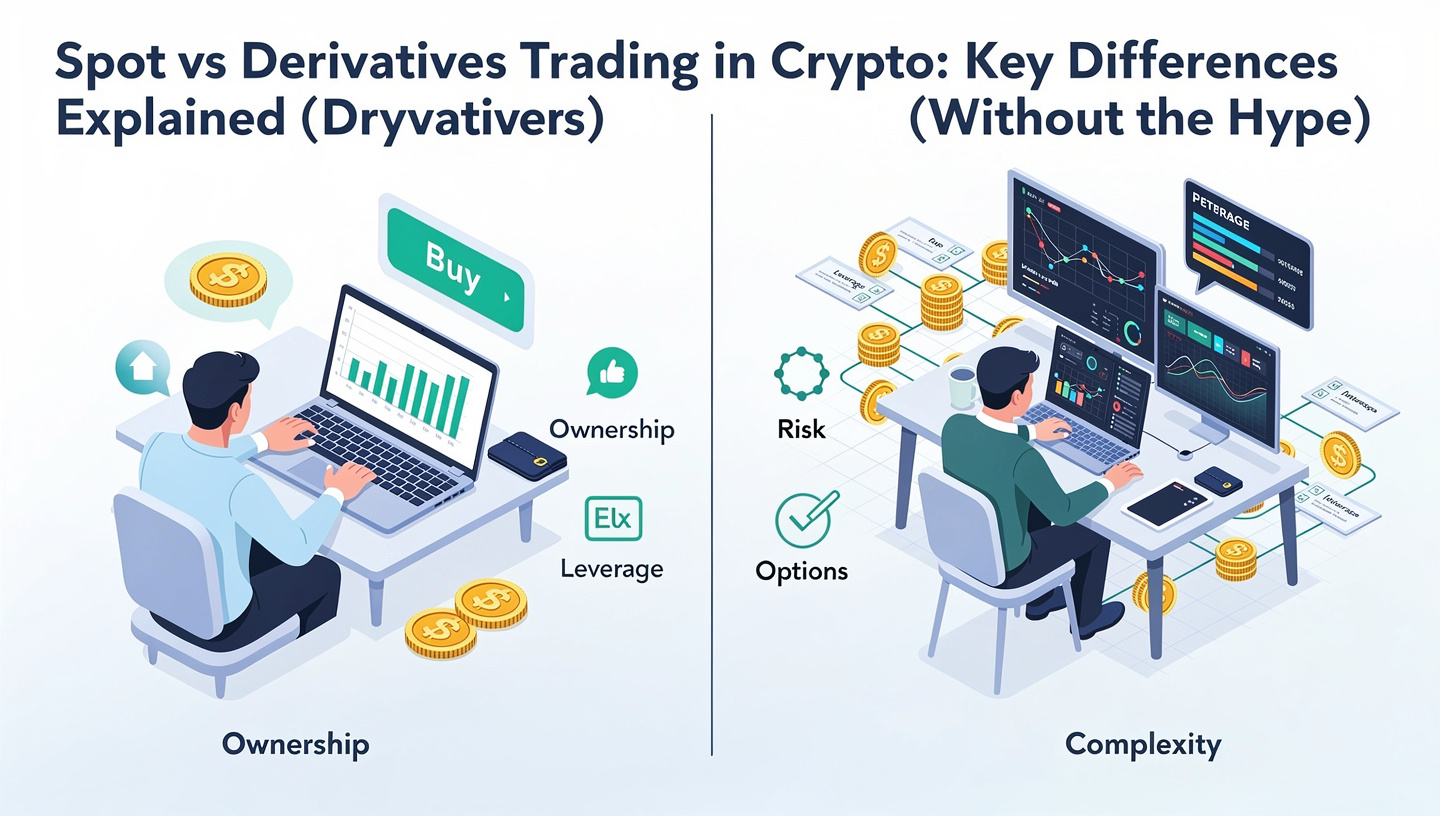
Markets don’t move because of narratives. They move because of positioning.
Every candle on a crypto chart is the residue of millions of decisions: hedges layered on top of leverage, liquidity hunting stops, arbitrage bots closing basis gaps, and long-term holders quietly accumulating while tourists chase momentum. If you want to understand crypto trading at a professional level, you don’t start with “bullish vs bearish.” You start with structure.
And structure, in crypto, is defined by one fundamental split:
spot markets versus derivatives markets.
Everything else—volatility, liquidations, funding rates, even sudden crashes—flows from this divide.
This article breaks down that divide precisely: what spot trading really is, how derivatives actually work, why they exist, who uses them, and how each shapes price discovery. No hype. No motivational fluff. Just mechanics, incentives, and consequences.
What “Spot Trading” Actually Means
Spot trading is the simplest form of market participation:
You exchange one asset for another, immediately.
If you buy Bitcoin on a spot exchange, you receive Bitcoin. If you sell it, you no longer own it. Settlement is direct. Ownership changes hands on-chain or via custodial ledger.
There are no contracts. No expiration dates. No synthetic exposure.
You hold the underlying asset.
That’s it.
When you buy Bitcoin on spot, you own BTC. When you buy Ethereum, you own ETH.
This sounds obvious—but it’s critical. Spot traders participate in the actual supply of crypto. They affect circulating availability. They can withdraw assets. They can self-custody. They directly influence scarcity.
Core Characteristics of Spot Trading
1. Real ownership
You hold the asset itself, not a financial proxy.
2. No leverage by default
You can’t lose more than you invest unless you borrow externally.
3. No liquidation mechanics
Your position cannot be forcibly closed by an exchange due to margin requirements.
4. Linear profit and loss
If price doubles, your investment doubles. If price drops 50%, your position drops 50%.
5. Simpler risk profile
No funding rates. No basis decay. No forced rollovers.
Spot trading is structurally conservative. It rewards patience, long-term conviction, and capital preservation.
It is how most retail participants enter crypto. It is how institutions accumulate. It is how cold wallets get filled.
But spot is only half the market.
What Crypto Derivatives Really Are
Crypto derivatives are financial contracts whose value is derived from an underlying cryptocurrency—without requiring ownership of that asset.
You’re trading exposure, not coins.
The most common forms:
- Perpetual futures (perps)
- Fixed-expiry futures
- Options
Unlike spot markets, derivatives allow:
- Leverage
- Short selling
- Synthetic positioning
- Capital efficiency
- Hedging without selling underlying holdings
You can bet on price direction, volatility, or time decay—all without touching actual BTC or ETH.
Most crypto volume today happens in derivatives, not spot.
Let that sink in.
Price discovery is dominated by contracts, not coins.
Perpetual Futures: Crypto’s Native Instrument
Perpetual futures have no expiry date. Instead, they use a funding rate mechanism to keep contract prices anchored to spot markets.
If longs are overcrowded, they pay shorts.
If shorts are overcrowded, they pay longs.
This payment happens every few hours.
Perps are simple to trade, easy to leverage, and brutally unforgiving when volatility spikes.
They are the engine behind most liquidations.
Fixed Futures and Options
Fixed futures expire on a set date. Traders must close or roll positions.
Options introduce asymmetric risk: calls, puts, implied volatility curves, and complex strategies like spreads and straddles.
These instruments are widely used by funds and desks on venues like CME Group, where institutional crypto exposure is primarily derivatives-based.
Retail tends to stick to perps.
Professionals use all of it.
The Structural Differences That Matter
Let’s strip this down to first principles.
Ownership vs Exposure
Spot gives you assets.
Derivatives give you contracts.
With spot, you participate in supply dynamics. With derivatives, you participate in price dynamics only.
This distinction defines everything.
Leverage
Spot trading usually operates at 1x.
Derivatives routinely offer 5x, 10x, even 100x leverage.
Leverage amplifies gains—and compresses survival time.
A 10% move against a 10x leveraged position equals liquidation.
This is why derivatives traders lose capital faster. Not because they’re careless—because the margin system is mathematically hostile to drawdowns.
Liquidations
Spot positions cannot be liquidated.
Derivatives positions can.
When margin falls below maintenance requirements, exchanges forcibly close positions at market price.
These cascading closures create the violent wick events crypto is famous for.
Spot markets do not generate liquidation cascades.
Derivatives do.
Funding Rates
Spot has no carrying cost.
Perpetual derivatives impose funding payments between longs and shorts. Over time, this cost materially affects returns.
Funding is the tax on leverage.
Market Impact
Spot buying removes liquidity from circulation.
Derivatives trading does not.
This is why large institutions often accumulate spot quietly while expressing directional views via derivatives.
They separate ownership from speculation.
Why Derivatives Dominate Volume
If spot trading represents ownership, why do derivatives account for most activity?
Three reasons:
1. Capital Efficiency
With derivatives, $10,000 can control $100,000 of exposure.
For traders seeking short-term returns, leverage is irresistible.
2. Ability to Short
Spot markets make shorting difficult or impossible.
Derivatives make it trivial.
This enables two-sided markets and faster price discovery.
3. Hedging
Miners, funds, and long-term holders hedge downside risk without selling spot holdings.
A Bitcoin miner, for example, may hold BTC while shorting futures to lock in revenue.
This is impossible using spot alone.
Exchanges: Where These Worlds Collide
Most centralized platforms now offer both spot and derivatives under one roof.
Retail participants typically interact with both on platforms like Binance.
Institutional desks often route derivatives flow through regulated venues while sourcing spot liquidity separately.
This separation matters.
Spot markets tend to be thinner. Derivatives markets tend to be deeper, faster, and dominated by algorithmic flow.
As a result:
- Derivatives often lead price
- Spot often follows
This is why funding spikes or open interest surges frequently precede large moves.
The derivatives market telegraphs intent.
Risk Profiles: Not Just Different—Opposite
Spot risk is time-based.
You can hold through drawdowns. You’re only wrong if price never recovers.
Derivatives risk is path-based.
You can be directionally correct and still get liquidated due to volatility.
This distinction is profound.
Spot traders survive volatility.
Derivatives traders are eliminated by it.
Who Should Use Spot Trading?
Spot trading fits:
- Long-term investors
- Accumulators
- Participants who want custody
- Those avoiding leverage risk
- Builders and users of on-chain ecosystems
Spot is about exposure to crypto as an asset class.
It rewards patience.
It punishes emotional trading less severely.
Who Uses Derivatives (Successfully)?
Derivatives are tools, not toys.
They are best suited for:
- Professional traders
- Funds managing portfolio risk
- Market makers
- Arbitrageurs
- Sophisticated retail traders with strict risk systems
Used correctly, derivatives allow:
- Delta-neutral strategies
- Volatility harvesting
- Hedging without liquidation of core holdings
Used incorrectly, they vaporize accounts.
There is no middle ground.
How Derivatives Shape Crypto’s Personality
Crypto is volatile because derivatives amplify reflexivity.
High leverage means small moves trigger forced selling. Forced selling creates larger moves. Larger moves trigger more liquidations.
It’s a feedback loop.
Traditional equity markets have circuit breakers.
Crypto has liquidation engines.
Understanding this is essential.
Every major crash—every sudden spike—has derivatives fingerprints all over it.
Spot holders feel the aftermath. Derivatives traders create the shockwaves.
The Quiet Strategy Professionals Use
Here’s what rarely gets discussed:
Serious capital often separates accumulation from speculation.
They:
- Buy spot over time
- Store assets cold
- Use derivatives tactically for short-term positioning
Spot builds the base.
Derivatives adjust exposure.
Retail typically does the opposite—trading derivatives while neglecting spot accumulation.
That inversion explains most performance gaps.
Final Thoughts: Choose Structure Before Strategy
Spot and derivatives are not competing products.
They serve fundamentally different purposes.
Spot is ownership.
Derivatives are instruments.
Spot builds wealth slowly.
Derivatives redistribute wealth quickly.
If you don’t understand that distinction, everything else—technical analysis, indicators, alpha signals—is secondary.
Markets reward structural literacy.
Before you choose entries, indicators, or narratives, choose your arena.
Because once you step into derivatives, you are no longer investing.
You are operating inside a leveraged system designed to transfer capital from the impatient to the disciplined.
And that system does not care what you believe about crypto.
Only how you manage risk.