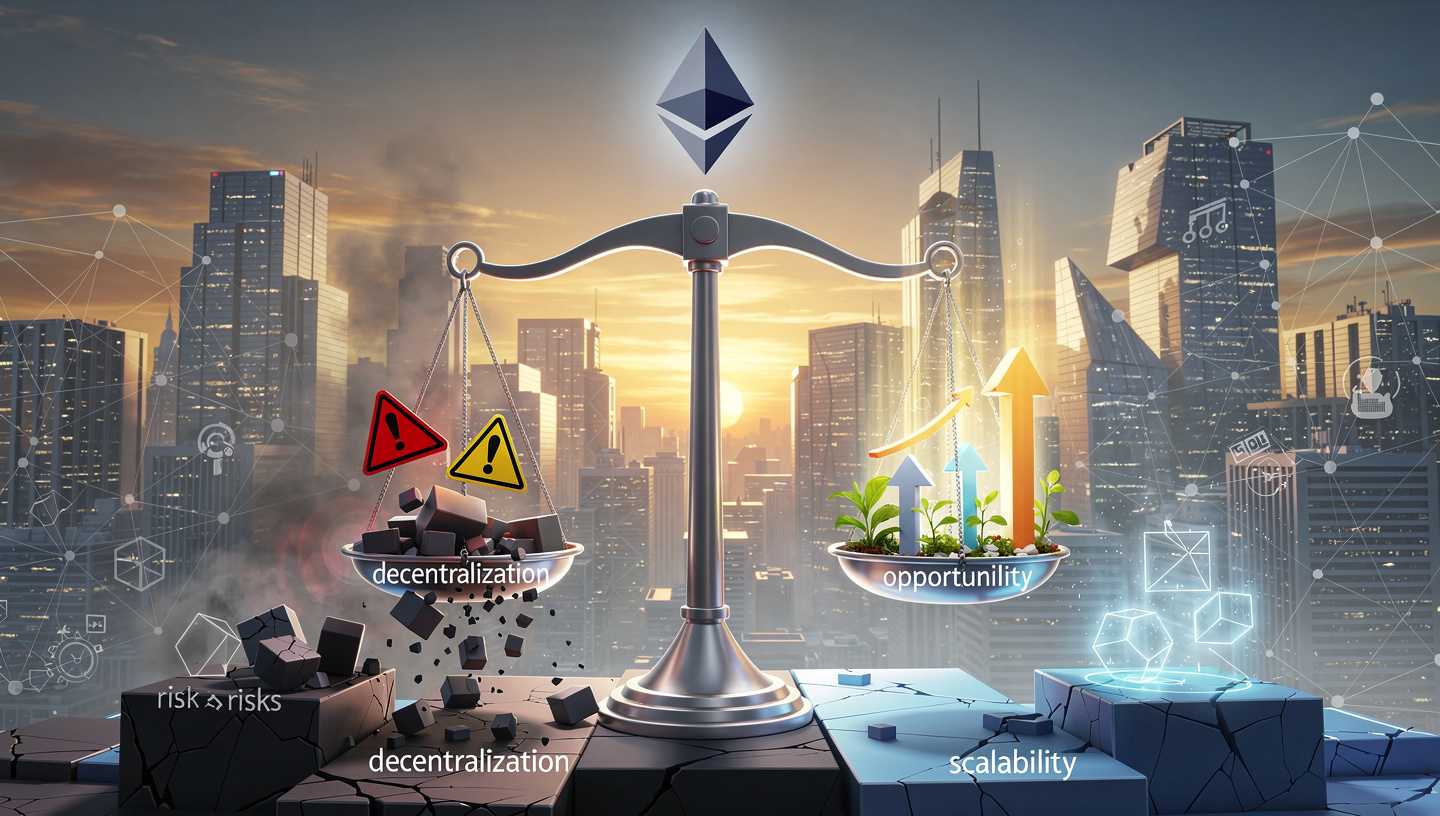
If Bitcoin introduced the world to decentralized money, Ethereum introduced the world to decentralized possibility. It transformed blockchains from simple ledgers into programmable platforms — places where developers could build financial systems, games, social networks, identity tools, and entirely new digital economies.
But as with any transformative technology, Ethereum carries both promise and peril.
Understanding those risks and opportunities is essential — whether you are a developer, investor, founder, student, or simply curious about where the internet is heading.
This essay takes a deep look at both sides of the equation.
We will explore:
- What makes Ethereum different
- The biggest opportunities emerging on Ethereum
- The major risks — technical, economic, and regulatory
- How the ecosystem might evolve from here
Let’s begin.
What Makes Ethereum Special?
Ethereum was created in 2015 by Vitalik Buterin and a team of early blockchain builders with a radical idea:
Instead of just sending coins, what if we could program the blockchain like a global computer?
That vision gave birth to several foundational concepts:
Smart contracts
Smart contracts are self-executing programs stored on the blockchain. They run exactly as written, with no intermediary, no bank, and no “off switch” unless coded.
Decentralized applications (dApps)
Developers build applications on Ethereum that:
- Run on distributed infrastructure
- Are transparent and auditable
- Are resistant to censorship
- Allow users to control their own assets
Ether (ETH)
ETH is the native asset used to:
- Pay for transactions (“gas”)
- Secure the network (staking)
- Incentivize validators
A global developer ecosystem
Ethereum is open source. Anyone can build on it. That has created one of the most innovative communities in technology today.
But innovation always brings uncertainty.
Let’s examine the opportunities first — because they explain why Ethereum has grown so fast.
Major Opportunities in the Ethereum Ecosystem
1. Decentralized Finance (DeFi)
DeFi is the idea of rebuilding financial services without traditional banks.
On Ethereum, users can:
- Borrow and lend assets
- Trade without centralized exchanges
- Earn yield by providing liquidity
- Issue synthetic assets
- Manage programmable portfolios
All using smart contracts.
Opportunity:
A financial system that is open, transparent, auditable, and available globally — 24/7 — with fewer intermediaries.
Why it matters:
Billions of people lack access to fair banking services. Ethereum lowers barriers. It makes capital programmable.
2. Tokenization of Real-World Assets (RWAs)
Real-world assets are increasingly being represented on-chain:
- Real estate shares
- Treasury bills
- Commodities
- Equity and bonds
- Invoices and receivables
- Art and collectibles
Tokenization allows:
- Instant settlement
- Fractional ownership
- Global transferability
- Transparent audit trails
Institutions are paying attention because tokenization can reduce friction, paperwork, and operational cost.
3. NFTs and Digital Ownership
NFTs are more than profile pictures.
They represent:
- Game items
- Music rights
- Access passes
- Digital identity assets
- Certificates and credentials
- Intellectual property licenses
The core innovation:
For the first time, digital items can be owned directly by users, not controlled entirely by platforms.
This unlocks creator economies and new digital business models.
4. DAOs: Organizing Without Central Leaders
DAOs (Decentralized Autonomous Organizations) use smart contracts to coordinate people and capital.
They can manage:
- Investment funds
- Protocol governance
- Community projects
- Grants and research
DAOs experiment with new models of democracy and corporate structure — transparent by default.
5. The Developer Opportunity
Ethereum offers:
- Open tools
- Public infrastructure
- Huge dev community
- Extensive documentation
- Layer-2 scaling networks
- Mature standards (ERC-20, ERC-721, ERC-1155, etc.)
Builders can create startups at global scale with minimal upfront infrastructure.
In many cases, the only requirement is:
- An idea
- A wallet
- A smart contract
- A community
That is unprecedented.
The Major Risks of the Ethereum Ecosystem
For all of its promise, Ethereum also contains serious risks. Ignoring them leads to bad outcomes.
Let’s discuss them candidly.
1. Smart Contract Bugs and Exploits
Code is law on Ethereum — but code can have bugs.
History has shown:
- Reentrancy attacks
- Oracle manipulation
- Flash-loan exploits
- Logic errors
- Misconfigured permissions
- Poor upgradeability design
Billions of dollars have been lost due to flawed contracts.
Risk:
Once deployed, smart contracts are difficult (or impossible) to change. Bugs can be catastrophic.
Mitigation:
- Formal verification
- Multiple independent audits
- Bug bounties
- Battle-tested libraries
- Conservative deployment processes
But risk can never be eliminated entirely.
2. Liquidity and Market Volatility
Ethereum-based assets can fluctuate violently.
DeFi protocols can fail under stress:
- Liquidations cascade
- Collateral values collapse
- Stablecoins de-peg
- Liquidity dries up
Many participants underestimate downside risk.
Reality:
Prices move fast. Leverage amplifies losses. Crypto markets do not have circuit breakers like traditional exchanges.
3. Regulatory Uncertainty
Governments around the world are still figuring out how to treat:
- Tokens
- Stablecoins
- DeFi protocols
- DAOs
- On-chain securities
Possible outcomes include:
- Restrictive regulations
- Stricter KYC/AML
- Legal liability for developers
- Taxes on transactions
- Limits on stablecoins
Uncertainty slows institutional adoption and complicates compliance.
4. Centralization Pressures
Ethereum markets itself as decentralized. But real forces create centralization risks:
- Large staking pools control meaningful stake
- Bridges and oracles act as chokepoints
- Major infrastructure providers host large percentages of nodes
- Wealth concentration among early adopters
- Governance capture by powerful participants
True decentralization is an ongoing challenge — not a finished achievement.
5. User Experience and Security Risks
Ethereum is still difficult for average users:
- Private keys can be lost forever
- Phishing scams are rampant
- Fake tokens look legitimate
- Signing transactions can be confusing
- Fees fluctuate unpredictably
Traditional apps have password resets and customer support.
Blockchains do not.
One mistake can be irreversible.
6. Environmental and Energy Misconceptions
Ethereum’s move to Proof-of-Stake dramatically reduced energy usage.
However, misunderstanding persists — and critics still group all blockchains together.
This creates perception risk. Public opinion influences policy and adoption.
Layer 2: A Solution and a New Set of Risks
Layer-2 networks (Arbitrum, Optimism, Base, zkSync, and others) aim to scale Ethereum.
They reduce costs and increase throughput by processing transactions off-chain and settling back to Ethereum.
Opportunities:
- Cheaper transactions
- Greater throughput
- More experimentation
Risks:
- Smart contract complexity
- Bridge vulnerabilities
- Centralized sequencers
- Withdrawal delays
- UX fragmentation across chains
Scaling solves old problems but introduces new ones.
Long-Term Outlook: Where Is Ethereum Headed?
Despite volatility and challenges, Ethereum has achieved something extraordinary:
- A self-sustaining developer ecosystem
- Massive network effects
- Institutional awareness
- Continuous protocol upgrades
- Growing use cases beyond speculation
The most likely trajectory is not linear dominance or total failure.
It is gradual evolution:
- More regulated on-ramps
- More robust security standards
- Clearer tax and legal frameworks
- More usable wallets
- More scalable Layer-2 infrastructure
- Better consumer-grade applications
- Deeper integration with traditional finance and enterprise systems
Ethereum is becoming infrastructure — invisible but essential.
Balanced Conclusion: Risk and Reward Are Deeply Connected
Ethereum represents one of the boldest experiments in digital history.
Its opportunities are enormous:
- Open financial systems
- Global digital ownership
- Programmable economies
- New governance structures
- Permissionless innovation
Its risks are real:
- Bugs
- Hacks
- Scams
- Market crashes
- Regulatory shocks
- Centralization pressures
Neither side should be ignored.
Prudence, research, skepticism, and risk management are essential. So is curiosity, creativity, and experimentation.
Because the truth is simple:
Ethereum is not finished. It is still being built — by developers, communities, entrepreneurs, and researchers worldwide.
And whether you see it as a revolution, a speculative bubble, an emerging platform, or an unfinished prototype — understanding it matters.
The next generation of the internet may be constructed, at least in part, on chains like Ethereum.
And it is better to understand that world than be surprised by it.