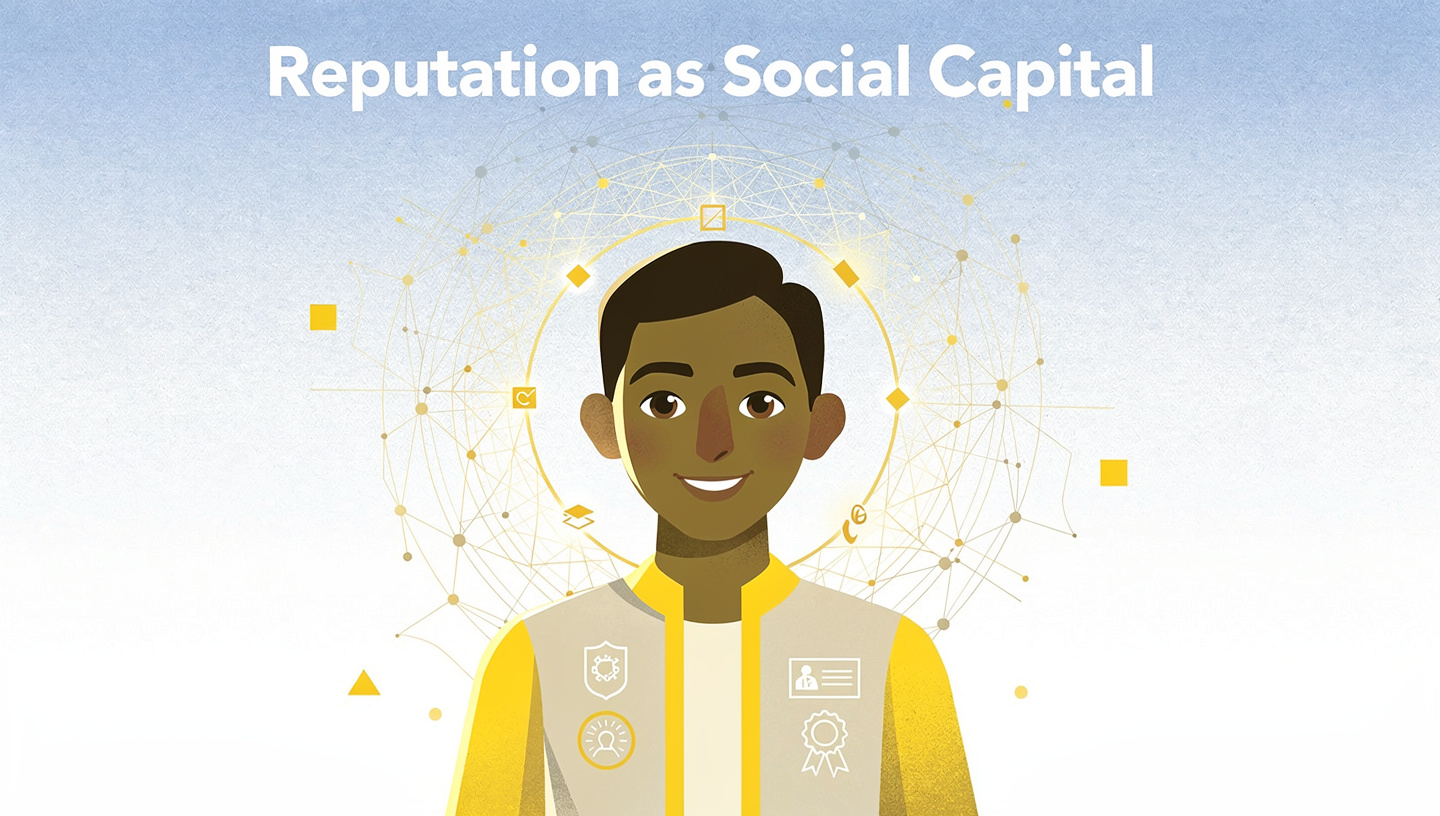
In traditional societies, reputation is implicit. It accumulates quietly through institutions: schools, employers, governments, banks. Credentials are issued, verified, and enforced by centralized authorities. Trust is mediated.
Crypto-native systems invert this structure.
Here, reputation is explicit. It is computed, portable, and often irreversible. It emerges from wallets, transactions, governance votes, open-source commits, and on-chain behavior. In decentralized environments, reputation is not a soft social layer sitting above the economy—it is the economy.
This article examines reputation as a primary form of social capital in crypto-based worlds. Not metaphorically. Structurally.
We will analyze:
- Why reputation replaces institutions in decentralized systems
- How cryptographic identity transforms social trust
- The mechanics of on-chain and off-chain reputation
- Game-theoretic incentives shaping behavior
- Emerging design patterns for reputation protocols
- Cultural consequences of living inside permanent ledgers
- Failure modes: sybil attacks, plutocracy, and social ossification
- Worldbuilding implications for crypto-native civilizations
This is not a speculative story. It is a systems-level exploration of how societies function when reputation becomes programmable.
1. Social Capital, Rewritten in Code
Sociologists define social capital as the accumulated value of relationships, trust, and status within a network. It determines access: to opportunities, resources, influence.
In fiat societies, social capital is diffuse and opaque. In crypto societies, it is granular and inspectable.
Every address leaves a trail. Every interaction becomes data.
A wallet is not merely a financial container—it is a persistent identity artifact. Its history forms a narrative:
- What protocols you used
- Which DAOs you voted in
- How early you adopted systems
- Whether you rug-pulled or contributed
- How often others route value through you
Reputation emerges as a graph.
This matters because decentralized systems lack enforcement hierarchies. There is no HR department. No credit bureau. No centralized blacklist.
Instead, coordination depends on probabilistic trust.
Reputation becomes the substitute.
2. Why Crypto Requires Reputation More Than States Do
Centralized societies externalize trust to institutions.
Crypto cannot.
Blockchains deliberately remove trusted intermediaries. This creates a vacuum:
- Who gets access to capital?
- Who governs protocols?
- Who moderates communities?
- Who resolves disputes?
In traditional systems, answers come from bureaucratic authority.
In decentralized systems, they come from reputation-weighted consensus.
This is already visible in ecosystems built on Bitcoin and Ethereum:
- Core developers earn informal authority through long-term contribution.
- Validators gain influence through uptime and reliability.
- DAO delegates accumulate power through demonstrated alignment.
- Founders maintain legitimacy through public credibility rather than legal ownership.
There is no formal crown.
Only accumulated trust.
3. Identity Without Names: The Rise of Pseudonymous Status
Crypto identities are not tied to passports. They are tied to keypairs.
This produces a strange paradox:
You can be anonymous, yet socially rich.
A wallet with a ten-year history, consistent governance participation, and respected protocol contributions carries immense social capital—even if no one knows the human behind it.
This gives rise to a new class: pseudonymous elites.
Not influencers. Not celebrities.
Reputation nodes.
Their power emerges from verifiable behavior over time, not personal branding.
This is historically unprecedented.
In crypto-native societies, identity is not who you are.
It is what your address has done.
4. Reputation as an Economic Primitive
In advanced crypto systems, reputation functions like a currency:
- It gates access to private deals
- It determines DAO voting weight
- It influences credit terms in DeFi
- It controls moderation rights
- It affects protocol upgrades
But unlike money, reputation is usually non-transferable.
You cannot send someone your credibility.
This makes reputation a soulbound asset—accumulated only through action.
Designers increasingly formalize this through:
- Non-transferable NFTs
- Attestation protocols
- On-chain credential systems
- Contribution badges
- Participation proofs
The goal is simple: quantify trust without commodifying it.
This is difficult.
If reputation becomes tradeable, it collapses into wealth.
If it becomes rigid, it ossifies hierarchy.
The design space is narrow.
5. Sybil Resistance: The Fundamental Constraint
Any reputation system faces one existential threat: fake identities.
In crypto, this is known as the Sybil problem.
Without safeguards, a single actor can generate thousands of wallets and simulate consensus.
Worldbuilders respond using layered defenses:
a. Economic Cost
Requiring stake, gas fees, or collateral makes identity expensive.
b. Temporal Weighting
Long-lived addresses carry more trust than new ones.
Time becomes proof of humanity.
c. Social Graph Anchoring
Reputation propagates through trusted relationships.
You gain credibility when credible actors vouch for you.
d. Proof-of-Personhood Experiments
Projects attempt biometric or social verification—controversial, fragile, but evolving.
None are perfect.
All are partial.
Sybil resistance remains the core unsolved problem of decentralized civilization.
6. Cultural Norms in Ledger Societies
Permanent records reshape behavior.
When every mistake is archived, people adapt.
Crypto-native cultures already display distinctive traits:
Radical Transparency
Wallet histories are public. Hypocrisy is searchable.
Long Memory
Communities remember scams, betrayals, and heroics for years.
Reputation decay is slow.
Meritocratic Mythology
Early contributors become folk figures. Protocol founders become cultural symbols.
(Consider the near-mythic status of Satoshi Nakamoto.)
Extreme Accountability
You cannot quietly reset your identity without abandoning your accumulated capital.
Exit is possible.
Redemption is harder.
These dynamics produce high-integrity environments—or ruthless ones—depending on system design.
7. Reputation vs Wealth: Competing Power Structures
Money buys influence.
Reputation earns it.
In crypto, these vectors collide.
Whales can dominate governance through token holdings.
But respected contributors can override whales through social legitimacy.
Successful protocols balance both:
- Capital secures infrastructure
- Reputation secures direction
When wealth dominates, systems drift toward plutocracy.
When reputation dominates, they drift toward technocracy.
Worldbuilders must choose deliberately.
8. DAOs as Reputation Engines
Decentralized Autonomous Organizations are not just coordination tools.
They are reputation factories.
Every proposal, vote, comment, and merge request becomes a data point.
Over time, DAOs generate internal hierarchies:
- Proposal authors
- Reviewers
- Delegates
- Moderators
- Maintainers
None are formally appointed.
All emerge through repeated interaction.
Advanced DAOs now experiment with:
- Delegate scoring
- Contribution-weighted voting
- Retroactive public goods funding
- Peer evaluation systems
These mechanisms attempt to encode soft social signals into hard protocol rules.
It is social engineering at planetary scale.
9. Designing Reputation for Worldbuilders
If you are constructing a crypto-native world—real or fictional—reputation must be treated as core infrastructure.
Key design questions:
What Actions Generate Reputation?
Code commits? Governance votes? Capital provision? Content moderation?
Every choice shapes culture.
Is Reputation Linear or Multidimensional?
Single scores oversimplify humans.
Modern systems use vectors:
- Technical competence
- Economic reliability
- Social contribution
- Governance alignment
Each dimension unlocks different permissions.
Can Reputation Decay?
Without decay, early actors entrench forever.
With decay, systems reward ongoing participation.
Time-weighted models are essential.
Can Reputation Be Lost?
If bad behavior carries no lasting penalty, trust collapses.
Slashing mechanisms—economic or social—must exist.
Is Redemption Possible?
Permanent exile creates brittle societies.
Robust systems allow slow recovery through verifiable positive action.
10. Dark Patterns: When Reputation Systems Fail
Poorly designed reputation creates dystopias.
Common failure modes:
Reputation Farming
Users optimize metrics instead of meaning.
Echo Chambers
People cluster with those who reinforce their scores.
Social Credit Drift
Systems begin ranking moral behavior, not contribution.
Elite Capture
Early insiders lock in influence indefinitely.
Identity Freezing
One mistake defines you forever.
These are not hypothetical.
They already appear in experimental crypto communities.
Worldbuilders must treat reputation like nuclear material: powerful, dangerous, and requiring containment.
11. Reputation in Post-National Societies
Crypto-native populations are not bound by geography.
They form cloud polities: overlapping networks of economic, technical, and cultural affiliation.
In such worlds:
- Citizenship is wallet-based
- Rights are protocol-defined
- Status is reputation-derived
You may belong to dozens of micro-societies simultaneously.
Your global standing becomes the aggregate of your on-chain and off-chain histories.
This is not science fiction.
It is already happening.
12. The Endgame: Civilization Without Central Memory
States maintain memory through records.
Crypto maintains memory through ledgers.
The difference is who controls it.
In decentralized systems, memory is collective, immutable, and permissionless.
Reputation becomes civilization’s backbone.
Not enforced by police.
Not granted by decree.
But continuously computed from behavior.
This is the deepest promise of crypto:
A world where trust is earned, not assigned.
Where identity is composable.
Where power flows from contribution.
Where social capital is transparent.
Closing: Reputation Is the Real Protocol
Blockchains secure transactions.
Smart contracts automate agreements.
But reputation secures civilization.
Without it, decentralized systems collapse into chaos or plutocracy.
With it, they become something unprecedented: self-organizing societies governed by verifiable history.
Crypto is not primarily a financial revolution.
It is a reputational one.
And in the worlds now being built—line by line, block by block—your most valuable asset is not your tokens.
It is the story your address tells.