Most crypto investors spend their time watching charts.
The professionals watch something else entirely.
They watch flows.
Not price action. Not sentiment. Not narratives.
They watch where value is created, and where it leaks out.
In traditional businesses, this is straightforward: revenue comes in, costs go out, profit remains. In crypto, the structure is stranger. Protocols often pay users to exist. Tokens are minted to subsidize activity. Incentives replace profitability. Growth is bought, not earned.
This creates a fragile equilibrium.
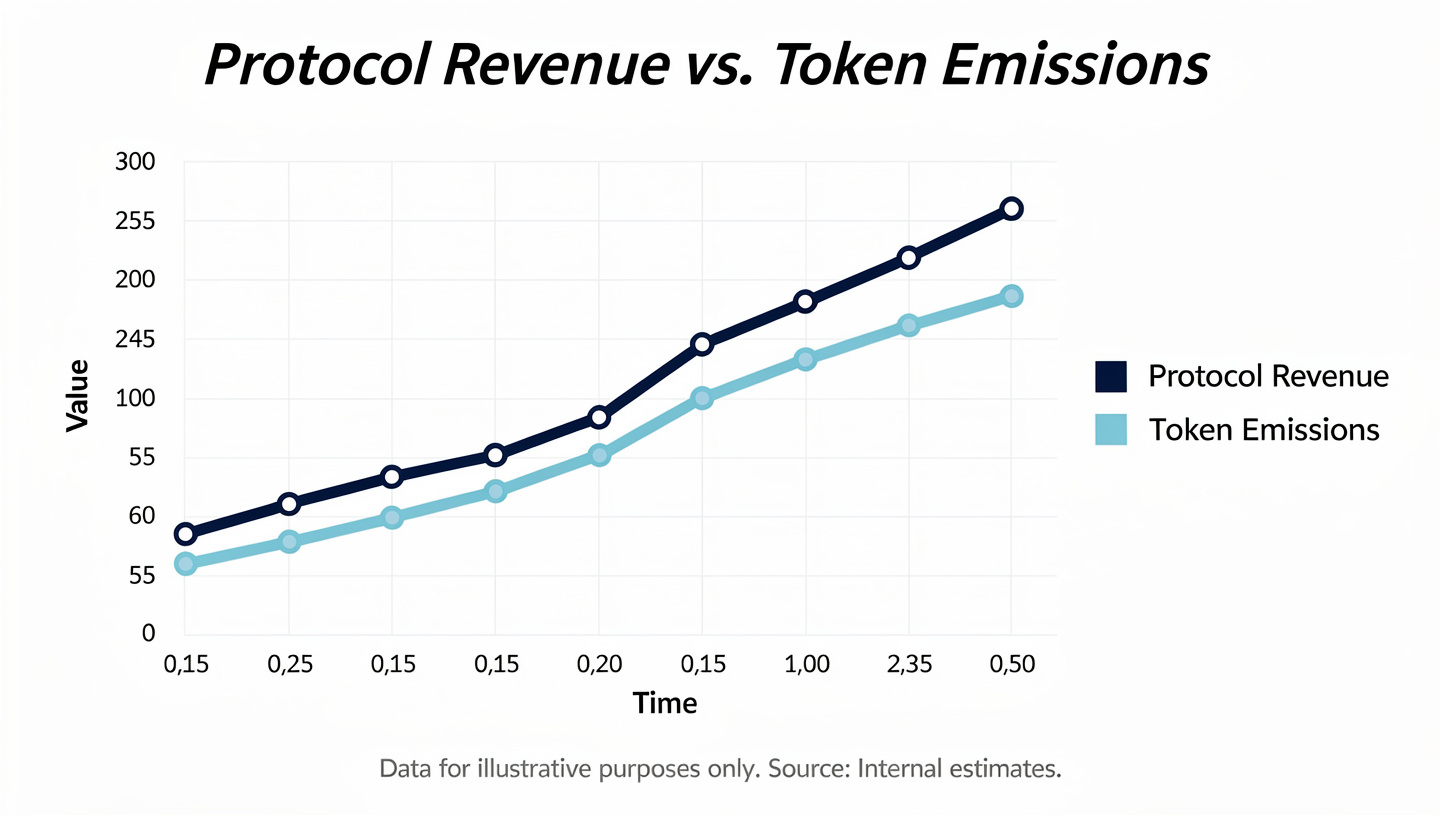
Every protocol lives inside a simple equation:
Value captured vs value emitted.
Ignore that equation, and you are speculating.
Understand it, and you are investing.
This article dissects that equation in depth.
We will examine:
- What protocol revenue actually means (and what it doesn’t)
- How token emissions function as hidden operating expenses
- Why high APY is usually a warning signal, not an opportunity
- The sustainability framework used by serious crypto analysts
- Real structural patterns separating durable protocols from temporary ones
- How to evaluate any project in under 15 minutes using revenue–emission dynamics
No hype. No storytelling. Just mechanics.
1. What Is Protocol Revenue — Really?
Protocol revenue is frequently misunderstood.
Most dashboards show “fees generated.” That is not the same thing.
True protocol revenue is:
Value that accrues directly to token holders or the protocol treasury after intermediaries are paid.
Let’s clarify with examples.
If a DEX generates $10M in trading fees but distributes 90% to liquidity providers, the protocol revenue is not $10M. It is $1M.
If a lending protocol earns interest but redirects it to depositors, that is not protocol revenue.
If a rollup charges gas fees but uses them entirely to pay sequencers and infrastructure, again—not protocol revenue.
Real protocol revenue must satisfy three conditions:
- It originates from organic user demand
- It remains within the protocol ecosystem
- It benefits token holders or strengthens the treasury
Anything else is gross activity, not revenue.
This distinction matters because only retained value compounds.
Everything else is throughput.
2. Token Emissions: Crypto’s Invisible Expense Line
In normal companies, expenses appear on income statements.
In crypto, they are hidden inside token inflation.
Token emissions are simply newly created tokens distributed to:
- Liquidity providers
- Stakers
- Farmers
- Validators
- Ecosystem participants
They serve one purpose: to bootstrap usage.
But economically, emissions are operating costs.
They dilute existing holders to subsidize growth.
This is equivalent to a company issuing new shares every day to pay employees and customers.
Yet most crypto investors treat emissions as yield.
That is backwards.
When you receive staking rewards funded by inflation, you are not earning income. You are reclaiming dilution.
It feels like profit because tokens appear in your wallet.
But system-wide, no new value was created.
Only supply increased.
This distinction separates speculation from fundamentals.
3. The Core Equation: Revenue Must Eventually Exceed Emissions
Every protocol begins life unprofitable.
That is acceptable.
Startups burn capital to acquire users. Crypto protocols burn token supply.
The difference is that startups burn investor money. Protocols burn your ownership.
Early emissions are justified if they produce durable usage.
But eventually, the model must flip.
A sustainable protocol reaches the point where:
Organic revenue ≥ token emissions
At that moment, dilution stops being necessary.
Until then, growth is artificial.
Most protocols never reach this stage.
They exist in permanent subsidy mode.
They survive only as long as new participants are willing to absorb inflation.
That is not a business model.
That is a treadmill.
4. Why High APY Is Usually a Red Flag
Retail investors are drawn to large numbers.
30%.
80%.
200%.
These yields almost always come from emissions, not revenue.
Let’s consider a simple example:
- Token supply: 100M
- Annual emissions: 20M
- Staking APY: 20%
If protocol revenue is negligible, every holder is diluted by 20% per year.
Stakers merely offset that dilution.
Non-stakers lose purchasing power.
Nobody wins.
Now imagine price rises anyway.
That happens when speculation overwhelms fundamentals.
But structurally, nothing improved.
When momentum fades, inflation remains.
Prices follow.
High APY without matching revenue is not generosity.
It is accounting smoke.
5. Real Yield vs Inflated Yield
Crypto analysts increasingly distinguish between:
Real Yield
Yield paid from protocol revenue.
Examples:
- Trading fees distributed to token holders
- Interest margin captured by lending protocols
- MEV or sequencer profits shared with stakers
This mirrors dividends or buybacks.
Value flows from users to owners.
Inflated Yield
Yield paid from token emissions.
No external value enters the system.
Supply expands.
Ownership is reshuffled.
Most DeFi “yield” today is inflated yield.
Real yield remains rare.
That scarcity matters.
6. The Sustainability Framework Used by Serious Analysts
Professional crypto funds evaluate projects using a simple structure:
Step 1: Measure Annual Protocol Revenue
Not TVL.
Not volume.
Not hype.
Actual retained revenue.
Step 2: Measure Annual Token Emissions (in USD terms)
Convert token inflation into dollar value.
This is the protocol’s operating expense.
Step 3: Compute Revenue Coverage Ratio
Revenue / Emissions
Interpretation:
- < 0.3 → Heavy subsidy dependency
- 0.3–0.7 → Transitional phase
- 1.0 → Self-sustaining
- 2.0 → Capital efficient
Very few protocols exceed 1.0.
Even fewer maintain it through market cycles.
Those that do tend to outperform long term.
Not dramatically.
Quietly.
7. Why Market Cycles Expose Weak Revenue Models
Bull markets hide structural flaws.
Token prices rise faster than dilution.
Emission-funded rewards look attractive.
Everyone feels smart.
Bear markets reverse the process.
Revenue drops. Emissions continue.
Treasuries shrink.
Token prices fall.
Projects that never achieved revenue dominance enter survival mode.
You see:
- Reward reductions
- Layoffs
- Pivot announcements
- Emergency tokenomics proposals
This pattern repeats every cycle.
Strong protocols contract but survive.
Weak ones disappear.
8. Treasury Runway Matters More Than Roadmaps
Most whitepapers are fiction.
What matters is runway.
Treasury assets divided by monthly burn gives you survival time.
Burn includes:
- Emissions
- Developer salaries
- Infrastructure
- Incentive programs
If a protocol has 18 months of runway at current burn, everything else is secondary.
Revenue growth without burn control is meaningless.
Good capital allocators care more about expense discipline than feature velocity.
Crypto rarely does.
That is why capital efficiency is scarce.
9. Token Value Accrual: The Missing Layer
Even when revenue exists, it often does not reach the token.
Common patterns:
- Fees go to LPs
- Revenue accumulates unused in treasury
- Governance never activates distribution
- Buybacks are promised but not implemented
A protocol can generate millions and still fail investors.
Revenue must be structurally linked to token value.
Mechanisms include:
- Fee sharing
- Token burns
- Buyback programs
- Revenue-backed staking
Without this link, tokens become governance souvenirs.
10. How to Evaluate Any Protocol in 15 Minutes
Use this checklist:
- What is annual protocol revenue?
- What is annual token emission value?
- Who receives the revenue?
- Is dilution decreasing over time?
- Does the token capture cash flow?
- How long is treasury runway?
- Is usage organic or incentive-driven?
If you cannot answer these from public dashboards, assume the worst.
Transparency correlates strongly with quality.
11. The Long-Term Winners Share One Trait
They are boring.
They optimize margins.
They reduce emissions.
They prioritize retained earnings.
They avoid flashy APYs.
They let adoption grow slowly.
They resemble infrastructure companies more than casinos.
Speculators overlook them.
Capital eventually finds them.
This is not exciting.
It is how compounding works.
Final Thoughts
Crypto does not fail because technology is weak.
It fails because economics are ignored.
Protocol revenue is real.
Token emissions are costs.
Everything else is narrative.
If revenue never overtakes emissions, value leaks forever.
If it does, ownership compounds quietly.
You do not need to predict markets.
You need to follow cash flows.
That principle worked before blockchains existed.
It still works now.
The only difference is that crypto makes dilution easier to hide.
Learn to see it.