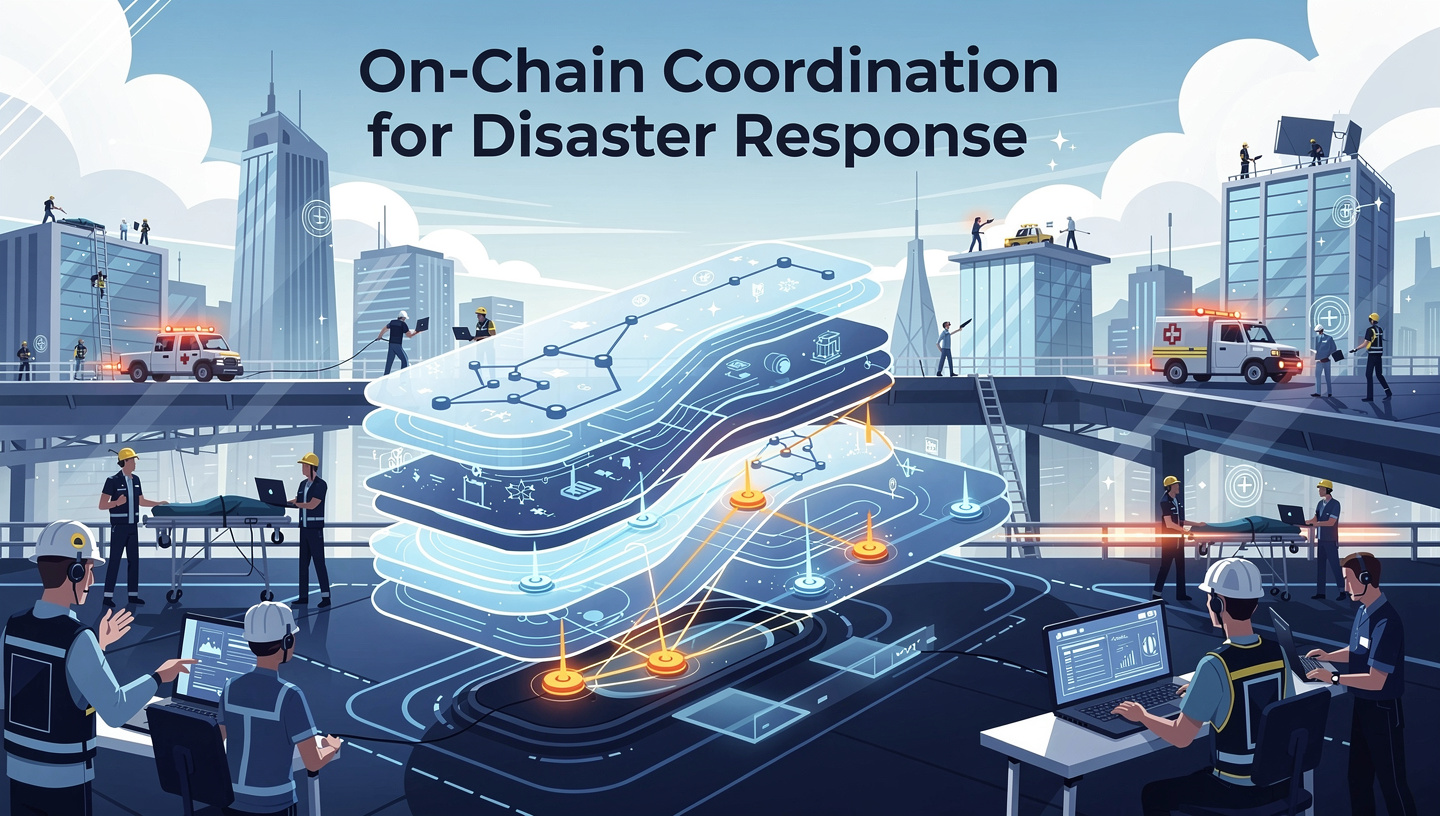
In the immediate aftermath of a natural disaster, coordination collapses before concrete does. Roads fracture, power grids fail, telecommunications degrade, and administrative systems grind to a halt. Yet the most consequential failure is often invisible: the breakdown of trust and synchronization among responders, governments, donors, and affected populations.
Disaster response is fundamentally a coordination problem under extreme uncertainty. Information is incomplete, incentives are misaligned, and resources are scarce. Traditional systems—centralized databases, siloed agencies, manual reporting processes—struggle under the load. Aid arrives late. Funds are misallocated. Duplication and corruption emerge precisely when accountability is hardest to enforce.
On-chain coordination offers an alternative architecture.
Blockchain-based systems—pioneered by networks such as Bitcoin and expanded through programmable platforms like Ethereum—introduce verifiable state, transparent execution, and programmable trust into adversarial and low-trust environments. In disaster contexts, these properties are not ideological luxuries. They are operational advantages.
This article examines how on-chain coordination can transform disaster response. It analyzes architectural models, governance structures, tokenized resource flows, identity systems, supply chain verification, and programmable funding mechanisms. It evaluates constraints, risks, and implementation realities. It outlines a practical roadmap for integrating blockchain infrastructure into emergency management frameworks.
The thesis is direct: on-chain coordination is not a replacement for humanitarian logistics. It is an enabling layer that can increase speed, transparency, and resilience in crisis response—if designed correctly.
The Structural Failures of Traditional Disaster Coordination
Before proposing alternatives, it is necessary to diagnose the systemic weaknesses of current models.
1. Fragmented Information Systems
Disaster response involves governments, NGOs, military units, international agencies, local volunteers, and private contractors. Each operates separate data systems. Information interoperability is limited. Data reconciliation is manual.
The result:
- Delayed situational awareness
- Conflicting reports
- Redundant resource deployment
- Poor real-time accountability
2. Opaque Financial Flows
Donor funds often move through multiple intermediaries before reaching beneficiaries. Financial transparency degrades at each layer. In high-volume crises, oversight lags.
Leakage can occur through:
- Administrative overhead
- Corruption
- Inefficient procurement
- Inaccurate beneficiary identification
3. Identity Verification Failures
In many disasters, individuals lose documentation. Without identity verification:
- Cash transfers stall
- Aid eligibility is contested
- Fraud risks increase
4. Trust Deficits in Low-Institutional Contexts
In regions with weak institutions, affected populations may distrust government distribution mechanisms. Donors may distrust local execution partners. This mutual skepticism slows coordination.
These failures are not accidental. They stem from centralized architectures operating under stress.
What “On-Chain Coordination” Means in Disaster Contexts
On-chain coordination refers to the use of blockchain infrastructure to:
- Record critical state transitions (fund allocations, inventory movements, beneficiary disbursements)
- Execute conditional logic through smart contracts
- Create shared, tamper-resistant data layers
- Align incentives via tokenized mechanisms
- Enable decentralized governance where appropriate
In practice, this does not mean replacing all operational systems with blockchain. It means anchoring high-value coordination points on-chain to reduce ambiguity and enforce rules programmatically.
Public blockchain networks such as Ethereum, scalable networks like Solana, and ecosystem frameworks such as Cosmos provide programmable infrastructure that can serve as the backbone for coordination layers.
Core Design Principles for Disaster-Oriented Blockchain Systems
1. Minimalism in On-Chain Data
Sensitive data should not be fully exposed on public ledgers. Instead:
- Hashes anchor documents.
- Zero-knowledge proofs verify claims.
- Off-chain storage systems maintain detailed records.
The chain becomes a verification layer, not a raw data warehouse.
2. Permissioned Participation, Public Verification
In disaster scenarios, open participation can create attack surfaces. Hybrid models allow:
- Authorized entities to write transactions.
- Public observers to audit state transitions.
This balances transparency with operational security.
3. Stable Value Rails
Volatility is incompatible with relief funding. Stablecoins—particularly those like USD Coin—can serve as programmable disbursement instruments. These assets enable instant, traceable transfers without exposure to extreme price fluctuations.
Use Case 1: Transparent Aid Fund Allocation
Problem
Billions of dollars in disaster relief funds pass through opaque channels. Donors lack granular visibility into how funds are deployed.
On-Chain Architecture
- Donor funds are deposited into a smart contract treasury.
- Allocation proposals are submitted by registered NGOs.
- Multi-signature governance approves disbursements.
- Each transfer is recorded immutably.
- Milestone-based releases occur upon proof submission.
Smart contracts enforce:
- Conditional release of funds.
- Auditability of every transaction.
- Automatic reporting dashboards.
Benefits
- Reduced administrative lag
- Public audit trails
- Decreased corruption surface
- Programmatic milestone enforcement
Use Case 2: Tokenized Supply Chain Verification
Disaster logistics involve food, medicine, water, and temporary shelter materials. Supply chains are vulnerable to theft, diversion, and counterfeit goods.
Architecture
Each batch of supplies:
- Is assigned a digital token.
- Is linked to verifiable shipping records.
- Updates state at each custody transfer.
IoT devices can sign updates to the chain, verifying location and condition.
By anchoring supply chain events on-chain:
- Stakeholders share a synchronized ledger.
- Diversion becomes detectable.
- Insurance claims can auto-trigger based on recorded damage events.
Use Case 3: Decentralized Identity for Displaced Populations
Loss of documentation impedes relief distribution.
Blockchain-based identity frameworks allow individuals to:
- Register biometric or attestable identity proofs.
- Receive cryptographic credentials.
- Prove eligibility without revealing excessive personal data.
Self-sovereign identity systems enable:
- Portable credentials.
- Reduced fraud.
- Faster aid disbursement.
Zero-knowledge proof frameworks ensure that eligibility can be verified without exposing full identity data.
Use Case 4: Conditional Cash Transfers via Smart Contracts
Cash-based interventions are more efficient than in-kind distribution in many contexts. However, oversight remains a concern.
Smart contracts can:
- Release funds upon verified completion of reconstruction milestones.
- Disburse daily living stipends automatically.
- Adjust allocations based on real-time needs assessments.
For example:
- A housing reconstruction grant is locked in escrow.
- Drone-based imagery verification confirms foundation completion.
- Smart contract releases next tranche.
This removes bureaucratic delay from conditional execution.
Use Case 5: DAO-Based Community Governance
Local communities often understand needs better than centralized agencies.
Decentralized autonomous organizations (DAOs) can:
- Allocate micro-grants.
- Vote on priority projects.
- Distribute pooled resources transparently.
Governance tokens can be distributed to verified residents. Voting records remain transparent. Treasury flows are visible.
This model enhances participatory reconstruction.
Interoperability with Traditional Institutions
On-chain systems must integrate with:
- Government treasury systems
- International NGOs
- Insurance providers
- Telecommunications infrastructure
Bridging mechanisms include:
- API integrations
- Off-chain oracle networks
- Stablecoin-to-fiat onramps
The objective is not to replace institutions but to reduce friction between them.
Resilience in Infrastructure Failure Scenarios
A critical question: What happens when internet connectivity is degraded?
Potential solutions include:
- Satellite internet integration
- Mesh networks
- Offline signing with later synchronization
- Local blockchain nodes in mobile data centers
Blockchain networks are inherently distributed. Unlike centralized databases housed in a single data center, distributed nodes maintain ledger continuity even if some regions go offline.
Risk Analysis
1. Cybersecurity Risks
Public ledgers are resistant to tampering but vulnerable at the application layer. Smart contract bugs can cause fund loss. Rigorous audits are mandatory.
2. Governance Capture
DAO governance may be dominated by actors with higher token weight. Disaster governance systems must prevent plutocratic capture.
3. Regulatory Constraints
Cross-border fund flows trigger compliance obligations. AML/KYC requirements must integrate with identity frameworks.
4. Digital Divide
Affected populations may lack smartphone access. Solutions must support low-tech interfaces, including SMS-based authentication.
Economic Modeling: Incentive Alignment in Crisis
On-chain systems allow incentive design beyond traditional bureaucratic models.
Mechanisms include:
- Reputation staking for NGOs.
- Slashing conditions for misreporting.
- Performance-based token rewards.
- Bonded oracle systems.
These mechanisms convert accountability from a post-hoc audit into a real-time economic constraint.
Case Study Framework (Hypothetical Deployment)
Scenario: Major typhoon impacts a coastal region.
Deployment sequence:
- Emergency relief treasury contract deployed.
- Stablecoin donations accepted globally.
- Verified NGOs submit proposals.
- Community DAO prioritizes needs.
- Supply chain tokens track shipments.
- Conditional smart contracts release reconstruction funds.
- Public dashboards monitor progress.
The result:
- Reduced duplication.
- Real-time auditability.
- Automated milestone enforcement.
Comparative Analysis: Centralized vs On-Chain Coordination
| Dimension | Centralized Model | On-Chain Model |
|---|---|---|
| Transparency | Limited | Immutable |
| Trust Model | Institutional | Cryptographic |
| Execution | Manual | Programmatic |
| Auditability | Retrospective | Real-time |
| Cross-border Funds | Slow | Instant (stablecoins) |
| Resilience | Central point of failure | Distributed |
The superiority of on-chain coordination is not universal. It depends on implementation quality. However, its structural advantages under stress are substantial.
Implementation Roadmap
Phase 1: Pilot Programs
- Small-scale regional disasters.
- Limited fund volume.
- NGO consortium governance.
Phase 2: Hybrid Integration
- Government integration.
- Stablecoin issuance frameworks.
- Compliance embedding.
Phase 3: Standardization
- Interoperable identity standards.
- Open-source smart contract libraries.
- International relief consortium adoption.
The Strategic Implications
On-chain coordination reframes disaster response as a programmable system rather than a bureaucratic process. It reduces dependence on trust in individuals and replaces it with verifiable execution.
This is not technological idealism. It is infrastructure modernization.
The same properties that secure decentralized financial systems—immutability, transparency, cryptographic guarantees—are directly applicable to high-stakes crisis environments.
Conclusion: Designing for the Worst Day, Not the Best
Disasters reveal institutional weaknesses that remain hidden in stable conditions. Systems built for ordinary operations fail under extreme load. Coordination fractures. Accountability weakens.
On-chain coordination does not eliminate suffering. It does not prevent hurricanes or earthquakes. It does not replace logistics expertise or humanitarian experience.
It does something narrower and more precise: it strengthens the informational and financial backbone of disaster response.
By anchoring aid flows, identity verification, supply chain tracking, and governance decisions on verifiable ledgers, disaster response can become faster, more transparent, and more resilient.
The future of emergency management will not be purely on-chain. It will be hybrid. But as programmable infrastructure becomes standard across finance and governance, its integration into disaster response is not speculative. It is inevitable.
When physical infrastructure fails, digital coordination must remain intact. On-chain systems provide that continuity—precisely when it is needed most.