The digital asset economy is frequently described in broad, imprecise terms. “Crypto” is used as shorthand for everything from decentralized payment systems to tokenized art markets. This linguistic compression obscures an essential structural distinction: cryptocurrencies and NFTs are not variations of the same asset class. They are fundamentally different primitives built on shared infrastructure.
Both rely on blockchain networks. Both use cryptographic verification. Both are transferred through wallets and validated by consensus mechanisms. Yet they serve distinct economic, technical, and functional purposes.
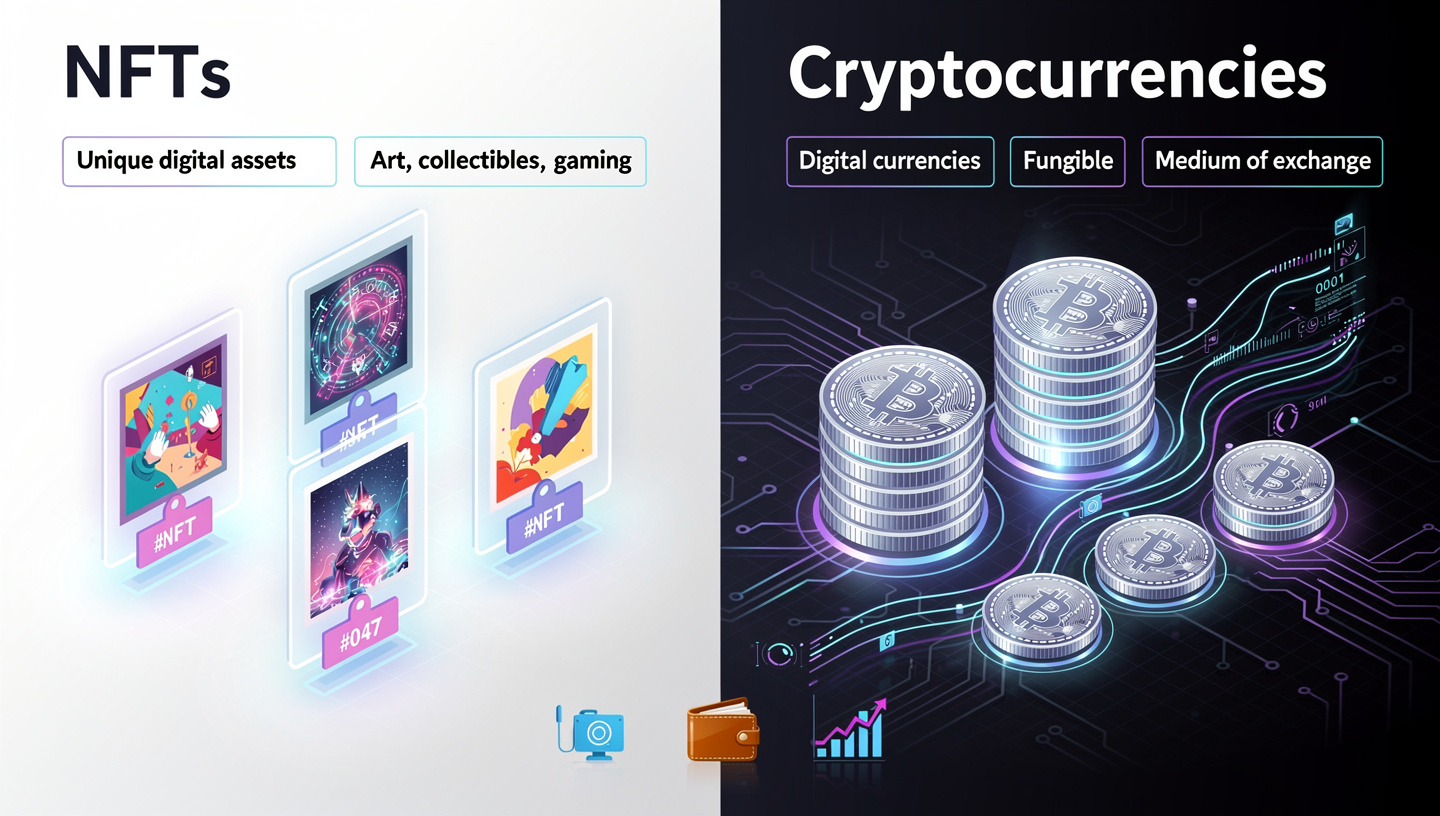
Cryptocurrencies are fungible monetary units optimized for value transfer and settlement. NFTs—non-fungible tokens—are unique digital assets designed to represent singular ownership, identity, or rights.
This article provides a rigorous, research-oriented explanation of NFTs vs cryptocurrencies, covering architecture, token standards, economic design, valuation models, regulatory treatment, technical mechanisms, and long-term implications. It is written for readers seeking conceptual clarity and structural depth.
1. Foundational Definitions
What Is a Cryptocurrency?
A cryptocurrency is a fungible digital token secured by cryptography and recorded on a blockchain. Units are interchangeable. One token equals any other token of the same denomination.
For example:
- 1 unit of Bitcoin equals any other 1 unit of Bitcoin.
- 1 unit of Ethereum equals any other 1 unit of Ethereum.
Cryptocurrencies are typically designed to function as:
- Medium of exchange
- Store of value
- Unit of account
- Settlement layer asset
- Network utility token
They operate through standardized token models (e.g., ERC-20 on Ethereum) and are divisible into fractional units.
What Is an NFT?
An NFT (Non-Fungible Token) is a cryptographically unique digital token recorded on a blockchain. Unlike cryptocurrencies, NFTs are not interchangeable. Each token has distinct metadata and a unique identifier.
NFTs are typically created using token standards such as:
- ERC-721
- ERC-1155
Most NFTs exist on the Ethereum network, though other blockchains support them.
An NFT represents ownership of:
- Digital art
- Collectibles
- Music
- Virtual land
- In-game assets
- Identity credentials
- Tokenized real-world assets
The defining characteristic is non-fungibility—no two tokens are identical in identity or metadata.
2. Fungibility vs Non-Fungibility: The Core Distinction
Fungibility
An asset is fungible if each unit is interchangeable with any other unit of the same type.
Examples:
- Currency (cash)
- Commodities (gold ounces)
- Standardized stocks
Cryptocurrencies follow this principle.
If two users each own 5 ETH, the origin of those tokens does not matter for economic equivalence (except in rare compliance contexts).
Non-Fungibility
An asset is non-fungible if it possesses unique characteristics that prevent interchangeability.
Examples:
- Real estate parcels
- Fine art
- Collectible trading cards
NFTs encode this uniqueness directly into the blockchain through token IDs and metadata.
3. Technical Architecture
Both NFTs and cryptocurrencies rely on blockchains, but they differ at the token contract level.
Cryptocurrencies (ERC-20 Model)
On Ethereum, fungible tokens follow the ERC-20 standard. The smart contract maintains:
- Total supply
- Balances mapping
- Transfer functions
- Allowance/approval functions
All tokens are identical units within the contract.
NFTs (ERC-721 Model)
ERC-721 introduces:
- Unique token IDs
- Ownership mapping per ID
- Metadata URI
- Individual transfer logic
Each token is discrete.
ERC-1155: Hybrid Model
ERC-1155 allows both fungible and non-fungible tokens within a single contract. It is commonly used in gaming ecosystems.
4. Economic Purpose and Utility
Cryptocurrencies: Monetary Infrastructure
Cryptocurrencies primarily function as:
- Decentralized money
- Network fuel (gas fees)
- Staking assets
- Collateral in DeFi
For example:
- Bitcoin functions as a decentralized store of value.
- Ethereum functions as programmable settlement infrastructure.
They are optimized for liquidity and velocity.
NFTs: Ownership Infrastructure
NFTs encode:
- Provenance
- Scarcity
- Authenticity
- Transferable rights
They are optimized for uniqueness and verifiable authorship, not monetary interchangeability.
5. Supply Models
Cryptocurrency Supply
Cryptocurrencies often feature:
- Fixed maximum supply (e.g., 21 million BTC)
- Inflationary issuance schedules
- Algorithmic emission curves
- Burn mechanisms
Supply models are transparent and coded into protocol rules.
NFT Supply
NFT supply can vary:
- Single unique asset (1/1)
- Limited edition collection (10,000 items)
- Open mint with dynamic issuance
Scarcity is a design choice by the issuer rather than protocol-imposed.
6. Divisibility
Cryptocurrencies:
- Divisible into small fractions (e.g., 1 BTC = 100,000,000 satoshis)
NFTs:
- Generally indivisible
- Fractional NFTs require separate wrapper contracts
Divisibility reflects different economic intent.
7. Valuation Frameworks
Cryptocurrency Valuation
Methods include:
- Network effect models (Metcalfe’s Law)
- Hash rate analysis
- Monetary premium modeling
- Supply-demand equilibrium
- On-chain metrics
NFT Valuation
NFT pricing depends on:
- Rarity traits
- Creator reputation
- Cultural relevance
- Utility access
- Community size
- Liquidity depth
NFT markets behave more like fine art markets than currency markets.
8. Liquidity Differences
Cryptocurrencies:
- Deep order books
- High-frequency trading
- Instant market pricing
NFTs:
- Thin liquidity
- Bid-ask spreads
- Price discovery through auctions
Liquidity asymmetry is one of the most significant structural differences.
9. Regulatory Considerations
Cryptocurrencies are evaluated under:
- Commodity frameworks
- Securities law tests
- Payment regulations
NFTs are treated differently depending on:
- Fractionalization
- Profit expectation
- Revenue-sharing structures
Regulatory treatment varies by jurisdiction and use case.
10. Security and Risk
Cryptocurrencies face risks such as:
- 51% attacks
- Smart contract vulnerabilities
- Exchange hacks
NFT-specific risks include:
- Metadata hosting failures
- Copyright disputes
- Illiquid exit markets
The risk profiles diverge because the economic structures differ.
11. Use Cases Comparison
| Dimension | Cryptocurrencies | NFTs |
|---|---|---|
| Fungibility | Yes | No |
| Divisibility | Yes | Usually No |
| Primary Role | Money & Settlement | Ownership & Identity |
| Liquidity | High | Low–Moderate |
| Pricing Model | Market-driven | Rarity & Narrative-driven |
| Standard | ERC-20 | ERC-721 / ERC-1155 |
12. Market Behavior
Cryptocurrency markets:
- Macro-correlated
- Influenced by liquidity cycles
- Institutional participation
NFT markets:
- Community-driven
- Socially amplified
- Narrative-sensitive
They exhibit different volatility patterns.
13. Interoperability
Cryptocurrencies:
- Used across DeFi, payments, staking, lending
NFTs:
- Used across marketplaces, metaverses, gaming ecosystems
Interoperability standards differ but share wallet infrastructure.
14. Are NFTs a Type of Cryptocurrency?
Technically:
NFTs are tokens issued on cryptocurrency networks.
Economically:
NFTs are not currencies.
Functionally:
NFTs are programmable property, not money.
15. The Broader Digital Asset Stack
Cryptocurrencies provide:
- Consensus layer
- Security budget
- Transaction validation
NFTs build on top of that base layer to represent unique state ownership.
They are complementary, not competitive.
16. Long-Term Implications
Cryptocurrencies aim to reshape:
- Monetary systems
- Global settlement
- Financial sovereignty
NFTs aim to reshape:
- Intellectual property markets
- Digital identity
- Creator monetization
- Asset tokenization
The distinction is structural and durable.
Conclusion: Two Primitives, One Infrastructure
NFTs and cryptocurrencies share cryptographic foundations but diverge in economic purpose and token architecture.
Cryptocurrencies are designed for fungible value transfer and monetary coordination.
NFTs are designed for unique ownership representation and digital scarcity.
Confusing them leads to flawed analysis, incorrect valuation models, and regulatory misunderstanding.
Understanding their differences clarifies the broader crypto ecosystem: a layered architecture in which fungible and non-fungible assets coexist, serving complementary but fundamentally distinct functions.
The digital economy does not revolve around a single type of token. It operates through specialized primitives optimized for different forms of coordination.
Cryptocurrencies secure value.
NFTs secure uniqueness.
Both redefine ownership—but in fundamentally different ways.