For many people, the word NFT still triggers a familiar image: pixelated avatars selling for absurd prices, speculative bubbles, and headlines declaring either the future of the internet or its greatest folly. Art, collectibles, hype—this narrow framing has followed NFTs since their explosive rise in 2021.
But here’s the uncomfortable truth most debates miss: NFTs were never meant to stop at art.
Art was merely the first visible use case, not the final destination. Beneath the surface, NFTs represent something far more profound—a new primitive for digital ownership, coordination, and trust. When stripped of speculation and celebrity mania, NFTs quietly unlock real-world applications that traditional databases, contracts, and platforms struggle to handle.
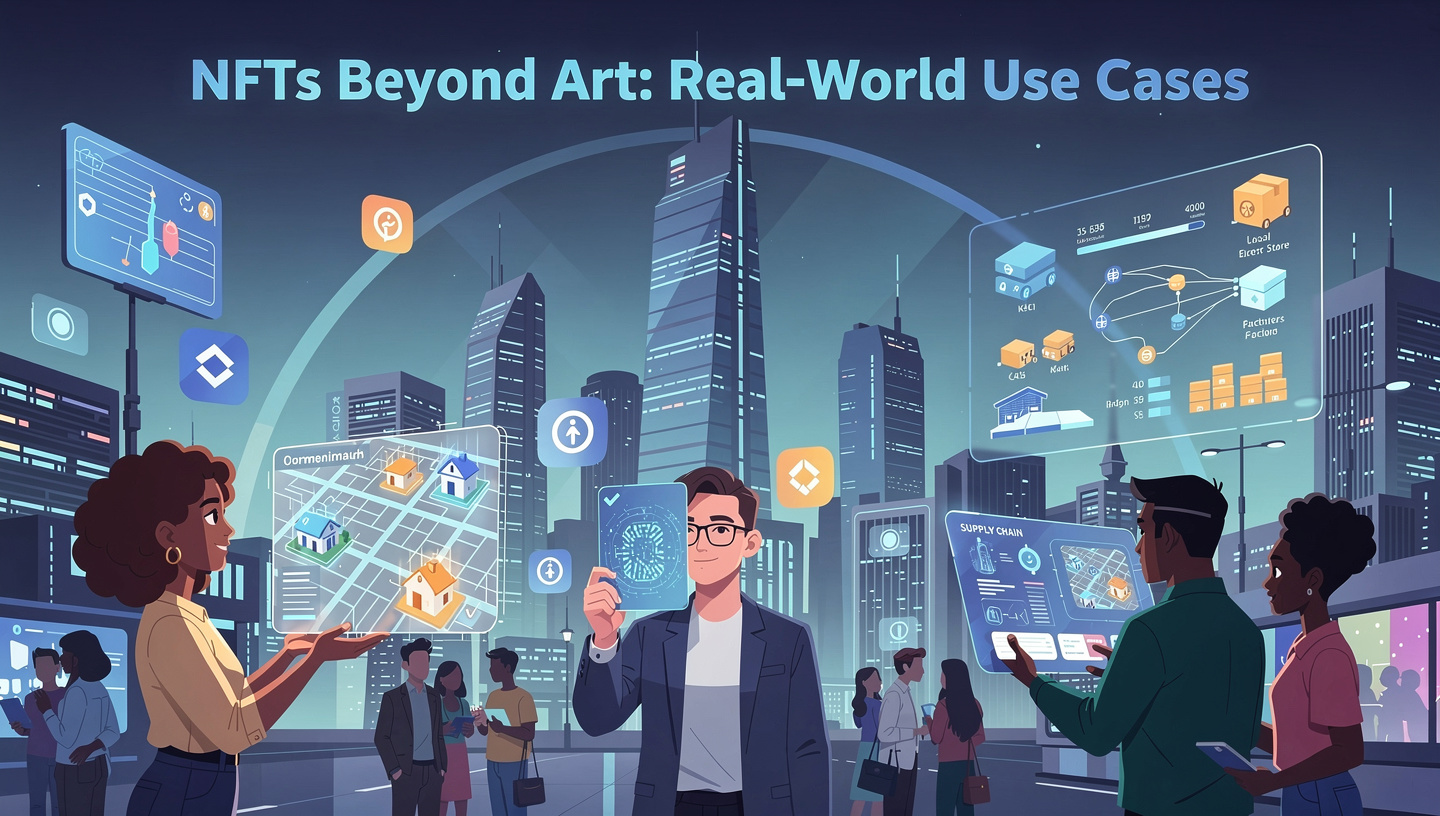
This article explores NFTs beyond the gallery walls—where they intersect with identity, finance, supply chains, gaming, education, real estate, and even governance. Not as a utopian fantasy, but as a pragmatic evolution of how value and rights are recorded in the digital age.
Understanding NFTs Beyond the Buzzwords
At their core, NFTs are unique, verifiable, programmable records on a blockchain. Unlike cryptocurrencies, which are interchangeable, NFTs carry identity. Each token can represent something specific, traceable, and non-duplicable.
What makes NFTs powerful is not the image they display—but what they prove:
- Ownership
- Authenticity
- Provenance
- Access rights
- Participation history
In other words, NFTs function as digital deeds, not just digital art.
Once this lens shifts, entire industries come into focus.
Digital Identity: Ownership of the Self
In today’s internet, identity is fragmented. Platforms own your data, governments issue IDs, and users exist as profiles rather than proprietors.
NFTs introduce a radical alternative: self-sovereign identity.
How NFTs Enable Identity
An NFT can represent:
- A verified professional credential
- A membership or accreditation
- A persistent digital persona across platforms
Unlike usernames or accounts, NFT-based identities are:
- Portable
- User-controlled
- Resistant to censorship or arbitrary deletion
Imagine:
- A freelancer whose verified work history exists as NFTs
- A refugee carrying credentials independent of any state
- A creator whose reputation follows them across platforms
This is not theoretical. Universities, DAOs, and Web3-native communities are already experimenting with NFT-based credentials that cannot be forged or revoked without consent.
Identity becomes something you own—not something you are granted.
Supply Chains: From Blind Trust to Verifiable Truth
Modern supply chains are astonishingly complex—and notoriously opaque. Counterfeit goods, unethical sourcing, and data manipulation plague industries from luxury fashion to pharmaceuticals.
NFTs introduce transparent provenance.
NFTs in Supply Chain Tracking
Each step of a product’s lifecycle can be minted or updated via NFTs:
- Raw material origin
- Manufacturing conditions
- Logistics and transportation
- Retail and resale history
Because NFTs are immutable and timestamped:
- Brands prove authenticity
- Consumers verify ethical sourcing
- Regulators audit without intermediaries
Luxury brands now explore NFTs as digital certificates tied to physical goods. Pharmaceuticals can track authenticity from factory to patient. Even agriculture benefits—allowing consumers to trace food back to farms.
Trust shifts from marketing claims to cryptographic proof.
Gaming: When Players Actually Own the Game
Traditional games monetize players but deny them ownership. Items, characters, and progress vanish when servers shut down or accounts are banned.
NFTs flip this model.
What NFTs Change in Gaming
- In-game assets become player-owned
- Items can move across games or marketplaces
- Time investment translates into transferable value
This isn’t just about “play-to-earn.” It’s about play-to-own.
NFTs allow:
- Secondary markets without publisher control
- Community-driven economies
- Persistent virtual identities
While early implementations struggled with balance and speculation, the long-term promise is profound: games as open economies, not closed casinos.
Ticketing & Access: Ending Fraud and Scalping
Concerts, conferences, and sports events suffer from fake tickets, scalping, and opaque pricing.
NFT-based tickets solve this elegantly.
NFT Ticketing Advantages
- Verifiable authenticity
- Programmable resale rules
- Built-in royalties for creators or organizers
- Post-event utility (souvenirs, perks, access)
Artists regain control. Fans gain fairness. Secondary markets become transparent.
A ticket stops being disposable and becomes a lasting digital artifact of experience.
Real Estate: Fractional Ownership Without Paperwork Nightmares
Real estate is valuable—but notoriously illiquid and inaccessible.
NFTs introduce programmable property rights.
How NFTs Reshape Real Estate
- Fractional ownership via tokenized deeds
- Faster settlement without endless intermediaries
- Transparent ownership history
- Global access to local assets
While regulations vary widely, pilot projects already tokenize commercial buildings, rental income streams, and even land rights.
This doesn’t replace traditional law—it interfaces with it, offering efficiency rather than rebellion.
Education: Credentials That Cannot Be Faked
Diplomas and certificates are easy to forge and hard to verify across borders.
NFTs offer a simple solution.
NFT-Based Academic Credentials
- Tamper-proof degrees
- Lifelong verification without contacting institutions
- Portable academic histories
Universities can issue NFT diplomas. Employers verify instantly. Students own their achievements forever.
Education becomes more global, transparent, and interoperable.
Healthcare: Data With Consent, Not Exploitation
Medical records are fragmented, siloed, and vulnerable.
NFTs can represent permissions, not data itself.
NFTs in Healthcare
- Patients control access to records
- Temporary permissions granted to providers
- Audit trails for every access
This model respects privacy while improving interoperability. Data stays secure; consent becomes programmable.
DAOs & Governance: Participation With Memory
Decentralized Autonomous Organizations (DAOs) struggle with governance, voter apathy, and identity.
NFTs introduce governance with context.
NFTs can represent:
- Voting power
- Contribution history
- Reputation
Unlike tokens that reward wealth, NFTs reward participation and impact.
Governance evolves from plutocracy to meritocracy—at least in design.
Why Art Came First (And Why It’s Not the End)
Art succeeded first because:
- It’s subjective
- It tolerates experimentation
- It attracts culture and attention
But focusing only on art is like judging the internet by email in 1995.
NFTs are not about JPEGs.
They’re about verifiable digital ownership in a world that increasingly lives online.
The Challenges Are Real—and Necessary
NFTs are not flawless.
They face:
- Scalability issues
- Regulatory uncertainty
- UX complexity
- Environmental concerns (largely improving)
But these challenges mirror every foundational technology in its infancy.
The question isn’t whether NFTs are perfect—but whether the problems they address are real.
They are.
Conclusion: Beyond Art Lies the Point
Art made NFTs famous.
Utility will make them permanent.
NFTs represent a shift from platform-controlled value to user-owned systems. From trust in institutions to trust in mathematics. From temporary access to lasting rights.
We are not watching a trend—we are watching a transition.
And like all meaningful transitions, it begins loudly… then continues quietly, reshaping everything beneath our feet.