The first generation of blockchain systems pursued vertical integration. Execution, consensus, and data availability were bundled into single monolithic architectures. This design simplified early deployment but imposed structural trade-offs: limited throughput, high fees during congestion, and rigid upgrade pathways. As decentralized finance (DeFi), non-fungible tokens (NFTs), and on-chain governance expanded, the limitations of monolithic chains became economically visible.
The next phase of blockchain innovation centers on modularity. Rather than embedding every function in one base layer, modular blockchains decouple core responsibilities—execution, consensus, settlement, and data availability—into specialized layers. This separation allows independent optimization and horizontal scaling.
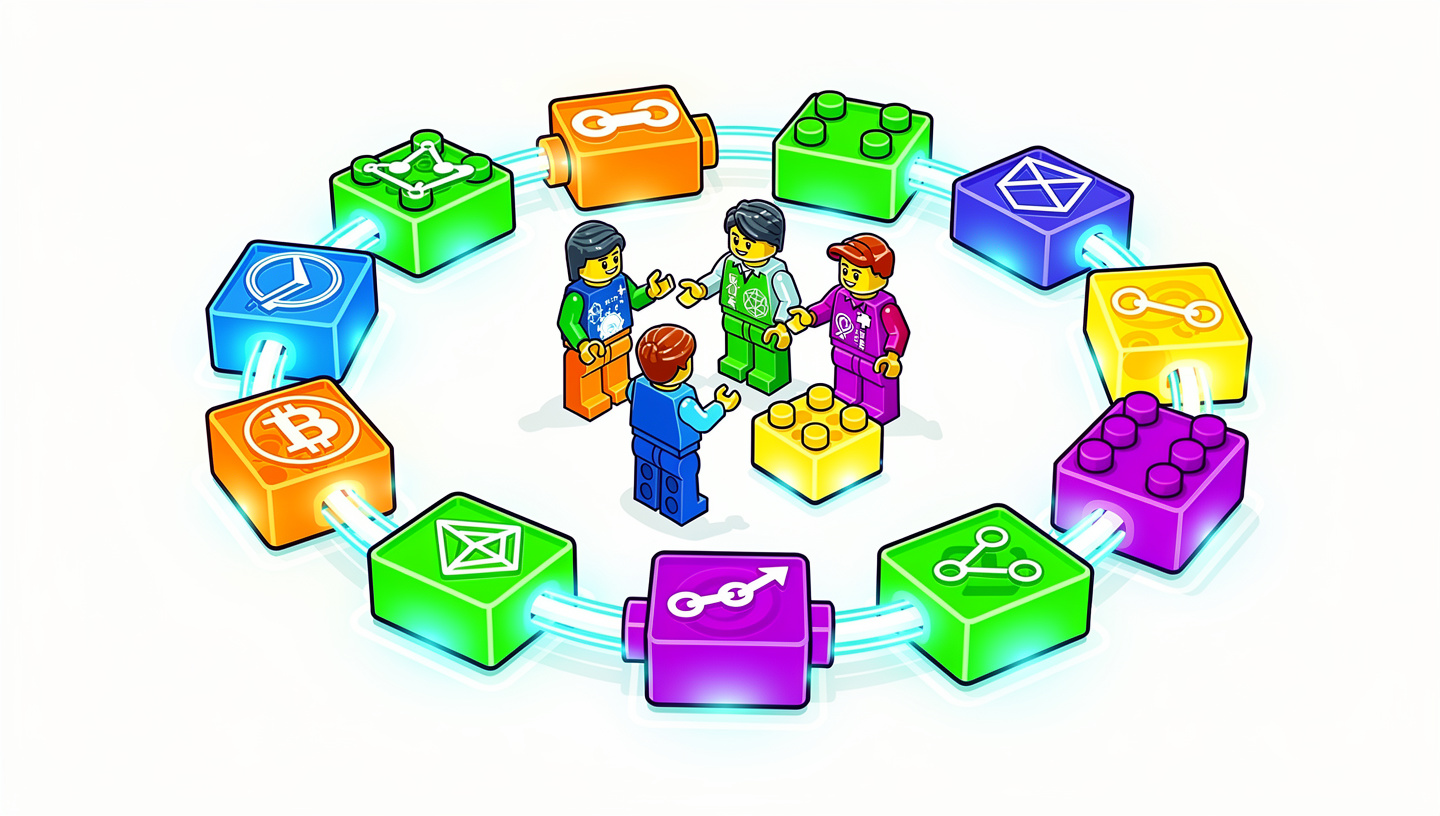
Parallel to this architectural shift is an economic transformation. On-chain systems are no longer isolated protocols. They behave like composable primitives—financial “Lego bricks”—that can be stacked, combined, and reconfigured into higher-order structures. This phenomenon, often referred to as “money legos,” now extends beyond DeFi into identity, governance, gaming, infrastructure, and real-world asset tokenization.
The convergence of modular blockchains and Lego-style economic composability defines a new phase of crypto infrastructure: scalable, programmable, interoperable, and capital-efficient.
This article examines:
- The technical foundations of modular blockchain design
- The economics of composability and Lego economies
- Key infrastructure players and emerging standards
- Security trade-offs and systemic risk
- Long-term implications for digital capital markets
1. Monolithic vs Modular Blockchain Architecture
Monolithic Blockchains
In a monolithic blockchain, a single network performs four primary functions:
- Execution – processing transactions and smart contracts
- Consensus – agreeing on transaction ordering and validity
- Data Availability (DA) – ensuring transaction data is accessible
- Settlement – finalizing state transitions
For example, Ethereum historically handled all four layers on its base chain. Likewise, Solana integrates execution and consensus tightly to maximize throughput.
Advantages of monolithic design:
- Simplified architecture
- Lower inter-layer latency
- Unified security domain
Limitations:
- Scalability bottlenecks
- High gas costs during peak demand
- Limited customization for application-specific needs
As on-chain applications scaled, these constraints became economically material.
2. The Modular Blockchain Thesis
Modular blockchains separate functions into specialized layers. Each layer can scale independently and optimize for distinct objectives.
2.1 Layer Separation
A modular stack typically includes:
- Execution Layer – Smart contracts and application logic
- Settlement Layer – Finality and dispute resolution
- Consensus Layer – Validator coordination
- Data Availability Layer – Ensuring transaction data is publicly retrievable
This design enables horizontal scaling by allowing multiple execution environments to operate in parallel while sharing common security guarantees.
2.2 Rollups as Modular Catalysts
The rise of rollups accelerated modular thinking.
Rollups execute transactions off-chain and post compressed data to a base chain. They inherit security from the settlement layer while reducing congestion.
Two major categories:
- Optimistic rollups
- Zero-knowledge (ZK) rollups
Examples include:
- Arbitrum
- Optimism
- zkSync
Rollups externalize execution from Layer 1 while preserving settlement guarantees. This is the first concrete implementation of modularity at scale.
3. Data Availability as a Standalone Layer
One of the most significant innovations in modular design is isolating data availability.
Traditionally, Layer 1 chains store transaction data permanently. This constrains scalability because nodes must download and verify all historical data.
Dedicated DA layers change the model.
3.1 Celestia and Data Availability Sampling
Celestia pioneered a blockchain focused solely on ordering transactions and ensuring data availability without executing smart contracts.
It introduced Data Availability Sampling (DAS), enabling light clients to verify data presence probabilistically without downloading the full dataset. This dramatically lowers hardware requirements and supports horizontal scaling.
3.2 Ethereum as a Settlement Layer
Post-upgrades, Ethereum increasingly functions as:
- Settlement layer
- Consensus layer
- Data availability provider (via blob transactions)
The rollup-centric roadmap effectively turns Ethereum into a modular base layer supporting dozens of independent execution environments.
4. The Emergence of Lego Economies
Modularity at the infrastructure layer enables composability at the application layer.
A “Lego economy” describes a system where:
- Protocols interoperate permissionlessly
- Smart contracts compose without bilateral agreements
- Assets are portable across applications
This phenomenon emerged prominently in DeFi.
4.1 Early DeFi Composability
Consider the composability loop:
- Liquidity provided to Uniswap
- LP tokens deposited into Aave
- Borrowed assets yield-farmed in Curve Finance
Each protocol acts as a modular financial primitive.
This inter-protocol stacking creates capital efficiency but also systemic interdependence.
5. Economic Implications of Composability
5.1 Capital Efficiency
Composable systems allow:
- Rehypothecation of collateral
- Automated yield routing
- Dynamic liquidity provisioning
Capital can serve multiple productive functions simultaneously.
5.2 Network Effects
Modular systems amplify network effects:
- More protocols → more integration points
- More integration → more liquidity
- More liquidity → tighter spreads and higher utility
This positive feedback loop strengthens dominant infrastructure layers.
5.3 Composability Risk
However, composability introduces:
- Cascading liquidation risk
- Oracle dependency vulnerabilities
- Smart contract coupling failures
The 2020–2022 DeFi cycles demonstrated how tightly integrated systems can transmit shocks rapidly.
6. Appchains, Sovereign Rollups, and Custom Execution
Modularity allows application-specific chains (“appchains”).
6.1 Sovereign Rollups
Sovereign rollups use a data availability layer but maintain independent settlement rules.
For example, Cosmos pioneered appchain design through its SDK model.
Projects like Polygon support customized execution environments tailored to specific use cases.
6.2 Advantages of Custom Execution
- Fee market isolation
- Governance autonomy
- Optimized performance parameters
- Reduced congestion externalities
Modularity enables application sovereignty without sacrificing shared security.
7. Cross-Chain Interoperability
A Lego economy requires asset portability.
Interoperability layers such as:
- Polkadot
- Cosmos
enable heterogeneous chains to communicate via standardized protocols.
Bridges remain one of the largest attack surfaces in crypto infrastructure. Modular design reduces dependency on centralized bridges by encouraging native interoperability standards.
8. Modular Security Models
Security in modular systems is multi-layered.
8.1 Shared Security
Rollups inherit security from the settlement layer. This concentrates trust but increases systemic reliance on Layer 1.
8.2 Restaking and Economic Security
Protocols like EigenLayer allow validators to reuse staked capital to secure additional modules.
This creates:
- Expanded economic security
- New slashing vectors
- Correlated failure risk
Restaking intensifies composability at the security layer.
9. Real-World Asset Integration
Modular infrastructure simplifies tokenization of:
- Bonds
- Real estate
- Private credit
- Structured products
Platforms such as MakerDAO have integrated real-world collateral into stablecoin issuance.
A Lego economy extends to off-chain assets, bridging traditional capital markets with programmable settlement.
10. Performance and Scalability Outlook
Modular systems aim for:
- Parallelized execution
- Lower hardware requirements
- Reduced validator load
- Specialized optimization per layer
Compared to monolithic throughput scaling, modularity scales via horizontal expansion—multiple rollups, shared data layers, optimized execution engines.
The roadmap emphasizes:
- ZK-proof compression
- Stateless clients
- Data pruning strategies
- Cross-rollup atomic composability
11. Governance in Modular Ecosystems
Governance fragments across layers:
- Settlement governance
- Rollup governance
- Application governance
This layered governance introduces complexity but improves resilience. Failure in one domain does not necessarily compromise the entire stack.
12. Strategic Outlook: Infrastructure as a Stack
The modular blockchain stack resembles cloud computing architecture:
- Base settlement layer (analogous to TCP/IP)
- Data availability services
- Execution environments
- Application layer
This structure supports rapid innovation without re-architecting foundational infrastructure.
Modular chains decouple innovation velocity from base-layer ossification.
13. Risks and Systemic Considerations
Despite its advantages, modularity introduces:
- Fragmented liquidity
- Increased MEV surfaces
- Cross-layer coordination complexity
- Multi-protocol dependency graphs
Lego economies amplify both innovation and contagion.
The central design challenge is maintaining composability while minimizing correlated systemic risk.
Conclusion: The Future of Crypto Is Modular
Modular blockchains redefine the architecture of decentralized systems. By separating execution, consensus, settlement, and data availability, crypto infrastructure achieves horizontal scalability without sacrificing security guarantees.
Simultaneously, Lego economies unlock programmable capital markets where financial, governance, and identity primitives interlock permissionlessly.
The long-term trajectory is clear:
- Settlement layers become neutral, minimal, and secure
- Execution environments proliferate
- Data availability becomes commoditized
- Applications compose dynamically
Modular blockchains are not merely a scaling strategy. They represent a structural reorganization of digital trust infrastructure.
In the coming decade, the dominant crypto ecosystems will not be those that maximize throughput in isolation, but those that optimize interoperability, capital efficiency, and composable economic design.
The era of vertically integrated blockchains is giving way to modular stacks and Lego economies—systems built not as single towers, but as networks of interoperable, programmable components.