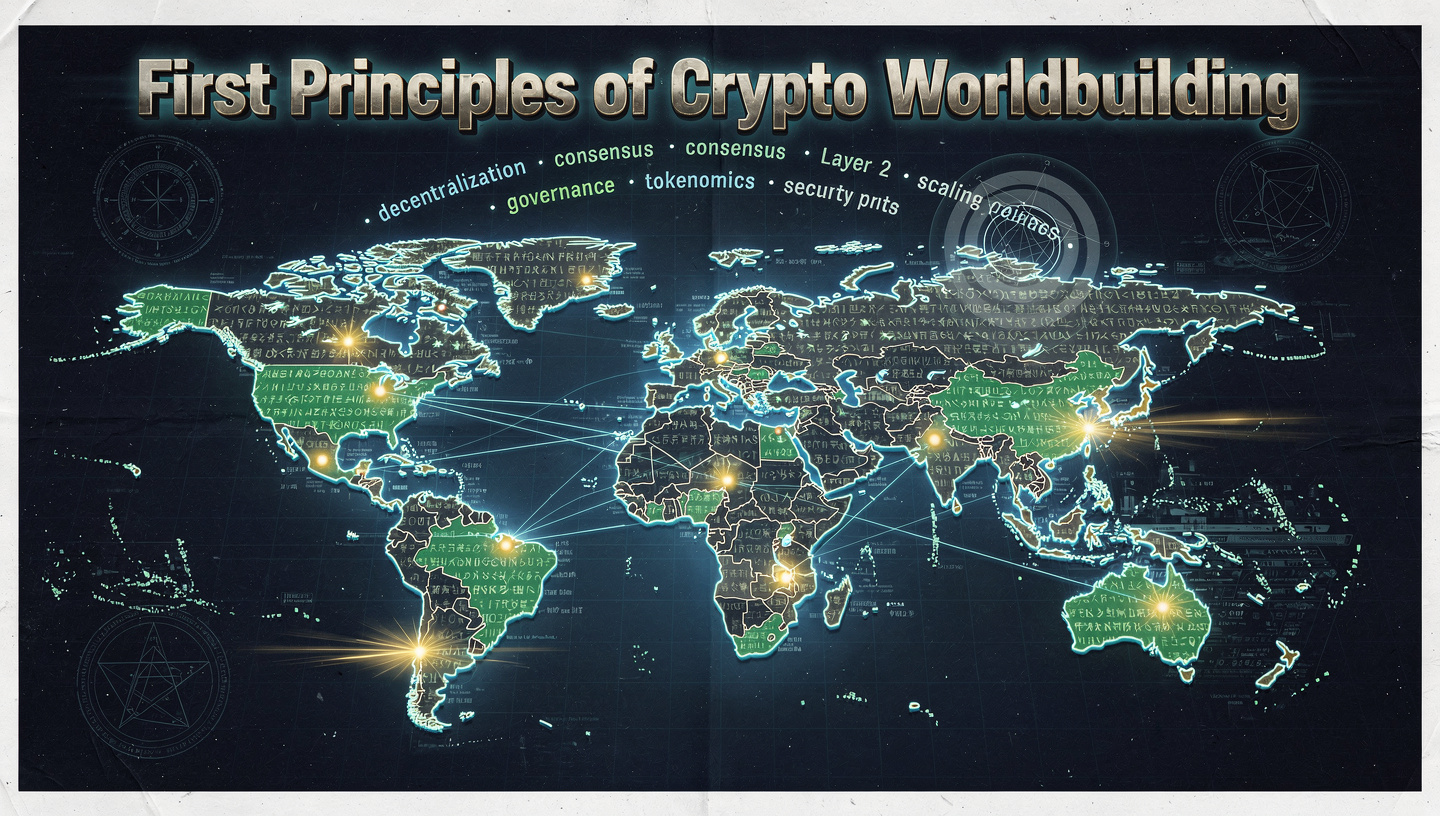
Migration has always been a defining force of civilization. Humans have moved across rivers, deserts, and oceans in search of opportunity, safety, or meaning. In the crypto-native era, migration is no longer constrained by geography alone. It happens across protocols, blockchains, DAOs, and digital cultures. Wallet addresses replace passports. Smart contracts substitute for visas. Reputation graphs become social capital.
This article examines migration between crypto societies as a serious worldbuilding problem: how decentralized communities emerge, how people and capital flow between them, and how values, governance, and economic incentives shape these movements. This is not speculative fiction. It is an analytical framework for understanding how crypto ecosystems function as proto-civilizations—and how individuals navigate between them.
We will explore:
- What constitutes a “crypto society”
- Why migration happens in decentralized systems
- The mechanics of digital citizenship
- Cultural friction between chains and communities
- Economic incentives and exit rights
- Governance arbitrage
- Identity, reputation, and portability
- The future of inter-protocol mobility
The premise is simple: crypto is not merely financial infrastructure. It is a laboratory for post-national social organization.
Defining Crypto Societies
A crypto society is not just a blockchain. It is a layered system composed of:
- Technical substrate (consensus, execution, data availability)
- Economic structure (tokens, incentives, market design)
- Governance mechanisms (on-chain voting, off-chain coordination)
- Cultural norms (memes, ethics, narratives)
- Social capital systems (reputation, contribution history)
Consider Bitcoin. Technically, it is a proof-of-work blockchain. Socially, it is a community with strong ideological commitments to immutability, minimal governance, and monetary hardness. By contrast, Ethereum is a programmable world-state computer whose society embraces experimentation, governance iteration, and rapid evolution.
Each network forms a distinct civilizational cluster—a combination of code, capital, and collective belief.
Crypto societies resemble city-states more than nation-states. They are opt-in, digitally native, and globally accessible. Their borders are APIs. Their laws are smart contracts. Their currencies are endogenous.
Migration between these societies is therefore not an anomaly—it is the default condition.
Why People Migrate in Crypto
Traditional migration is driven by push and pull factors: war, poverty, opportunity, freedom. Crypto migration follows similar dynamics, but with protocol-specific triggers.
1. Economic Opportunity
Liquidity mining, staking yields, NFT markets, and early-stage token launches create powerful gravitational fields. Capital and labor (in the form of developers, designers, and community builders) flow toward ecosystems with higher expected returns.
When incentives shift, migration accelerates.
This is why entire communities have moved from one Layer 1 to another during bull cycles. Yield is a visa.
2. Governance Dissatisfaction
Crypto users migrate when governance feels captured, stagnant, or hostile to minority views. Forks, rage-quits, and DAO exits are digital equivalents of political asylum.
Decentralized Autonomous Organizations—commonly called DAOs—make this explicit. Members can leave with their assets, fork the codebase, or spin up a parallel institution.
Exit is not just a right; it is a core design principle.
3. Cultural Alignment
Some communities value stability. Others prioritize innovation. Some favor minimalism; others embrace complexity. These differences matter.
Bitcoin maximalists and Ethereum builders inhabit radically different cultural universes, even when they share wallets and exchanges.
Migration often reflects value alignment more than raw profit.
4. Technical Constraints
High fees, slow finality, or limited composability push users toward alternative environments. Infrastructure quality directly affects population movement.
Scalability is not just an engineering concern—it is a demographic one.
Digital Citizenship: Wallets as Passports
In crypto societies, identity is portable.
A wallet address functions as:
- Proof of asset ownership
- Credential for governance participation
- Anchor for reputation
- Entry point to communities
Unlike nation-states, crypto societies rarely enforce exclusivity. You can belong to many simultaneously. Multi-chain citizenship is normal.
However, this freedom introduces new challenges.
Sybil Resistance
If identities are cheap, governance is vulnerable. Societies respond with staking requirements, reputation systems, or proof-of-humanity protocols.
Reputation Portability
Today, your contribution history on one chain rarely carries weight on another. This creates friction for migrants. A respected builder in one ecosystem may arrive as an anonymous outsider elsewhere.
The lack of interoperable reputation is one of the largest unsolved problems in crypto migration.
Governance Arbitrage
Just as corporations engage in regulatory arbitrage between countries, crypto participants engage in governance arbitrage between protocols.
They move toward environments where:
- Voting power is cheaper
- Influence is more concentrated
- Rules are more favorable
- Coordination costs are lower
This has profound implications.
Protocols with weak governance attract opportunistic actors. Those with rigid governance risk stagnation. The equilibrium lies somewhere between adaptability and capture resistance.
Notably, Ethereum’s governance culture—shaped in part by Vitalik Buterin—emphasizes rough consensus, off-chain deliberation, and social legitimacy over pure on-chain voting. This produces a very different migration profile compared to more formalized systems.
Economic Systems as Migration Engines
Every crypto society encodes its own economic logic.
Some prioritize sound money. Others optimize for developer velocity. Some reward early adopters heavily. Others distribute value slowly and broadly.
These design choices determine who arrives—and who leaves.
Tokenomics and Settlement Layers
Hard-capped assets attract savers. Inflationary tokens attract builders. High-throughput chains attract traders. Privacy-preserving networks attract dissidents.
Economic architecture is destiny.
Migration patterns reveal which values are being rewarded.
Labor in Crypto Societies
Work is increasingly modular and borderless:
- Developers contribute to multiple DAOs
- Designers operate across NFT ecosystems
- Researchers publish independently and receive retroactive funding
Labor migrates faster than capital. Talent follows narrative momentum and community health more than APR.
Cultural Friction Between Chains
Migration is never frictionless.
Each crypto society has implicit norms:
- How proposals are written
- How disagreement is handled
- What constitutes legitimacy
- Which tools are standard
A user moving from Bitcoin to Ethereum encounters not just new technology, but a new culture: faster iteration, more governance discourse, and higher tolerance for change.
This cultural gap explains why many migrants churn. They arrive for yield but leave due to misalignment.
Worldbuilding in crypto must account for this. Protocols that invest in onboarding, education, and narrative coherence retain migrants more effectively.
Exit Rights as a Foundational Primitive
In traditional states, exit is costly. In crypto, exit is cheap.
You can:
- Bridge assets
- Withdraw liquidity
- Fork code
- Start a competing DAO
This creates a radically different power dynamic.
Governance is disciplined by mobility. Leaders cannot rely on coercion. They must compete for participants continuously.
This is one of crypto’s most profound contributions to political theory: legitimacy through voluntary association.
The original vision attributed to Satoshi Nakamoto implicitly encoded this idea. Bitcoin offered an exit from centralized monetary systems without requiring permission.
Migration is therefore not a side effect. It is the enforcement mechanism.
The Rise of Meta-Societies
As bridges, cross-chain messaging, and shared liquidity improve, we are witnessing the emergence of meta-societies: networks of networks.
Users increasingly inhabit:
- Multiple Layer 2s
- Several DAOs
- A portfolio of NFT communities
- Parallel governance forums
Identity fragments across contexts. Belonging becomes compositional.
This resembles a federated civilization, where allegiance is fluid and layered.
Future crypto societies will likely compete not on isolation, but on interoperability quality.
Worldbuilding Implications: Designing for Migration
If you are designing a protocol, DAO, or crypto-native institution, migration must be treated as a first-class concern.
Key design questions include:
1. How do newcomers onboard?
Documentation, tooling, and social pathways matter. A hostile onboarding experience repels migrants regardless of incentives.
2. How is reputation earned—and recognized?
Without portable reputation, societies remain siloed. Expect increasing experimentation with cross-protocol identity primitives.
3. What are the exit conditions?
Clear exit mechanics build trust. Ambiguous or punitive exits create reputational damage.
4. What cultural values are encoded?
Code expresses values. So do governance processes, community norms, and funding mechanisms. Migrants sense this quickly.
The Long-Term Trajectory
Over the next decade, expect:
- More specialized crypto societies
- Stronger cultural differentiation between chains
- Increasing importance of reputation portability
- Governance models optimized for high mobility
- Hybrid on-chain/off-chain citizenship systems
Crypto will not converge into a single global network. It will fragment into many value-aligned micro-civilizations connected by bridges, standards, and shared liquidity.
Migration will remain constant.
The winners will be societies that embrace it.
Conclusion: A Civilization Built on Choice
Migration between crypto societies represents a fundamental shift in how humans organize collectively.
For the first time at scale, people can opt into economic systems, governance regimes, and cultural communities without moving their bodies or surrendering sovereignty. They can leave when values diverge. They can belong to many worlds at once.
This is not just technological evolution. It is civilizational re-architecture.
Crypto societies are experiments in voluntary coordination. Migration is their feedback loop.
Design accordingly.
Because in this new world, borders are protocols—and citizenship is a wallet away.