For most of modern economic history, ownership has been lumpy. Equity required accreditation. Real estate demanded capital concentration. Infrastructure investments were institutional. Intellectual property flowed through intermediaries. Even digital platforms—arguably the most scalable systems ever built—concentrated ownership among founders, venture capital firms, and public market participants.
Cryptographic networks disrupt that structural asymmetry.
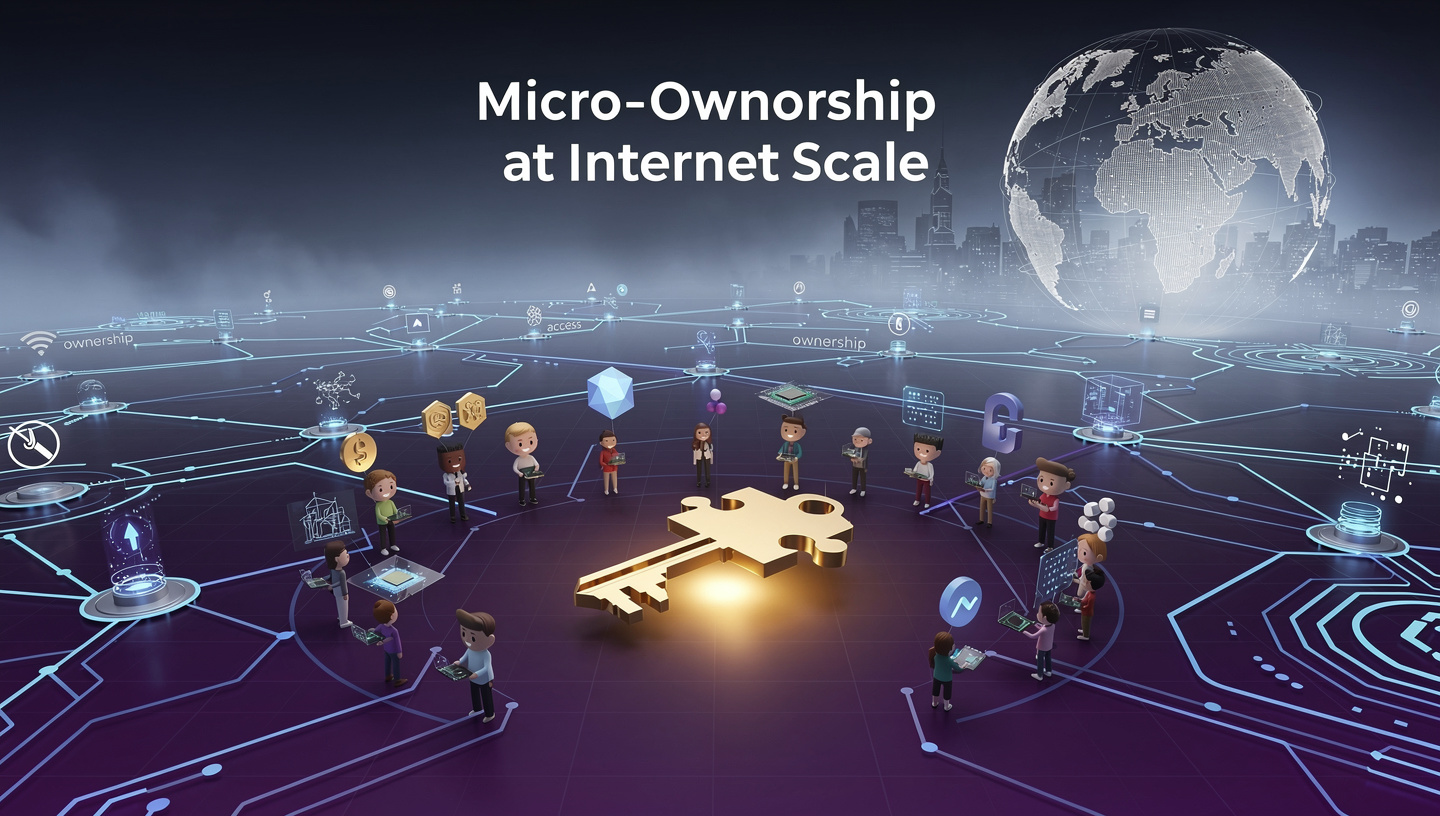
Micro-ownership at internet scale refers to the programmable, fractional, and globally accessible allocation of economic rights across vast networks of participants. Enabled by blockchain infrastructure, tokenization, smart contracts, and decentralized finance (DeFi), micro-ownership transforms capital formation, value distribution, and governance into software-native primitives.
This is not a theoretical shift. It is a structural one. Public blockchains such as Ethereum and Solana support millions of token holders. Protocol-native tokens distribute fee revenue, governance rights, and network incentives to globally dispersed stakeholders. Real-world assets are increasingly tokenized. Digital creators monetize directly via non-fungible tokens (NFTs). Infrastructure networks reward users for participation.
Micro-ownership is the financialization of participation itself.
This article analyzes the architectural foundations, economic implications, regulatory considerations, technological constraints, and future trajectory of micro-ownership at internet scale. It examines how programmable assets reshape capital markets, how decentralized governance modifies corporate structure, and how frictionless fractionalization challenges traditional property regimes.
1. The Structural Limits of Traditional Ownership
Ownership systems evolved around physical scarcity, geographic limitation, and centralized record-keeping. Three structural constraints dominated:
- Capital Concentration – Large assets required large pools of capital.
- Jurisdictional Boundaries – Ownership transfer depended on local legal infrastructure.
- Administrative Friction – Share registries, clearinghouses, custodians, and intermediaries added latency and cost.
Public equity markets partially solved liquidity constraints but introduced new intermediaries. Clearing systems such as Depository Trust & Clearing Corporation became essential nodes. Access remained limited by brokerage accounts, geographic restrictions, accreditation requirements, and trading hours.
Micro-ownership requires three properties absent from legacy systems:
- Programmable fractionalization
- Global settlement finality
- Near-zero marginal distribution cost
Blockchain infrastructure enables these properties natively.
2. Tokenization: The Primitive of Fractionalization
Tokenization is the process of representing economic rights as cryptographic tokens on a blockchain. These tokens may represent:
- Governance rights
- Revenue shares
- Utility access
- Claims on real-world assets
- Intellectual property royalties
- Physical infrastructure usage
Standards such as ERC-20 and ERC-721 on Ethereum allow digital assets to interoperate across wallets, exchanges, and protocols.
Fractionalization becomes computational rather than contractual. An asset can be divided into 1,000 units—or 1 billion—without additional administrative complexity. Smart contracts automatically enforce transfer logic, distribution mechanisms, and participation rules.
Micro-ownership emerges when:
- Asset issuance is permissionless.
- Distribution is programmatic.
- Liquidity is algorithmic.
- Governance is transparent.
3. Decentralized Finance and Automated Liquidity
Liquidity is the oxygen of ownership.
Without liquidity, fractionalization remains theoretical. Decentralized exchanges (DEXs) such as Uniswap introduced automated market makers (AMMs), replacing order books with algorithmic pricing curves. Any token can become tradable without centralized listing approval.
This architecture produces:
- Continuous global markets
- 24/7 price discovery
- Permissionless liquidity pools
- Composable financial primitives
Micro-ownership scales because liquidity no longer depends on centralized gatekeepers.
Further, DeFi protocols integrate staking, lending, and yield mechanisms. Token holders can deploy micro-capital into productive networks without institutional intermediation. Participation and ownership converge.
4. Governance Tokens and Network-Owned Infrastructure
Traditional corporations separate users from owners. Cryptographic networks collapse this distinction.
Governance tokens distribute voting rights across token holders. Protocol upgrades, treasury allocation, parameter changes, and economic adjustments are decided via on-chain governance systems.
Examples include:
- MakerDAO – governance over stablecoin parameters.
- Aave – community-driven lending market adjustments.
- Optimism – retroactive public goods funding via token governance.
Micro-ownership extends beyond passive holding. It embeds participatory control.
The shift is structural: infrastructure becomes collectively capitalized and collectively governed.
5. Creator Economies and Programmable Royalties
Digital creators historically relied on platforms that captured the majority of value. Web2 platforms centralized monetization, advertising revenue, and audience data.
NFT standards enable:
- Direct primary sales
- Embedded royalty logic
- Secondary market participation
- Global buyer access
Artists mint works and encode royalty splits directly into smart contracts. Secondary sales automatically distribute proceeds without manual enforcement.
Platforms such as OpenSea and Blur demonstrated the liquidity potential of creator-issued assets.
Micro-ownership allows fans to hold economic exposure to cultural production. The boundary between consumer and investor dissolves.
6. Real-World Asset Tokenization (RWA)
Tokenized real-world assets represent the convergence of traditional finance and blockchain infrastructure.
Applications include:
- Fractional real estate
- Treasury-backed stablecoins
- Private credit pools
- Commodity-backed tokens
Institutional interest accelerated as asset managers explored tokenized funds. BlackRock launched tokenized fund initiatives on blockchain infrastructure, signaling institutional validation.
Benefits of RWA tokenization:
- Reduced settlement time
- Fractional global access
- Improved transparency
- Programmable compliance
Micro-ownership extends beyond digital-native assets into tangible capital markets.
7. Economic Implications: Distribution vs Concentration
Critics argue that token distributions replicate traditional concentration patterns. Early investors, insiders, and large holders can dominate governance and liquidity.
However, micro-ownership introduces new dynamics:
- Community airdrops
- Liquidity mining
- Retroactive rewards
- Contribution-based allocation
Protocols experiment with incentive engineering to align long-term participation with ownership.
The challenge is designing distribution mechanisms that prevent plutocratic capture while preserving capital efficiency.
Game theory and mechanism design become central disciplines.
8. Legal and Regulatory Frameworks
Ownership implies legal enforceability.
Jurisdictions differ in how they classify tokens:
- Securities
- Commodities
- Payment instruments
- Utility tokens
Regulators such as the U.S. Securities and Exchange Commission evaluate token offerings under securities law frameworks.
Tokenized assets require:
- KYC/AML compliance in some contexts
- Custodial clarity
- Tax reporting frameworks
- Cross-border harmonization
Regulatory clarity will determine the velocity of institutional adoption.
9. Infrastructure Constraints and Scalability
Micro-ownership at internet scale demands high throughput and low transaction costs.
Layer 2 scaling networks such as Arbitrum and Polygon reduce transaction fees and improve speed.
Challenges remain:
- Network congestion
- Smart contract vulnerabilities
- Governance attack vectors
- Key management complexity
Account abstraction, social recovery mechanisms, and wallet UX innovation reduce participation friction.
Scalability is both technical and human.
10. Data, Identity, and Composability
Ownership becomes portable when identity is portable.
Decentralized identity (DID) frameworks enable:
- On-chain reputation
- Credential verification
- Sybil resistance
- Governance weighting models
Composability allows tokens issued in one protocol to interact with others. Capital becomes interoperable across ecosystems.
Micro-ownership thrives in composable environments.
11. Micro-Ownership as Capital Formation Infrastructure
Traditional IPO processes are expensive and jurisdiction-bound. Token issuance reduces issuance overhead and globalizes access.
Emerging models include:
- Fair launches
- Bonding curves
- Liquidity bootstrapping pools
- Retroactive token distribution
Capital formation shifts from institutional syndicates to distributed communities.
The barrier between user growth and capital formation erodes.
12. Risks and Failure Modes
Micro-ownership introduces systemic risks:
- Token volatility
- Governance capture
- Regulatory intervention
- Smart contract exploits
- Liquidity fragmentation
Speculative bubbles distort allocation efficiency. Ponzi-like incentive structures can masquerade as sustainable networks.
Robust auditing, transparent tokenomics, and conservative treasury management mitigate systemic fragility.
13. Social Impact: Democratization or Illusion?
The promise is democratized capital access. The risk is pseudo-democratization where power remains concentrated.
Metrics to evaluate genuine decentralization:
- Gini coefficients of token distribution
- Active governance participation rates
- Treasury transparency
- Validator diversity
Micro-ownership must translate into agency, not merely token balances.
14. The Path to Internet-Scale Adoption
For micro-ownership to achieve internet scale, the following conditions must be met:
- Seamless user experience
- Embedded compliance frameworks
- Stable regulatory regimes
- Institutional-grade custody
- Sustainable token economics
Infrastructure providers and custodians are integrating blockchain settlement into traditional systems.
The boundary between centralized finance and decentralized finance is eroding.
15. Future Outlook: Network-Native Economies
Micro-ownership transforms:
- Platforms into protocols
- Users into stakeholders
- Capital into programmable code
- Governance into transparent computation
Over the next decade, expect:
- Tokenized infrastructure (energy grids, wireless networks)
- Decentralized physical infrastructure networks (DePIN)
- On-chain corporate governance
- Hybrid securities-token instruments
- Global micro-equity participation
Ownership becomes granular, liquid, and continuous.
Conclusion: The Rewriting of Economic Participation
Micro-ownership at internet scale is not incremental innovation. It is an architectural redesign of economic coordination.
By merging cryptographic security, programmable contracts, decentralized liquidity, and global accessibility, blockchain networks convert ownership into a digitally native primitive.
The implications extend beyond finance. Cultural production, infrastructure deployment, governance systems, and capital formation mechanisms are being restructured around distributed ownership.
The decisive question is not whether micro-ownership is technically feasible. It already is.
The decisive question is whether governance design, regulatory harmonization, and incentive engineering can align scale with resilience.
If they can, the result is a networked global economy where ownership is no longer concentrated by default, but distributed by design.