Crypto doesn’t rise because of whitepapers.
It rises because of belief.
It crashes because of fear.
And it goes parabolic because culture catches fire.
If you’ve spent any meaningful time inside crypto, you already know this. Fundamentals matter long-term, sure — but in the short and medium term, markets are driven by narratives, tribal momentum, and emotional liquidity.
That’s where meme coins and NFTs come in.
On the surface, they look like jokes.
Underneath, they represent something far deeper: two radically different expressions of speculative culture in the digital age.
Meme coins are velocity.
NFTs are identity.
One trades primarily on momentum and virality.
The other trades on ownership and meaning.
Both are misunderstood. Both are dismissed. Both have created billionaires — and destroyed portfolios.
This article is not about price targets.
It’s about psychology.
It’s about cultural capital.
It’s about why these two asset classes exploded, how they differ structurally, and what they reveal about the future of speculative markets.
Let’s break it down.
Part I – What Meme Coins Really Are (Beyond the Joke)
At a technical level, meme coins are simple:
They are fungible tokens, usually deployed on fast, low-cost blockchains like Ethereum, Solana, or BNB Chain.
They typically have:
- No unique utility
- No proprietary technology
- No defensible moat
- No revenue model
So why do they work?
Because meme coins are not technology products.
They are social instruments.
A meme coin is essentially a financialized inside joke.
Dogecoin. Shiba Inu. Pepe. Bonk. WIF.
Each one began as internet culture. What transformed them into market forces was collective participation.
Meme coins succeed when:
- The meme is recognizable
- The community is loud
- Liquidity arrives fast
- Influencers amplify it
- Retail feels early
This creates reflexivity.
Price goes up → attention increases → more buyers arrive → price goes up again.
It’s pure narrative momentum.
No discounted cash flow model can explain it.
This is emotional liquidity.
Meme Coins as Crowd Psychology Engines
Meme coins tap directly into:
- FOMO
- Tribal identity
- Risk-seeking behavior
- Short-term dopamine cycles
They reward speed over analysis.
Being early matters more than being right.
Unlike traditional investments, meme coins don’t require belief in a future product — only belief that others will buy after you.
This makes meme coins structurally closer to:
- Forex momentum trading
- Sports betting
- Viral TikTok trends
They thrive in bull markets when liquidity is abundant and attention spans shrink.
They collapse when liquidity tightens.
Importantly: meme coins democratize speculation.
You don’t need technical knowledge.
You don’t need capital.
You just need timing and courage.
That accessibility is part of their power.
Part II – NFTs Are Not Just JPEGs (They Never Were)
If meme coins are velocity, NFTs are permanence.
Non-Fungible Tokens introduced something radically new:
verifiable digital ownership.
Before NFTs, digital content could be copied infinitely.
After NFTs, scarcity entered cyberspace.
That’s a fundamental shift.
An NFT is not an image.
It’s a cryptographic proof of ownership attached to a unique token ID on a blockchain.
This allows:
- Digital collectibles
- On-chain identity
- Royalties for creators
- Permissionless marketplaces
- Programmable intellectual property
NFTs enable digital objects to behave like physical assets.
That matters.
NFTs as Cultural Infrastructure
The biggest misunderstanding about NFTs is thinking they are primarily speculative.
Speculation exists — but NFTs are closer to cultural primitives than financial instruments.
NFTs power:
- Profile picture identities
- Membership access
- Creator economies
- Gaming assets
- Metaverse land
- Brand engagement
Projects like CryptoPunks, Bored Ape Yacht Club, Art Blocks, and Pudgy Penguins succeeded not because of art quality alone — but because they created social signaling layers.
Owning certain NFTs communicates status, belonging, and taste.
Just like fashion.
Just like watches.
Just like sneakers.
NFTs are digital luxury goods with composable utility.
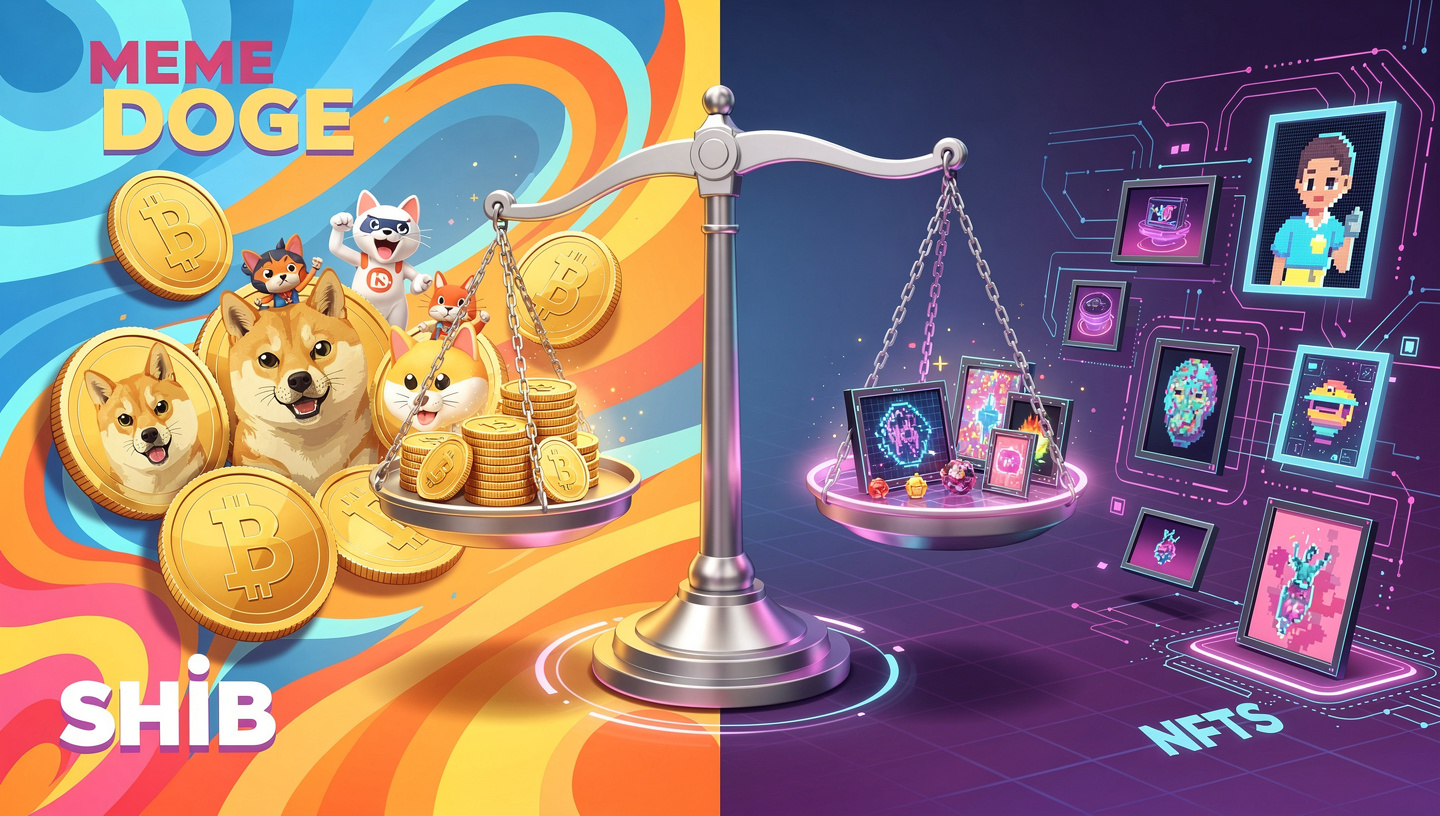
Part III – Speculation Models: Fungible Frenzy vs Singular Scarcity
Here’s the core structural difference:
Meme Coins
- Fully fungible
- Massive supply
- Identical units
- Price driven by velocity
- Low attachment
- High churn
NFTs
- Non-fungible
- Unique assets
- Individual valuation
- Price driven by perceived meaning
- High emotional attachment
- Lower velocity
Meme coins trade like waves.
NFTs trade like artifacts.
Meme coins want liquidity.
NFTs want conviction.
This changes everything about how participants behave.
Liquidity Dynamics
Meme coins require continuous inflow.
If buying pressure stops, price collapses.
NFTs can survive low volume because holders often anchor emotionally to specific pieces.
That’s why NFT bear markets feel quiet.
Meme coin bear markets feel violent.
Part IV – The Role of Narrative in Both Markets
Crypto is narrative-first.
Meme coins run on humor and rebellion.
NFTs run on identity and belonging.
Both are narrative assets — but with different emotional payloads.
Meme coins appeal to:
- Degens
- Short-term traders
- Momentum chasers
NFTs appeal to:
- Collectors
- Creators
- Community builders
- Digital natives seeking identity
One is fast money.
The other is slow culture.
Part V – Creator Economies vs Crowd Economies
NFTs empower creators.
Meme coins empower crowds.
With NFTs:
Artists earn royalties.
Developers build experiences.
Brands experiment with ownership models.
With meme coins:
Communities pump symbols.
No creators. No royalties. No roadmap.
Just collective belief.
This is why NFTs integrate naturally with gaming, music, fashion, and media — while meme coins remain largely speculative instruments.
Part VI – Risk Profiles: Different Dangers, Same Volatility
Let’s be precise.
Both are high-risk.
But the risks differ.
Meme Coin Risks
- Rug pulls
- Insider allocations
- Zero fundamentals
- Extreme dilution
- Flash crashes
NFT Risks
- Illiquidity
- Overvaluation
- Platform dependence
- Cultural decay
- Long holding periods
Meme coins kill you fast.
NFTs kill you slowly.
Both require discipline.
Part VII – Why Both Exist (And Why They’re Not Going Away)
These markets persist because they satisfy deep human needs.
Meme coins satisfy:
- Gambling instincts
- Collective humor
- Desire for rapid wealth
NFTs satisfy:
- Ownership
- Identity
- Creativity
- Digital permanence
They are not temporary trends.
They are emergent behaviors in a programmable economy.
As long as humans seek meaning and money, both will exist.
Part VIII – The Institutional Perspective
Institutions largely avoid meme coins.
They increasingly explore NFTs.
Why?
Because NFTs integrate with:
- IP rights
- Branding
- Licensing
- Entertainment
- Gaming
Meme coins don’t offer enterprise value.
NFTs do.
This matters long-term.
Two Mirrors of the Same Revolution
Meme coins and NFTs are not enemies.
They are reflections.
One reflects speculation.
The other reflects culture.
Both emerged from the same realization:
Digital assets can carry value because humans agree they do.
Crypto didn’t invent this.
It just removed gatekeepers.
Meme coins show how fast belief can move.
NFTs show how deep belief can go.
Understand both — and you understand modern crypto psychology.
Ignore either — and you miss half the picture.