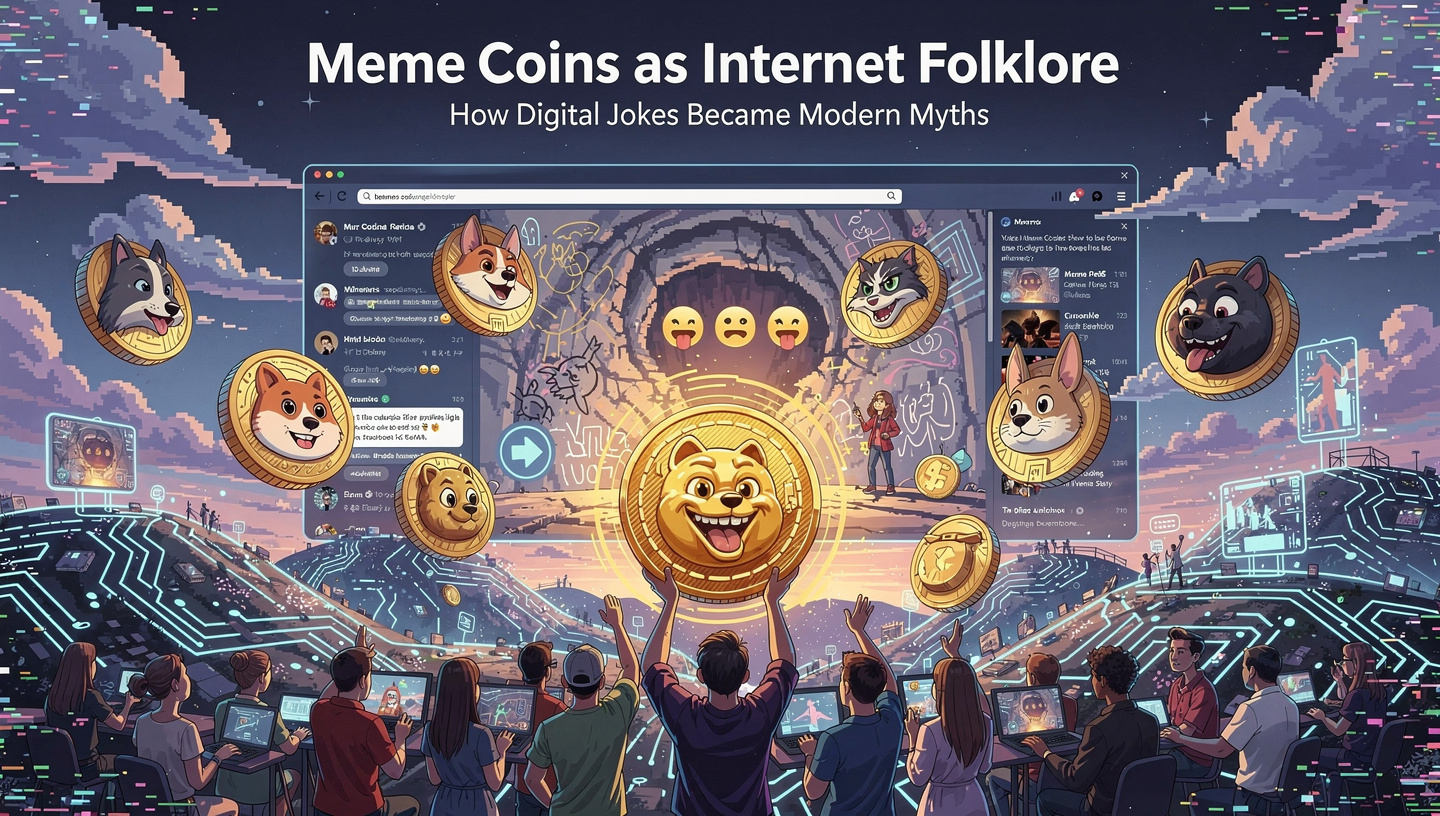
Financial innovations begin with necessity. Meme coins began with laughter.
That distinction matters more than it appears. Meme coins were not born to optimize capital allocation, reduce transaction costs, or solve cross-border settlement. They emerged from internet culture—specifically, from the same chaotic, remix-driven spaces that produce memes, inside jokes, viral formats, and fleeting collective obsessions. Yet somehow, these “jokes” evolved into multi-billion-dollar assets, global communities, and persistent cultural artifacts.
This article examines meme coins not as speculative instruments or marketing anomalies, but as digital folklore—a new category of internet-native mythmaking. By treating meme coins as folklore rather than finance, their resilience, emotional power, and recurring patterns become far easier to explain.
The central argument is simple but uncomfortable for traditional analysts:
Meme coins persist because they function the way myths have always functioned—encoding shared beliefs, values, humor, and identity in symbolic form.
Once you see that, their behavior stops looking irrational.
1. Folklore, Rewritten for the Internet Age
Classical folklore served several purposes:
- It transmitted shared values
- It reinforced group identity
- It simplified complex realities into symbolic narratives
- It survived through repetition, variation, and communal ownership
Internet folklore does the same thing, just faster—and with memes instead of campfire stories.
Memes are not jokes in isolation. They are compressed narratives. A single image or phrase can carry layers of context: irony, history, belonging, and emotional resonance. Meme coins take that compression one step further by embedding it directly into an economic object.
A meme coin is not merely inspired by a meme.
It is the meme, rendered tradable.
This transformation—from image to token—creates something unprecedented: folklore with a price chart.
2. Why Meme Coins Feel “Alive”
One of the most misunderstood aspects of meme coins is the way communities describe them. Holders routinely use language that sounds irrational to outsiders:
- “The coin has a soul.”
- “This meme refuses to die.”
- “It always comes back.”
From a financial perspective, this is nonsense. From a folkloric perspective, it is entirely coherent.
Folklore persists because it is collectively animated. No single author controls it. No definitive version exists. The story evolves through retelling. Meme coins follow the same pattern:
- There is no canonical roadmap that matters.
- Development teams are often secondary to community behavior.
- Meaning is generated socially, not technically.
When a meme coin “dies” and later revives, it mirrors the lifecycle of myths that disappear and re-emerge when cultural conditions are right again. The revival is not driven by fundamentals; it is driven by recognition.
People remember the joke.
3. The Joke as a Social Filter
Traditional projects try to attract users. Meme coins filter them.
Humor is exclusionary by design. If you do not understand the joke, you are not supposed to be there. This filtering effect creates unusually strong in-group cohesion. Early holders are not just investors; they are participants in a shared cultural reference.
This has three important consequences:
- Reduced Need for Rational Justification
Participants do not need utility narratives to justify involvement. The joke is sufficient. - Higher Tolerance for Volatility
Price swings feel less threatening when participation is framed as cultural engagement rather than pure financial exposure. - Stronger Identity Lock-In
Selling feels like leaving a community, not closing a position.
In folklore terms, the joke acts as a ritual initiation. You either get it, or you don’t. And if you do, you are “inside.”
4. Meme Coins as Modern Totems
Anthropologically, totems are symbols that represent a group’s identity and values. They are not useful in a practical sense; their power lies in shared belief.
Meme coins function in exactly this way.
- Dogecoin symbolizes ironic optimism.
- Pepe-based coins channel anti-establishment chaos.
- Absurdist memes reflect nihilistic humor in late-stage internet culture.
The token itself becomes a portable symbol of alignment. Holding it signals taste, worldview, and cultural fluency more than financial strategy.
This is why attempts to “improve” meme coins with excessive utility often fail. Adding seriousness to a totem weakens it. Folklore resists optimization.
5. How Digital Myths Are Born
The lifecycle of a successful meme coin follows a myth-creation pattern rather than a startup trajectory:
Phase 1: Emergence
A meme already circulating online is tokenized. The initial appeal is familiarity, not innovation.
Phase 2: Early Believers
A small group assigns meaning beyond the joke. Language shifts from “this is funny” to “this feels inevitable.”
Phase 3: Canon Formation
Key phrases, images, and narratives stabilize. Certain jokes become “sacred.” Deviations are rejected.
Phase 4: Evangelism
Community members spread the meme not as advertising, but as cultural expression. Virality replaces marketing.
Phase 5: Dormancy and Revival
Interest fades, then resurfaces during favorable cultural or market conditions. Each revival reinforces mythic status.
Notably, failure at any phase does not disqualify future success. Like folklore, meme coins can remain dormant indefinitely before reactivation.
6. Price Charts as Storytelling Devices
In meme coin ecosystems, price action is not just data; it is narrative material.
Charts are screenshotted, annotated, and shared as evidence of destiny, betrayal, or resilience. A sudden pump becomes a “moment.” A crash becomes a “test of faith.” Sideways movement becomes “consolidation before the prophecy.”
This narrative framing serves a critical psychological function:
It transforms randomness into meaning.
Traditional finance attempts to remove emotion from price interpretation. Meme coin culture does the opposite. It embraces emotional storytelling as a feature, not a flaw.
This is why meme coins generate engagement even during downtrends. The story continues, regardless of direction.
7. Why Rational Criticism Misses the Point
Critics often argue that meme coins lack fundamentals. That critique assumes they are supposed to have them.
Folklore does not need fundamentals. It needs relevance.
The value of a meme coin lies in:
- Cultural timing
- Symbolic resonance
- Community participation
- Narrative adaptability
These variables cannot be modeled easily, which is why meme coins consistently surprise analysts trained in traditional valuation frameworks.
The mistake is not underestimating meme coins.
The mistake is misclassifying them.
8. Meme Coins and the Compression of Belief
One of the most powerful aspects of meme coins is how efficiently they compress belief systems.
A whitepaper might take 30 pages to explain a vision. A meme coin can express one instantly:
- Distrust of institutions
- Celebration of chaos
- Irony as armor against disappointment
- Hope disguised as humor
This compression makes meme coins unusually adaptable across languages, regions, and cultures. Folklore scales better than logic.
Laughing at the Campfire Again
Meme coins are often dismissed as childish, unserious, or temporary. But folklore has always been dismissed that way by those who misunderstand its function.
These digital jokes endure because they are not trying to be respectable. They are trying to be remembered.
And in a networked world where attention is scarce and belief is fragmented, being remembered is a form of power that spreadsheets cannot measure.
Meme coins are not the future of finance.
They are something stranger—and more revealing.
They are the internet, telling stories about itself, and assigning them a price.