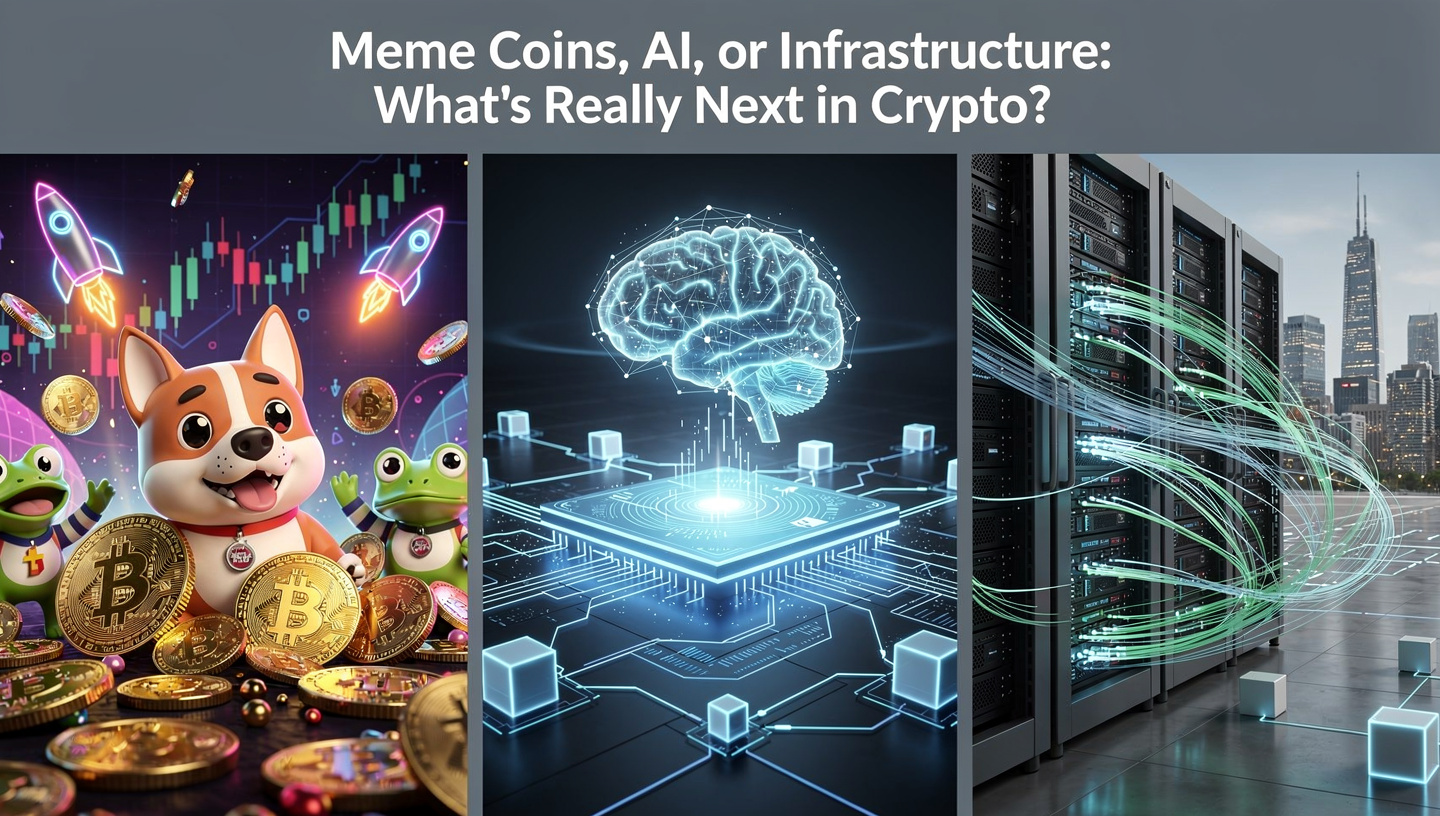
The crypto market does not move forward in neat chapters. It lurches, improvises, doubles back, then suddenly accelerates. One month the collective attention span is consumed by cartoon frogs and dog avatars. The next, it pivots to artificial intelligence, data sovereignty, or tokenized Treasury bills. Capital flows faster than narratives can stabilize.
That chaos is not noise. It is signal.
Every major crypto cycle has been driven by a tension between spectacle and substance—between what attracts attention and what quietly builds foundations. Today, that tension is sharper than ever. Meme coins dominate timelines. AI tokens promise intelligence on-chain. Infrastructure projects grind away at throughput, privacy, and settlement finality.
So what is actually next?
Not what trends on X. Not what pumps hardest in a week. But what compounds over years.
Let’s deconstruct the three dominant forces competing for crypto’s future: meme coins, AI, and infrastructure—and then zoom out to see how they interlock.
Meme Coins: Financial Performance Art
Meme coins are often dismissed as jokes. That’s inaccurate.
They are closer to performance art with liquidity.
A meme coin compresses culture, speculation, identity, and coordination into a single tradable object. Its value is not derived from cash flows or protocol fees—it comes from narrative velocity and social gravity.
This is why meme coins repeatedly outperform expectations:
- They onboard users faster than any DeFi app ever has.
- They spread virally without marketing budgets.
- They create instant communities.
- They reward early cultural alignment more than technical analysis.
Meme coins are the purest expression of crypto-native capitalism: attention → liquidity → identity → price.
But here’s the critical limitation: meme coins do not build reusable systems.
They extract energy from the ecosystem rather than storing it. They recycle capital among traders instead of creating new economic primitives. Even when they achieve massive market caps, they rarely leave behind infrastructure, tooling, or lasting developer ecosystems.
That does not make them irrelevant.
It makes them cyclical accelerants.
Meme coins act as speculative ignition. They pull fresh retail into crypto. They generate volatility. They refill liquidity pools. Then, inevitably, that capital migrates elsewhere—usually toward projects with actual utility.
Historically, meme seasons precede infrastructure investment.
They are not the destination. They are the on-ramp.
AI Meets Crypto: A Promising but Immature Marriage
AI is the most powerful technological narrative on Earth right now. It is reshaping productivity, software development, and knowledge work at breathtaking speed—driven largely by centralized platforms like OpenAI and the compute dominance of NVIDIA.
Crypto wants in.
The thesis is compelling:
- Decentralized AI inference
- Tokenized data marketplaces
- Permissionless model hosting
- Autonomous agents with wallets
- On-chain coordination for machine intelligence
In theory, crypto provides what AI lacks: open ownership, censorship resistance, and composability.
In practice, most “AI crypto” projects today fall into one of three categories:
- Brand association tokens – loosely connected to AI, riding the narrative.
- Compute networks – attempting to decentralize GPU resources.
- Agent frameworks – early experiments in autonomous on-chain behavior.
Very little of this is production-grade.
The core problem is economic, not conceptual. Training frontier models requires massive capital expenditure and tightly optimized hardware stacks—conditions that currently favor centralized operators. Meanwhile, inference latency and cost remain difficult to compete with hyperscale providers.
Crypto-based AI infrastructure is real, but embryonic.
Where this gets interesting is not large language models competing with ChatGPT. It’s narrow, crypto-native applications:
- On-chain risk modeling
- Automated market making strategies
- Wallet-level personal agents
- Smart contract auditing
- Autonomous DAO operations
These do not need trillion-parameter models. They need reliability, composability, and economic alignment.
AI in crypto will matter—but quietly, incrementally, and underneath user interfaces. It will be a layer, not a headline.
Not the next cycle’s hero.
The one after that.
Infrastructure: The Unsexy Engine of Every Real Cycle
Every lasting crypto wave has been built on infrastructure.
Not memes.
Not narratives.
Infrastructure.
Exchanges. Wallets. Layer-2s. Bridges. Oracles. Custody. Compliance tooling. Developer frameworks. Indexers. Rollups. ZK circuits. MEV mitigation. Fiat rails.
None of this trends on social media. All of it determines whether the ecosystem can scale.
Right now, infrastructure is undergoing its most important transformation since DeFi summer.
Three structural shifts matter:
1. The Financialization of Blockchains
Traditional finance is no longer observing crypto from a distance. Firms like BlackRock are actively pushing tokenized assets, on-chain funds, and blockchain-based settlement. Retail gateways such as Coinbase are building institutional-grade custody, compliance, and derivatives stacks.
This changes everything.
Crypto infrastructure is being reshaped to support:
- Real-world assets (RWAs)
- Regulated stablecoins
- On-chain identity
- Auditable reserves
- Institutional liquidity
This is not ideological decentralization.
This is practical integration.
2. Modularization
Monolithic blockchains are giving way to modular architectures:
- Execution layers
- Data availability layers
- Settlement layers
- Application-specific chains
This allows teams to optimize for specific use cases instead of forcing every application into a single performance envelope.
It also enables faster experimentation.
Infrastructure is becoming composable at the protocol level, not just at the application layer.
That is a fundamental upgrade.
3. UX Finally Matters
For a decade, crypto users tolerated atrocious interfaces.
That era is ending.
Smart wallets, account abstraction, embedded compliance, and invisible gas fees are converging. The goal is clear: make crypto feel like software, not like a science experiment.
Onboarding is being reduced from 12 steps to one.
This is how adoption actually happens.
Not through ideology.
Through convenience.
Why Infrastructure Always Wins (Eventually)
Speculation creates cycles. Infrastructure survives them.
Every major crypto boom leaves behind permanent scaffolding:
- 2017 gave us exchanges and custody.
- 2020 gave us DeFi primitives.
- 2021 gave us NFTs and creator tooling.
- 2024–2026 will give us regulated on-chain finance and consumer-grade wallets.
Meme coins burn bright and fade.
AI tokens will consolidate.
Infrastructure compounds.
The pattern is consistent because it mirrors how technology evolves in every industry: first excitement, then experimentation, then standardization.
Crypto is no exception.
The Capital Flow Map
Here is what is already happening, beneath the surface:
Retail money enters through meme coins.
Some of it migrates into AI narratives.
Most of it eventually settles into infrastructure plays: layer-2 ecosystems, middleware, developer platforms, and financial rails.
Meanwhile, institutional capital bypasses memes entirely and goes straight to:
- Stablecoin issuers
- Custody providers
- Compliance tooling
- Tokenized asset platforms
- Core protocol development
These flows rarely intersect at first.
But over time, they converge.
That convergence is where the next durable phase of crypto emerges.
So What’s Really Next?
Not meme coins.
Not AI tokens.
Infrastructure—augmented by AI, fueled by speculative cycles, and shaped by regulatory reality.
The next era of crypto will look less like a casino and more like a financial operating system:
- Stablecoins used for payroll and remittances
- Tokenized securities settling instantly
- Smart wallets replacing login systems
- Autonomous agents managing portfolios
- Blockchains functioning as backend infrastructure, invisible to users
Meme coins will still exist.
AI will be embedded everywhere.
But the real value creation will happen where systems are built, not where narratives spike.
Crypto is graduating from experiment to substrate.
That transition will not be loud.
It will be gradual, technical, and uneven.
And by the time it feels obvious, most of the upside will already be priced in.
Final Perspective
If you zoom out far enough, crypto stops looking like a collection of tokens and starts looking like a coordination layer for digital value.
Meme coins test cultural velocity.
AI tests automation.
Infrastructure tests permanence.
Only one of those determines whether crypto becomes a global financial primitive.
History already tells us which one that is.