Price is merely the final footprint left behind after liquidity has already been harvested.
In meme coins, this misunderstanding becomes lethal. Traders obsess over candles, patterns, indicators, and narratives, while the market itself is operating on a far simpler and far more brutal principle: where liquidity sits, price will eventually go.
Liquidity zones are not an advanced concept reserved for institutions. They are the core mechanism behind every violent meme coin pump, every sudden wick, every “unexpected” dump that wipes out retail traders in seconds. If you do not understand liquidity, you are not trading price action—you are reacting to it.
This article breaks down, with precision and depth, how liquidity zones form, how meme coin price action is engineered around them, and how experienced traders use liquidity—not hype—to make decisions in the most chaotic segment of crypto.
What Liquidity Actually Means in Meme Coin Markets
Liquidity is often explained poorly. It is not volume. It is not market cap. It is not “how popular” a coin is.
Liquidity is the concentration of executable orders—stop losses, limit orders, liquidations, and panic exits—sitting at specific price levels.
In meme coins, liquidity is especially visible because:
- Markets are thin
- Retail dominates
- Order placement is emotionally predictable
- Large players can move price with relatively small capital
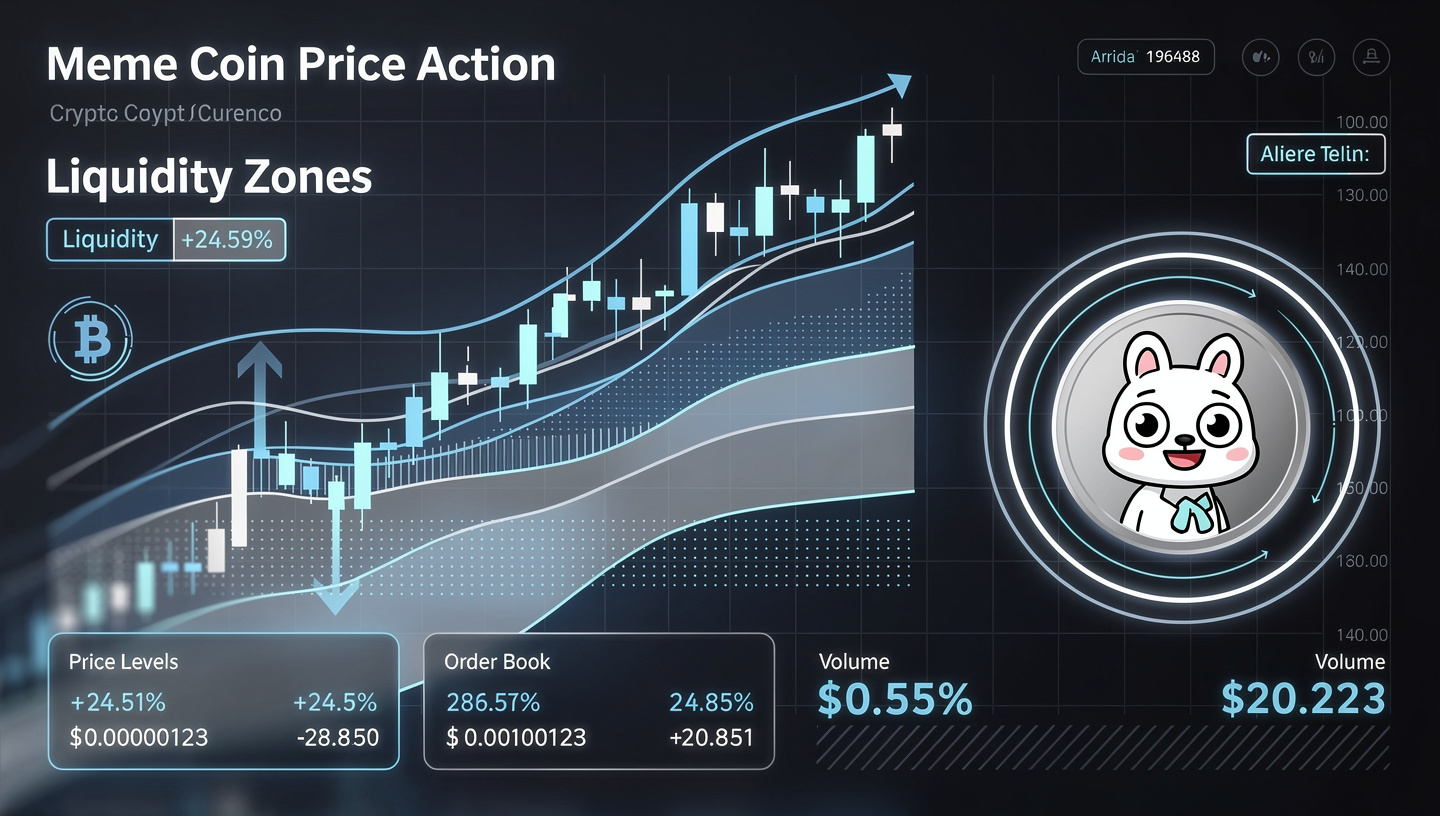
Every time a meme coin trades sideways, stalls at a level, or repeatedly rejects a price, it is not indecision—it is liquidity building.
The Three Core Types of Liquidity Zones in Meme Coins
1. Equal Highs and Equal Lows (Retail Clusters)
Retail traders love symmetry.
They place stops in obvious places.
When you see:
- Multiple rejections at the same high
- Multiple bounces from the same low
You are not seeing support or resistance.
You are seeing a liquidity pool forming.
Above equal highs:
- Buy stops from breakout traders
- Short stop losses
- FOMO market orders
Below equal lows:
- Long stop losses
- Forced liquidations
- Panic sells
Meme coins thrive on these zones because they allow smart money to execute size with minimal slippage.
2. Large Wick Zones (Absorbed Liquidity)
In meme coin charts, wicks matter more than bodies.
A long upper wick often indicates:
- Aggressive buying into resistance
- Absorption by large sellers
- Stop hunts that failed to follow through
A long lower wick often indicates:
- Forced selling
- Liquidation cascades
- Smart money accumulation
These wick zones become future liquidity magnets. Price almost always revisits them—not randomly, but to rebalance unfilled orders.
3. Consolidation Ranges (Liquidity Warehouses)
Sideways price action is not boring.
It is strategic.
When a meme coin compresses in a tight range:
- Orders accumulate on both sides
- Emotional tension builds
- Leverage increases
This range becomes a warehouse of liquidity. The eventual breakout is not driven by narrative or news—it is driven by which side provides the most profitable liquidity to raid first.
Why Meme Coins Are Perfect Liquidity Hunting Instruments
Meme coins are not inefficient markets.
They are emotionally efficient markets.
Key reasons liquidity strategies work so well in meme coins:
- Retail Predictability
Traders place stops in obvious locations. Repeatedly. - Low Depth Order Books
Price can be moved with less capital. - Narrative Overload
Traders justify bad entries with memes instead of structure. - High Leverage Usage
Liquidations provide instant liquidity injections.
Liquidity is not hunted in meme coins by accident. It is the business model.
Liquidity Sweeps: The Most Misunderstood Move in Meme Coins
A liquidity sweep occurs when price aggressively moves into a liquidity zone, triggers orders, and then reverses.
Retail interpretation:
- “Fake breakout”
- “Manipulation”
- “Scam wick”
Professional interpretation:
- Order execution complete
In meme coins, liquidity sweeps are often violent and fast. They exist because:
- Large players need fills
- Stops provide instant counterparties
- Speed minimizes slippage
If you trade against liquidity sweeps, you are donating capital.
Liquidity Zones vs Traditional Support and Resistance
Support and resistance are static concepts.
Liquidity is dynamic.
Support assumes buyers will defend a level.
Liquidity assumes buyers will be used.
In meme coins:
- Support is often broken intentionally
- Resistance is often breached briefly to trigger stops
- The real move begins after liquidity is taken
This is why meme coins frequently:
- Break support and instantly reverse
- Break resistance and collapse
- Move hardest when traders are most confused
How Liquidity Dictates Meme Coin Price Action Phases
Accumulation Phase
- Price ranges tightly
- Volume decreases
- Liquidity builds above and below
Expansion Phase
- Liquidity is raided
- Stops are triggered
- Price moves explosively
Distribution Phase
- New liquidity forms at highs
- Late buyers provide exit liquidity
Collapse Phase
- Downside liquidity is harvested
- Panic accelerates price movement
These phases repeat regardless of narrative, chain, or meme quality.
Using Liquidity Zones for High-Probability Entries
Liquidity-based entries do not chase price.
They anticipate where price must go.
High-probability setups often occur:
- After a liquidity sweep, not before
- At reclaimed ranges
- When price returns to a swept zone and holds
This approach removes emotion and replaces it with structure.
Common Retail Mistakes Around Liquidity
- Entering breakouts without confirming liquidity clearance
- Placing stops exactly where everyone else does
- Assuming wicks are random
- Believing volume alone confirms strength
- Trading narratives instead of execution zones
In meme coins, mistakes are punished faster and harder.
Liquidity Zones and SEO Reality: Why This Topic Matters
From an SEO perspective, liquidity-focused content outperforms generic meme coin articles because:
- Traders actively search for “why price moved”
- Liquidity explains volatility better than indicators
- It aligns with real trader pain points
Search intent favors explanation over hype.
Liquidity Is the Only Honest Teacher
Meme coins do not move because they are funny.
They move because liquidity demands it.
Once you stop asking “Why did price do this?”
and start asking “Where was liquidity sitting?”
the chaos begins to make sense.
Liquidity zones are not a strategy.
They are the language of the market.
If you learn to read that language, meme coins stop feeling random—and start feeling predictable.