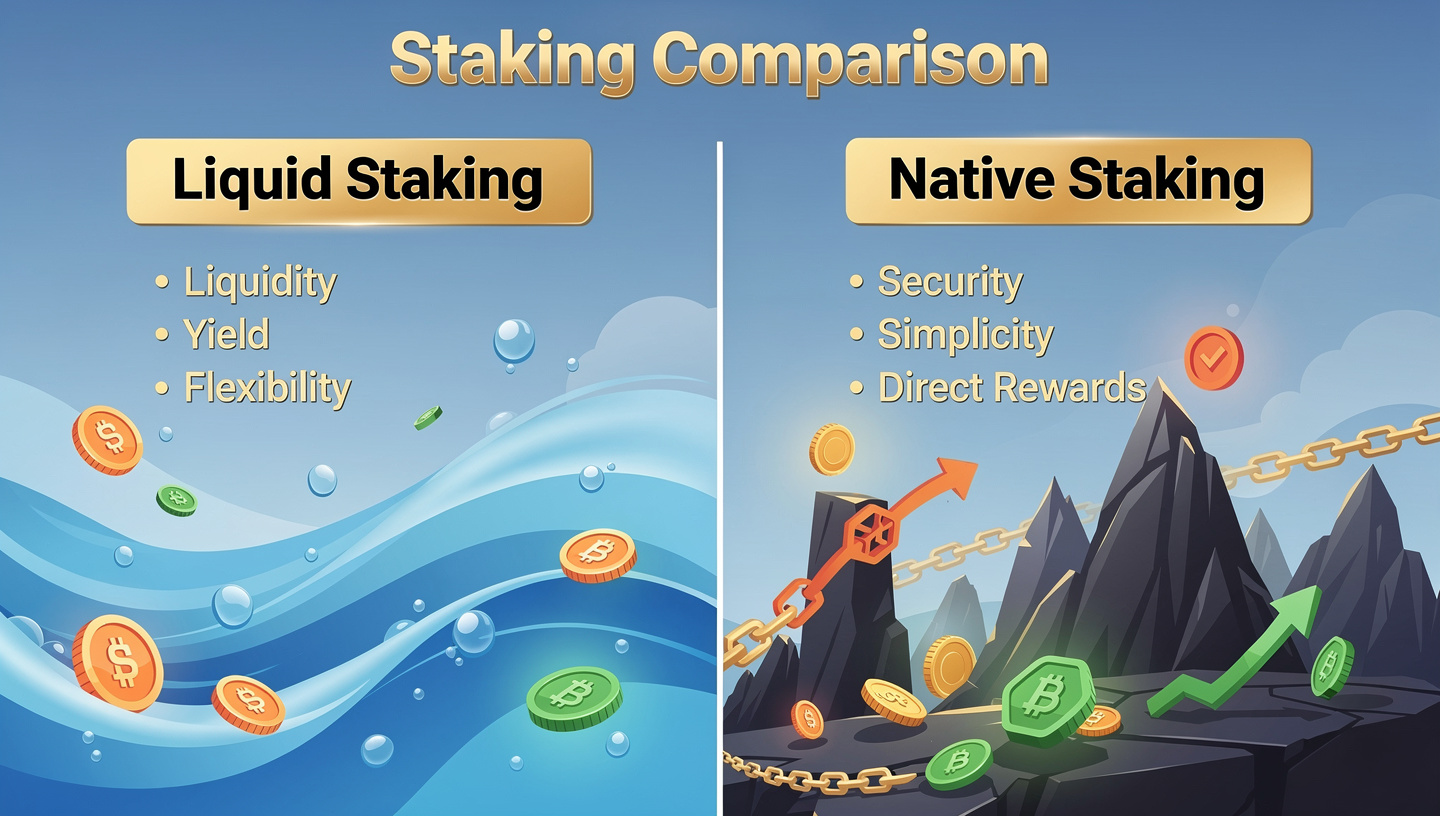
Experienced capital allocators focus on structure.
That distinction matters more in crypto than almost anywhere else.
Two investors can stake the same asset, earn the same nominal yield, and yet end up with dramatically different outcomes — not because of timing, but because of how their capital is deployed.
This is the overlooked fault line between native staking and liquid staking.
On the surface, both promise rewards for securing blockchain networks. Both appear to offer passive income. Both are marketed with similar annual percentage yields.
But under the hood, they operate on entirely different financial mechanics.
Native staking is about participation.
Liquid staking is about financialization.
Understanding that difference is the first step toward making rational decisions in a space that often rewards speed over thinking.
This article breaks down liquid staking versus native staking from first principles — covering architecture, risk models, capital efficiency, real-world use cases, and why one is fundamentally closer to traditional finance than most people realize.
What Is Native Staking?
Native staking is the original staking model implemented directly at the protocol level of Proof-of-Stake blockchains such as Ethereum, Solana, Cosmos, Avalanche, and Polkadot.
You stake your tokens directly with a validator (or run your own validator), helping secure the network. In return, the protocol pays you rewards.
Core Characteristics of Native Staking
- Assets are locked
Your tokens are bonded to the network. On Ethereum, withdrawals require an exit queue. On Cosmos chains, unbonding periods can last weeks. - Rewards are protocol-defined
Yield comes from block issuance and transaction fees, not external leverage or DeFi activity. - Slashing risk exists
If your validator misbehaves or goes offline, part of your stake can be penalized. - Minimal composability
While staked, your capital is idle. You cannot use it elsewhere.
Native staking is simple, transparent, and conservative by crypto standards. You earn yield by directly contributing to network security.
In traditional finance terms, it resembles holding a productive asset that generates cash flow — closer to owning infrastructure than trading derivatives.
What Is Liquid Staking?
Liquid staking introduces a synthetic layer on top of native staking.
Instead of locking your assets directly, you deposit them into a liquid staking protocol (such as Lido, Rocket Pool, or Marinade). The protocol stakes on your behalf and issues you a derivative token — for example:
- ETH → stETH
- SOL → mSOL
- ATOM → stATOM
This derivative represents your claim on the underlying staked asset plus accrued rewards.
You can then freely trade or deploy that token across DeFi.
Core Characteristics of Liquid Staking
- You receive a liquid derivative
Your staked position becomes transferable. - Rewards accrue automatically
The derivative increases in value relative to the base asset. - Capital becomes reusable
You can lend, borrow, farm, or provide liquidity while still earning staking rewards. - Additional smart contract risk
You are now exposed to protocol code, oracle mechanisms, and peg stability.
Liquid staking transforms staking from a passive security activity into a composable financial primitive.
This is where things become interesting — and dangerous.
Native Staking vs Liquid Staking: Structural Comparison
| Dimension | Native Staking | Liquid Staking |
|---|---|---|
| Custody | You (or validator) | Protocol |
| Liquidity | Locked | Tradable |
| Yield Source | Protocol | Protocol + DeFi |
| Risk Type | Slashing, validator | Smart contracts, depegs, systemic |
| Complexity | Low | High |
| Capital Efficiency | Low | High |
| Failure Modes | Isolated | Cascading |
Native staking fails locally.
Liquid staking can fail systemically.
That distinction matters.
Capital Efficiency: The Real Selling Point of Liquid Staking
Liquid staking exists for one reason: capital efficiency.
With native staking, one dollar works once.
With liquid staking, the same dollar can be reused multiple times.
Example:
- Stake ETH via Lido → receive stETH
- Deposit stETH into Aave
- Borrow USDC
- Buy more ETH
- Stake again
This recursive loop creates synthetic leverage on top of staking yield.
From a financial engineering perspective, liquid staking turns base-layer assets into collateralized yield instruments.
From a risk perspective, it introduces reflexivity.
The system becomes sensitive to price shocks, liquidity drains, and protocol failures.
This is structurally similar to rehypothecation in traditional banking — where the same collateral supports multiple obligations.
That mechanism works until it doesn’t.
Risk Analysis: Why Liquid Staking Is Not “Just Better Staking”
Marketing often frames liquid staking as native staking plus flexibility.
That framing is incomplete.
Liquid staking introduces entirely new categories of risk.
1. Smart Contract Risk
Native staking relies on protocol-level code battle-tested by years of operation.
Liquid staking adds:
- Custodial logic
- Mint/burn mechanisms
- Oracle pricing
- Validator routing
- Governance layers
Each is a potential attack surface.
2. Depeg Risk
Liquid staking tokens are not guaranteed to trade at parity.
During stress events, stETH and similar assets have traded at significant discounts.
This is not theoretical — it already happened.
When liquidity dries up, derivatives detach from fundamentals.
3. Centralization Risk
Large liquid staking providers can accumulate massive validator share.
At times, Lido controlled over 30% of Ethereum stake.
This introduces governance and censorship concerns that native staking distributes more evenly.
4. Systemic Contagion
Liquid staking derivatives are widely used as DeFi collateral.
If one protocol fails, the shock propagates across lending markets, DEX liquidity pools, and stablecoin systems.
Native staking failures do not cascade this way.
Yield Reality: Higher APY Does Not Mean Higher Return
Liquid staking platforms often advertise higher effective yields because users can stack strategies.
But higher yield comes from higher exposure, not free efficiency.
Native staking provides a clean, base-layer return.
Liquid staking creates layered returns by increasing:
- Leverage
- Counterparty risk
- Correlation during drawdowns
In calm markets, liquid staking outperforms.
In stressed markets, losses compound faster.
This asymmetry is not obvious from APY dashboards.
When Native Staking Makes More Sense
Native staking is rational when:
- You prioritize asset safety over composability
- You intend to hold long-term
- You want predictable protocol-level yield
- You avoid leverage
- You value decentralization
It behaves like infrastructure ownership.
Quiet. Durable. Boring in a good way.
When Liquid Staking Makes Sense
Liquid staking is rational when:
- You actively manage positions
- You understand DeFi risk
- You use derivatives productively (not recursively)
- You accept volatility
- You treat staking assets as working capital
It behaves like a financial instrument.
Powerful, flexible, and unforgiving.
A Buffett-Style Summary
Native staking is owning the railroad.
Liquid staking is building derivatives on top of the railroad.
Both can be profitable.
Only one remains standing when leverage unwinds.
Most crypto participants chase yield.
Long-term winners manage structure.
They understand that liquidity is not free.
They recognize that composability amplifies both returns and mistakes.
And they choose their tools accordingly.
Final Thoughts
Liquid staking represents the financialization of Proof-of-Stake.
Native staking represents its foundation.
Neither is inherently superior.
They serve different objectives, different temperaments, and different risk budgets.
But confusing them — or treating liquid staking as a simple upgrade — is how disciplined investing turns into speculative exposure.
In crypto, as in traditional markets, sustainable wealth comes not from maximizing yield, but from minimizing surprises.
Few surprises are larger than discovering your “passive income” was built on layered leverage you never fully priced.