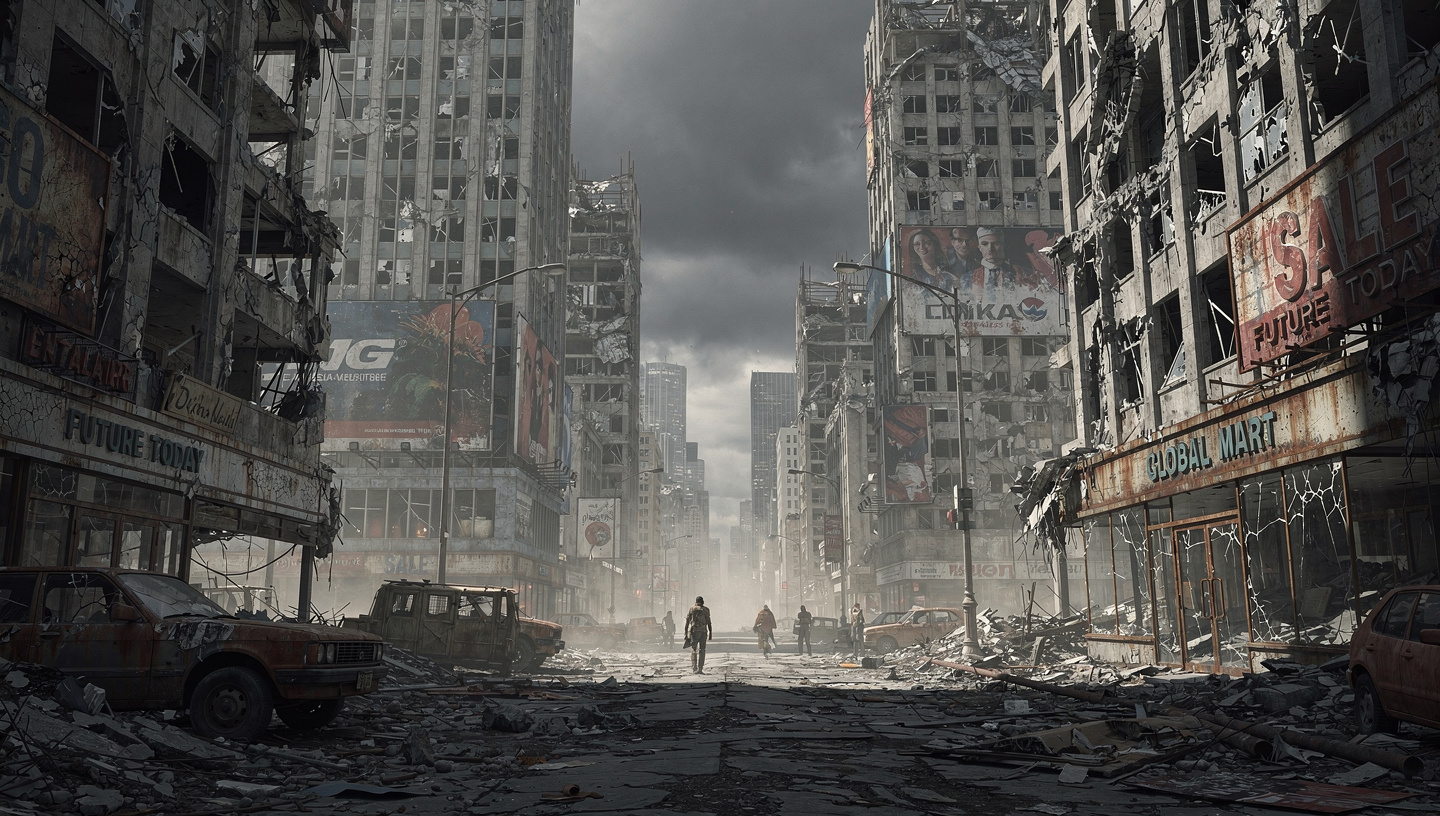
It did not feel like an apocalypse.
There were no mushroom clouds, no sirens. Instead, there was silence—first in the order books, then in the newsrooms, and finally in the corridors of central banks. Screens that had once pulsed with green and red froze mid-refresh. Trading desks emptied. Automated liquidators ran until they had nothing left to sell.
The event would later be labeled The Global Liquidation: a cascading unwind across crypto, derivatives, sovereign debt proxies, and tokenized assets that erased decades of accumulated leverage in less than forty-eight hours.
In the months that followed, economists debated causes. Engineers argued about protocols. Politicians blamed algorithms. But for ordinary people, the story was simpler:
Ownership evaporated. Credit vanished. Trust had to be rebuilt from scratch.
This is a research-oriented fictional account of what came next—how societies adapted after digital capital collapsed, how crypto mutated from speculative engine into survival infrastructure, and how life reorganized itself around scarcity, verification, and code.
Chapter I — The Mechanics of Collapse
Every liquidation has a trigger. This one had many.
It began with a sequence of oracle failures—small discrepancies in pricing feeds that widened under volatility. Smart contracts executed precisely as designed. Margin thresholds were crossed. Collateral pools drained. Synthetic assets de-pegged. Automated market makers repriced instantly, with no concept of mercy.
In traditional finance, circuit breakers would have paused the carnage. In decentralized systems, there was no pause button.
Cross-chain bridges became chokepoints. Wrapped assets lost parity. Lending protocols seized collateral en masse. Liquidation bots competed in microseconds, extracting whatever value remained. The result was a self-reinforcing feedback loop: falling prices triggered forced sales, which drove prices lower, which triggered more forced sales.
By the time centralized exchanges halted withdrawals, it was already over.
Estimates varied, but postmortems converged on one figure: roughly 72% of all tokenized value had been vaporized.
Not transferred. Not stolen.
Gone.
Chapter II — When Code Meets Reality
The foundational promise of crypto had always been radical transparency and trustless execution. And in a technical sense, the system performed flawlessly. Every transaction was verifiable. Every liquidation traceable.
Yet perfection in code exposed fragility in human design.
Risk models had assumed independent markets. They were not.
Stablecoins had assumed liquid reserves. They were not.
Governance tokens had assumed rational voters. They were not.
The liquidation revealed what many had warned for years: decentralization of infrastructure does not guarantee decentralization of power. Liquidity concentrated in a handful of protocols. Governance concentrated in a few wallets. Influence clustered around insiders who understood the mechanics well enough to exit early.
Some commentators invoked the original ethos attributed to Satoshi Nakamoto—a peer-to-peer economy resilient to centralized failure. But what had emerged instead was something more complex: a hyper-automated financial organism, optimized for speed rather than stability.
Chapter III — Governments React, Slowly
States did what states always do after systemic shock: they convened emergency panels, issued carefully worded statements, and blamed foreign actors.
The International Monetary Fund published a white paper within weeks, outlining a framework for “digital asset containment.” The Federal Reserve reopened dormant liquidity facilities and offered swap lines to allied central banks.
But crypto existed largely outside their jurisdiction.
There were no balance sheets to backstop. No deposit insurance. No lender of last resort for smart contracts.
Capital controls were attempted in multiple countries. On-ramps were restricted. Off-ramps were taxed aggressively. Yet wallets remained pseudonymous, and peer-to-peer rails continued to function.
The paradox became obvious: governments could regulate interfaces, but not protocols.
Chapter IV — The Human Aftermath
In New York City, former traders drove rideshare vehicles. In Singapore, entire co-working floors emptied overnight. Remote freelancers who had been paid exclusively in tokens found themselves suddenly unbanked.
The psychological impact rivaled the financial one.
People had not just lost money; they had lost narratives.
For years, crypto had promised escape from inflation, from gatekeepers, from legacy systems. It had offered identity through NFTs, status through on-chain history, and community through DAOs. The liquidation stripped all of that away in a single cycle.
What remained were skills, relationships, and local networks.
Mutual aid groups formed in Discord servers that once hosted yield-farming strategies. Developers pivoted from DeFi dashboards to logistics tools. Mesh networks appeared in regions where payment rails collapsed.
Crypto did not disappear. It went quiet—and then it changed.
Chapter V — From Speculation to Infrastructure
Six months after the liquidation, transaction volume stabilized at a fraction of its former peak. But the composition of activity looked radically different.
Speculative trading gave way to:
- Local settlement layers for small businesses
- Tokenized supply chains for food and medicine
- Reputation graphs replacing traditional credit scores
- Programmable aid distributions managed by NGOs
- Community treasuries funding public goods
Yield farming died. Utility survived.
Developers began designing systems for low-bandwidth environments. Wallets shipped with offline signing. Identity primitives prioritized privacy over profitability. Protocol upgrades emphasized fault tolerance rather than throughput.
The lesson had been internalized: a financial system optimized for leverage will eventually liquidate itself.
Chapter VI — The New Social Contract
Post-liquidation crypto communities adopted principles that would have seemed quaint during the bull markets:
- Capital is slow. Velocity limits were introduced at the protocol level.
- Governance is weighted by participation, not stake. Quadratic voting became standard.
- Transparency includes liabilities. Proof-of-reserves expanded into proof-of-obligations.
- Exit is a right. Users demanded native mechanisms for graceful unwinds.
A new generation of builders rejected maximalism. They treated blockchains not as replacements for states, but as complements—neutral coordination layers for societies that no longer trusted monolithic institutions.
Some governments reciprocated. Regulatory sandboxes emerged. Municipalities experimented with on-chain budgeting. Tax collection integrated wallet APIs.
Not everywhere. But enough to matter.
Chapter VII — What Economists Learned
Academic models had long struggled to capture reflexivity in crypto markets. After the liquidation, a clearer picture emerged:
- Automated liquidation engines behave like high-frequency predators.
- Correlated collateral creates systemic fragility.
- Governance tokens incentivize short-term extraction.
- Narrative risk moves faster than capital.
The most influential post-crisis papers reframed crypto not as an asset class, but as a socio-technical system—part monetary network, part game theory experiment.
Risk was no longer measured solely in volatility. It was measured in code paths.
Chapter VIII — Life, Repriced
Five years later, life feels different.
People still hold tokens. They still transact on-chain. But few believe in overnight wealth anymore. Crypto wallets sit alongside government IDs. Smart contracts manage leases, insurance pools, and cooperative businesses.
Children learn basic cryptography in school.
Artists mint selectively.
Farmers hedge weather derivatives.
The system did not become utopian. Inequality persists. Power still concentrates. Exploits still happen.
But the mythology is gone.
Crypto is no longer a casino dressed as a revolution. It is infrastructure—imperfect, evolving, and embedded in daily life.
Conclusion: After the Fire
The Global Liquidation was not the end of crypto.
It was its adolescence.
Speculative excess burned away illusions. What survived was a quieter, harder version of the technology—less glamorous, more grounded, and finally accountable to the societies using it.
History will likely record the event as a necessary collapse, a forced reckoning between abstract finance and lived reality.
For those who lived through it, the lesson was simpler:
Code can execute flawlessly. Markets can clear instantly. But resilience is human.
And after everything was sold, liquidated, and written down—
people rebuilt anyway.