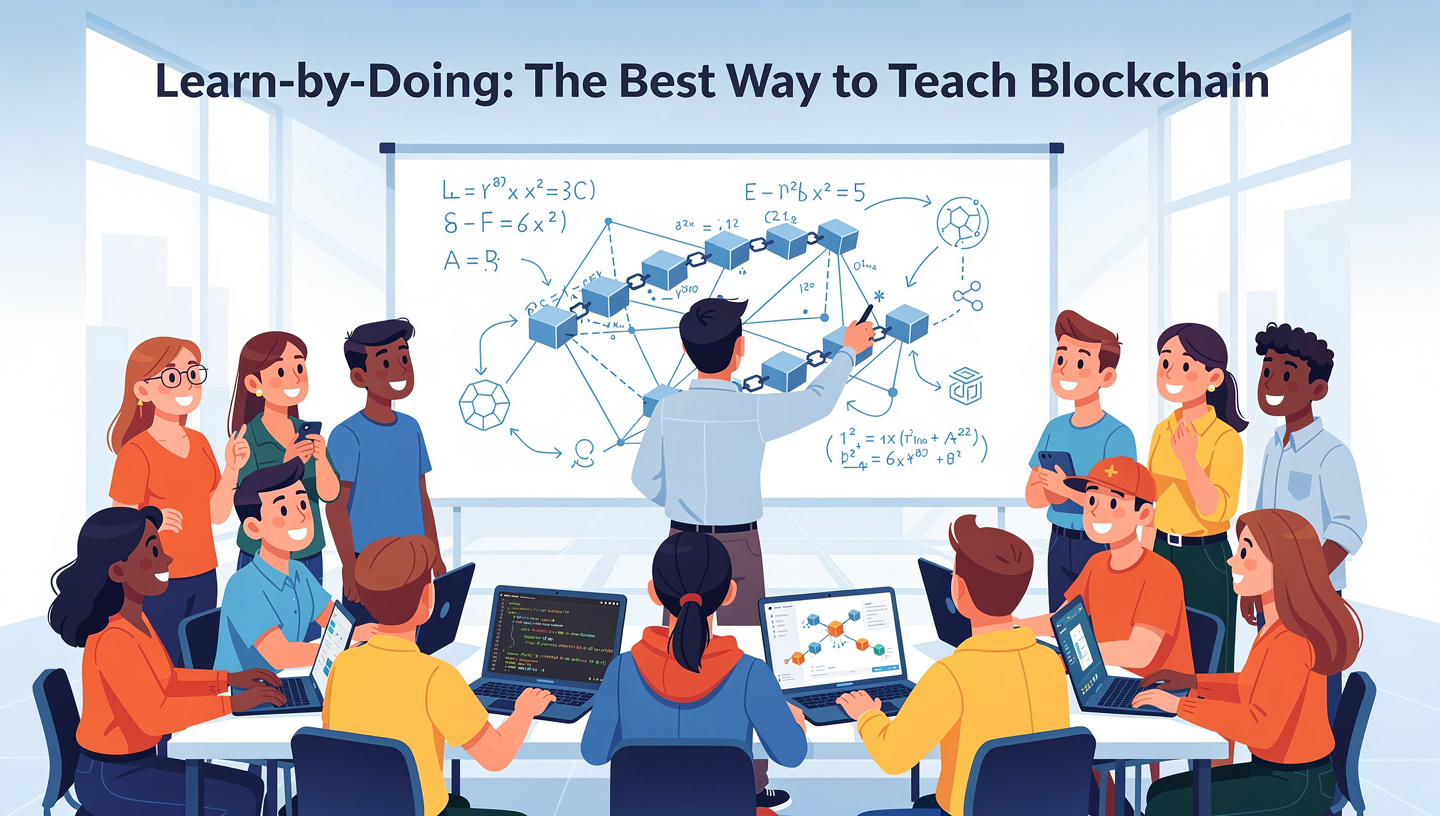
Blockchain is not merely a technology; it is a paradigm shift in how humans coordinate trust, value, and information. Yet most educational approaches still treat it like a static subject—something to be memorized rather than experienced. This mismatch is the central failure of contemporary crypto education.
Traditional instruction methods—lectures, slides, and textbook diagrams—are optimized for knowledge transmission, not comprehension through interaction. But blockchain is inherently participatory. It is a system you use, test, break, and rebuild. To truly understand decentralization, one must experience what it feels like when there is no central authority. To grasp consensus, one must simulate disagreement. To appreciate cryptographic security, one must attempt to attack a system and fail.
This is why learn-by-doing is not just a teaching strategy for blockchain—it is the only method aligned with the technology’s nature.
This article presents a research-grounded, pedagogically sound, and field-tested framework for teaching blockchain through experiential learning. It synthesizes educational theory, cognitive science, developer training methodologies, and real-world blockchain practice to demonstrate why hands-on learning produces deeper understanding, faster skill acquisition, and more innovative thinkers in the crypto space.
1. The Cognitive Science Behind Learn-by-Doing
1.1 Active Learning Builds Durable Knowledge
Educational psychology consistently shows that active learning methods outperform passive ones. When learners manipulate systems, test hypotheses, and receive feedback, they construct mental models rather than memorizing facts. Blockchain concepts—hashing, consensus, distributed state—are abstract. Without interaction, they remain invisible processes.
Experiential learning activates multiple cognitive pathways simultaneously:
- procedural memory (how systems work),
- conceptual understanding (why they work),
- and metacognition (awareness of one’s own understanding).
This triad dramatically improves retention and transfer of knowledge to new contexts.
1.2 Desirable Difficulty and Technical Mastery
Research shows that learning improves when tasks are slightly challenging. Blockchain is inherently complex, which actually makes it ideal for experiential pedagogy. When learners deploy a smart contract and encounter an error, they enter a problem-solving state that strengthens neural encoding. Difficulty, when structured properly, is not a barrier—it is the mechanism of learning.
1.3 Simulation vs Explanation
Explaining consensus algorithms verbally is like explaining swimming without water. Simulation allows learners to:
- act as nodes,
- vote on blocks,
- experience forks,
- observe chain reorganizations.
In minutes, students internalize what hours of lectures cannot convey.
2. Why Blockchain Demands Experiential Education
2.1 Blockchain Is a System, Not a Topic
Unlike subjects such as history or literature, blockchain is a living infrastructure. Understanding it requires systems thinking:
- incentives
- game theory
- cryptography
- distributed networks
- economics
- governance
Only hands-on environments can reveal how these layers interact.
2.2 The Illusion of Understanding
Many learners believe they understand blockchain after watching videos or reading articles. But when asked to deploy a node, inspect transaction data, or sign a message, they struggle. This gap is called illusion of competence—a well-documented cognitive bias.
Practical exercises immediately expose knowledge gaps, allowing correction before misconceptions solidify.
2.3 Crypto Is an Applied Discipline
Blockchain is closer to engineering than theory. Developers, analysts, auditors, and researchers all operate in applied contexts. Therefore, training must mirror real-world conditions.
3. The Core Pillars of Learn-by-Doing Blockchain Education
A robust experiential blockchain curriculum rests on five pillars.
Pillar 1 — Interactive Conceptual Simulations
Before coding, learners must visualize mechanics.
Effective exercises:
- manual hashing with paper
- human consensus voting games
- token economy simulations
- network propagation roleplay
These activities transform invisible processes into tangible experiences. Students feel latency, disagreement, and synchronization.
Pillar 2 — Sandbox Environments
Learners should interact with blockchains in risk-free environments:
- local test networks
- testnets
- private chains
- simulated wallets
Safe experimentation encourages exploration. Mistakes become educational assets rather than costly failures.
Pillar 3 — Guided Construction
Instead of teaching blockchain components separately, students should build a system incrementally:
- create a block structure
- add hashing
- chain blocks
- introduce validation
- simulate consensus
- add transactions
By the end, learners have constructed a simplified blockchain from scratch. This progression builds structural intuition.
Pillar 4 — Real-World Tasks
Theory must transition into authentic tasks:
- deploying smart contracts
- analyzing blockchain data
- verifying transactions
- interacting with decentralized applications
- auditing code logic
Authenticity increases motivation and professional readiness.
Pillar 5 — Reflection and Iteration
Learning completes only when students reflect on what happened and why.
Reflection prompts:
- Why did the transaction fail?
- What assumption was incorrect?
- How would you redesign the system?
Reflection converts activity into insight.
4. Designing a Learn-by-Doing Blockchain Curriculum
Stage 1 — Foundations Through Interaction
Focus: mental models, not code.
Activities:
- simulate blocks with paper cards
- build a ledger manually
- perform consensus voting
Outcome: conceptual clarity.
Stage 2 — Technical Mechanics
Focus: internal processes.
Activities:
- write simple hash functions
- inspect transaction signatures
- run local nodes
Outcome: structural understanding.
Stage 3 — Construction
Focus: creation.
Activities:
- build a blockchain prototype
- implement proof-of-work simulation
- create token transfers
Outcome: engineering mindset.
Stage 4 — Application
Focus: real ecosystem interaction.
Activities:
- deploy contracts
- connect front-ends
- analyze chain data
Outcome: professional competence.
Stage 5 — Innovation
Focus: original thinking.
Activities:
- design protocols
- create token economies
- audit systems
Outcome: mastery.
5. Pedagogical Models That Work Best
5.1 Project-Based Learning
Students work toward a final artifact such as a decentralized app or protocol design. Projects create intrinsic motivation and integrate multiple skills.
5.2 Problem-Driven Learning
Instead of teaching concepts sequentially, present a challenge:
“Design a system where strangers can transact without trust.”
Students discover blockchain concepts naturally as solutions.
5.3 Peer Instruction
Explaining blockchain mechanics to others strengthens understanding more than studying alone.
5.4 Reverse Engineering
Analyzing existing systems teaches architecture patterns and design logic.
6. Tools and Environments That Enable Hands-On Learning
An effective experiential blockchain course leverages the right technical tools:
- local blockchain simulators
- browser-based development environments
- transaction explorers
- cryptographic libraries
- network visualization tools
The key principle: remove setup friction. If learners spend hours installing dependencies, cognitive energy is wasted before learning begins.
7. Measuring Learning Outcomes in Practical Blockchain Education
Traditional exams measure recall. Blockchain competence requires performance metrics:
Better evaluation methods:
- working prototypes
- code quality audits
- system design explanations
- debugging ability
- threat modeling analysis
Performance-based assessment predicts real-world capability far more accurately.
8. Common Mistakes in Blockchain Teaching
Mistake 1 — Starting With Theory
Learners disengage when abstract concepts appear before context.
Mistake 2 — Overloading With Jargon
Terminology should follow experience, not precede it.
Mistake 3 — Ignoring Failure
Failure is not a sign of poor teaching. It is evidence of experimentation.
Mistake 4 — Teaching Tools Instead of Principles
Tools change. Principles endure. Focus on architecture, not software interfaces.
9. The Psychological Advantage of Experiential Crypto Learning
Hands-on learning changes identity, not just knowledge. Students begin to see themselves as builders, analysts, or researchers. This identity shift increases persistence, curiosity, and innovation.
Motivational psychology shows that autonomy and competence are the strongest drivers of engagement. Practical blockchain tasks provide both:
- autonomy through exploration
- competence through problem solving
10. Learn-by-Doing for Different Learner Types
Developers
Need:
- code challenges
- protocol building
- debugging exercises
Investors and Analysts
Need:
- on-chain data analysis
- transaction tracking
- wallet activity studies
Designers
Need:
- UI interaction with wallets
- transaction flow visualization
- usability testing
Policy Researchers
Need:
- governance simulations
- consensus debates
- economic modeling
Each role requires tailored experiential pathways.
11. Case Study Framework: A One-Week Intensive Bootcamp
Day 1 — Build a Ledger
Day 2 — Add Cryptography
Day 3 — Simulate Consensus
Day 4 — Deploy Contracts
Day 5 — Build a DApp
Day 6 — Security Testing
Day 7 — Present Innovations
Participants emerge not just informed—but capable.
12. Why Learn-by-Doing Produces Better Blockchain Innovators
Innovation requires three elements:
- deep understanding
- creative experimentation
- tolerance for failure
Experiential education cultivates all three simultaneously.
Memorization produces followers. Practice produces creators.
13. The Future of Blockchain Education
The next generation of blockchain education will resemble laboratories, not lecture halls. We will see:
- simulation-driven courses
- interactive protocol sandboxes
- gamified consensus environments
- collaborative network experiments
The boundary between learning and building will disappear.
Students will not study blockchain. They will participate in it.
14. Implementation Blueprint for Educators
To adopt a learn-by-doing model:
- Replace lectures with guided labs.
- Introduce concepts only after interaction.
- Encourage experimentation.
- Assess performance, not recall.
- Create collaborative challenges.
- Reward curiosity, not speed.
- Integrate reflection after each activity.
Even partial adoption dramatically improves learning outcomes.
Conclusion: Understanding Blockchain Means Experiencing It
Blockchain cannot be mastered passively. It is a participatory technology that rewards interaction, experimentation, and construction. Learn-by-doing is not simply an effective teaching method—it is the method that mirrors blockchain’s essence.
When learners build blocks, validate transactions, simulate attacks, and design systems, they do more than acquire knowledge. They internalize the logic of decentralized systems. They develop intuition for trustless environments. They cultivate the mindset required to innovate in a permissionless world.
The future of crypto education belongs to those who teach not by telling—but by enabling learners to do.