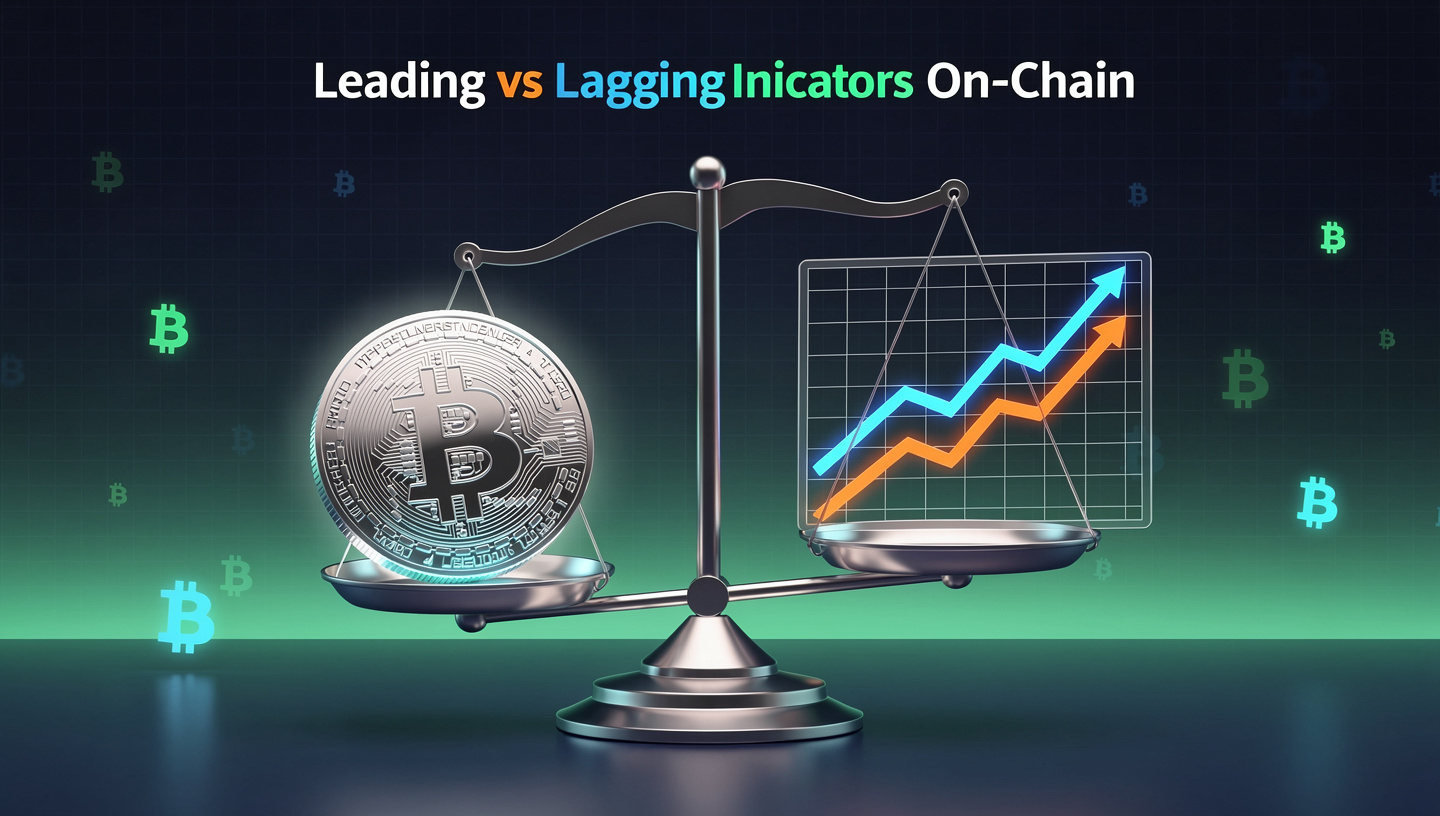
Price is not truth; price is reaction. It is the final echo of decisions already made, capital already deployed, and risk already absorbed by someone else. In traditional finance, investors accept this delay as inevitable. In crypto, that assumption is obsolete.
Blockchains are not markets — they are accounting systems with perfect memory. Every transaction, every transfer of conviction, every redistribution of risk is etched into an immutable ledger before price reacts. On-chain data, therefore, is not a trading signal. It is a causal layer.
The real question is not whether on-chain indicators work. The real question is whether you understand which indicators lead reality and which merely describe it after the fact.
This research dissects on-chain indicators through a structural lens: leading vs. lagging. Not by popularity, not by dashboards, but by causality. If you cannot distinguish cause from confirmation, you are not analyzing — you are narrating history.
Defining the Core Distinction: Leading vs. Lagging in On-Chain Context
In classical macroeconomics, leading indicators anticipate economic shifts, while lagging indicators confirm them after they are visible. On-chain analytics follows the same logic, but with higher resolution and fewer excuses.
Leading On-Chain Indicators
A leading on-chain indicator satisfies three conditions:
- It reflects decisions before price discovery
- It represents capital movement, not sentiment alone
- It changes prior to volatility expansion or trend reversal
Leading indicators measure intent. They capture what informed actors are doing before the market is forced to acknowledge it.
Lagging On-Chain Indicators
Lagging indicators, by contrast:
- Respond after price has already moved
- Aggregate outcomes rather than intentions
- Excel at validation, not anticipation
They are not useless — but they are reactive. They answer “what just happened,” not “what is about to happen.”
Confusing these two categories is the intellectual failure that separates researchers from retail commentators.
Why On-Chain Data Can Lead Price (And Sometimes Cannot)
On-chain data leads price only when blockchain activity is the bottleneck.
When coins move:
- Custody changes
- Liquidity availability changes
- Risk distribution changes
But when markets trade derivatives, ETFs, or internalized order books, price can move without immediate on-chain settlement. This introduces temporal distortion.
Therefore, on-chain indicators lead spot-driven structural moves, but may lag derivative-driven reflexive volatility.
A serious analyst does not ask “Does on-chain work?”
They ask “Under what market regime does on-chain dominate?”
Category I: Leading On-Chain Indicators (Causal Layer)
1. Exchange Net Position Change (Capital Migration Signal)
What it measures:
Net inflow or outflow of assets to centralized exchanges.
Why it leads:
Assets do not move to exchanges accidentally. They move for one reason: potential liquidity deployment.
- Sustained net outflows imply long-term storage, reduced sell pressure
- Sharp inflows precede distribution, hedging, or collateralization
Critically, price often reacts after this migration completes.
Research insight:
The rate of change of exchange flows is more predictive than absolute values. Acceleration matters more than magnitude.
2. Long-Term Holder (LTH) Supply Dynamics
What it measures:
Coins held beyond a defined age threshold (e.g., 155 days for Bitcoin).
Why it leads:
Long-term holders represent high-conviction capital. When they accumulate, supply is removed from circulation before demand expresses itself in price.
Distribution by LTHs typically occurs:
- Near cyclical tops
- During liquidity abundance
- Before volatility expansion
Key mistake:
Watching LTH supply in isolation. The signal emerges only when combined with:
- Price compression
- Declining realized volatility
3. Dormancy and Coin Days Destroyed (Conviction Release Indicator)
What it measures:
Movement of previously inactive coins.
Why it leads:
Dormant capital moving is never neutral. It reflects a decision by holders who had no time pressure.
- Rising dormancy during flat price → strategic repositioning
- Dormancy spikes after parabolic moves → confirmation, not signal
Advanced insight:
Dormancy is leading only when it diverges from price momentum. Convergence makes it lagging.
4. Miner Behavior Metrics (Structural Supply Control)
What it measures:
Miner balances, outflows, and revenue pressure.
Why it leads:
Miners are forced sellers by design. Their behavior changes before supply shocks materialize.
- Declining miner balances during low fees → structural stress
- Accumulation during high difficulty → confidence in future pricing
Miner capitulation historically precedes macro bottoms, not tops.
Category II: Hybrid Indicators (Context-Dependent)
Some indicators oscillate between leading and lagging depending on regime.
5. MVRV (Market Value to Realized Value)
MVRV becomes:
- Leading when approaching historical extremes slowly
- Lagging during sharp speculative phases
Its value lies not in thresholds, but in velocity and duration.
6. Realized Profit/Loss
Short-term realized profit spikes often:
- Lag breakouts
- Lead local exhaustion points
This metric is reflexive — it measures reaction to price, but the decay of realized profit can foreshadow trend weakness.
Category III: Lagging On-Chain Indicators (Confirmation Layer)
7. Active Addresses
Despite popularity, active addresses are largely descriptive.
Why?
- Activity increases because price moves
- Bots and batching distort signal
- User growth does not equal capital deployment
Useful for adoption narratives, not market timing.
8. Transaction Count and Volume
These metrics confirm network usage, not valuation inflection.
They lag because:
- Fees incentivize batching
- Layer-2s abstract activity
- Volume follows volatility
They belong in fundamental valuation, not trading frameworks.
The Structural Error Most Analysts Make
Most analysts fail not because they lack data, but because they collapse timeframes.
They mix:
- Leading indicators from weekly horizons
- Lagging indicators from daily charts
- Price action from intraday noise
This creates analytical incoherence.
Rule:
A leading indicator on a weekly horizon is meaningless on a 15-minute chart.
On-chain data is slow capital. Treating it like price is category error.
Building a Proper On-Chain Research Stack
A professional framework separates indicators into layers:
Layer 1: Capital Intent (Leading)
- Exchange flows
- LTH dynamics
- Dormancy metrics
Layer 2: Capital Stress (Transitional)
- Realized P/L
- Miner behavior
- MVRV velocity
Layer 3: Capital Outcome (Lagging)
- Active addresses
- Transaction volume
- Fee totals
Signals only emerge when layers align, not when individual metrics flash green.
Why Leading Indicators Feel “Wrong” Before They Are Right
Leading indicators are uncomfortable by nature.
They:
- Trigger before consensus
- Contradict prevailing narratives
- Require patience
Lagging indicators feel good because they agree with price. But agreement is not insight.
Markets do not reward agreement. They reward correct disagreement, early.
On-Chain Is Not About Prediction — It Is About Positioning
On-chain analytics does not predict price. It reveals who is positioned, how they are positioned, and how that positioning is changing.
Leading indicators expose reallocation of conviction.
Lagging indicators describe confirmation of consequence.
If you treat both as equal, you will always arrive late.
The blockchain already told the truth.
The market simply has not admitted it yet.