If you have used Ethereum during periods of high activity, you already know the feeling: you try to send a transaction, and suddenly the network fee costs more than the transaction itself.
It is frustrating. It also raises a hard question:
If Ethereum is supposed to be the future of decentralized finance and Web3, how can it scale to millions — or billions — of users?
The answer is not simply “make Ethereum bigger.”
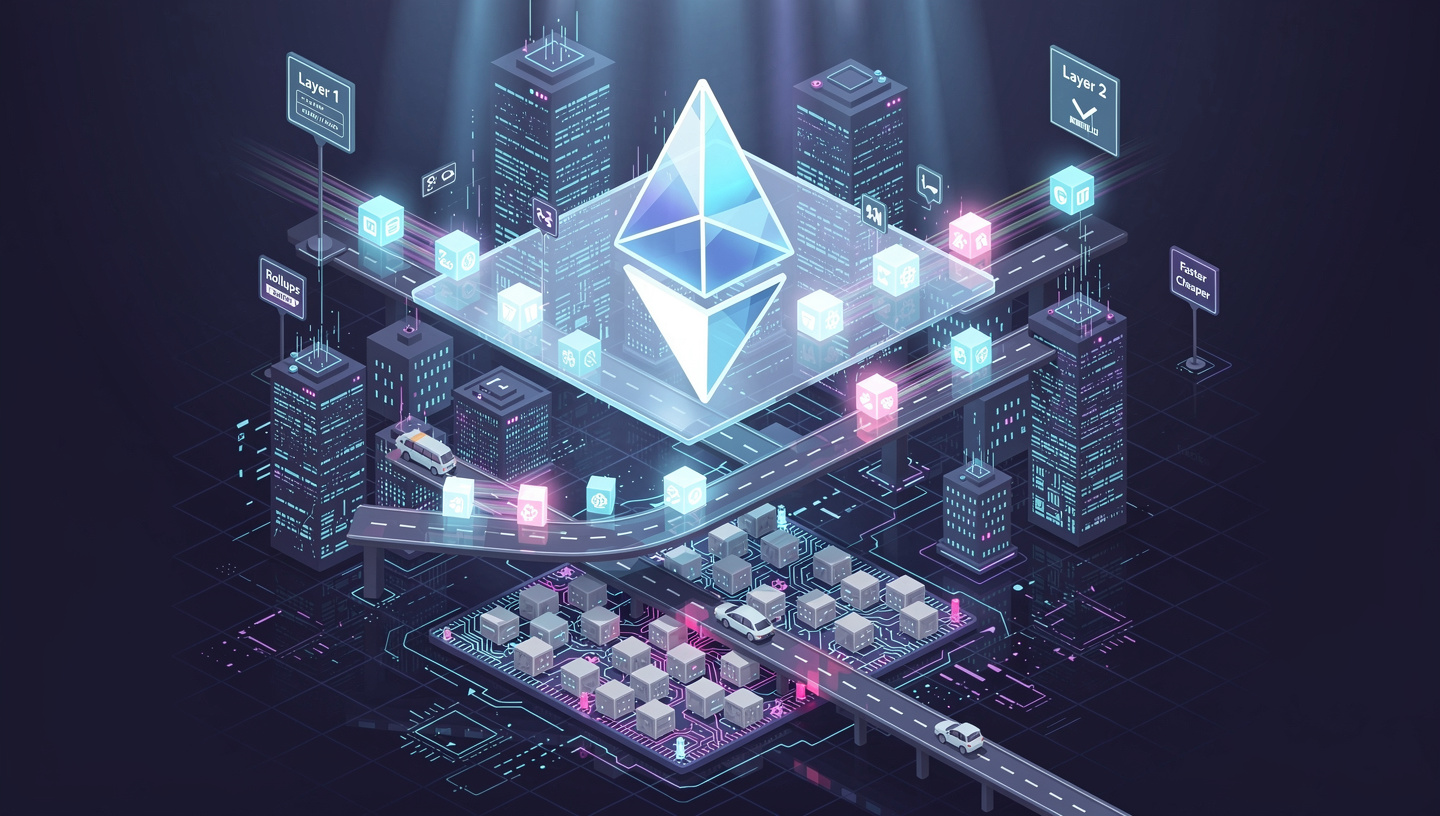
Instead, the industry is taking a layered approach. Ethereum is evolving into a secure base layer, while additional systems — called Layer 2 solutions — handle high-volume transactions faster and at a lower cost.
This article explains, in depth:
- Why Ethereum became slow and expensive
- What Layer 2 actually means
- The different types of Layer 2 technologies
- How they reduce costs and increase throughput
- Real-world examples you may already be using
- The risks, tradeoffs, and future outlook
By the end, you will understand not only what Layer 2 is, but why it matters so much to the future of blockchain.
1. Why Ethereum Struggles With Speed and Cost
Ethereum’s architecture prioritizes security and decentralization.
Every full node must:
- Verify every transaction
- Agree on the same blockchain history
- Store the complete ledger
This design prevents fraud and tampering. However, it also limits throughput.
Ethereum’s Capacity Problem
On average, Ethereum handles roughly:
- ~15–30 transactions per second (depending on conditions)
Visa, by comparison, can process:
- 24,000+ transactions per second (or more, depending on configuration)
When demand exceeds Ethereum’s capacity:
- Transactions compete for block space
- Users bid higher fees to be included faster
- Fees spike sometimes to tens or even hundreds of dollars
This is not simply an inconvenience — it limits entire business models:
- Micro-payments cannot work
- Gaming and NFTs become too costly
- DeFi becomes an exclusive playground for large wallets
Ethereum needed scalability — but without compromising its security guarantees.
This is where Layer 2 enters the picture.
2. What Exactly Is a Layer 2?
A Layer 2 (L2) solution is a secondary framework or protocol built on top of Ethereum that:
- Processes transactions off-chain (partially or entirely)
- Batches them together
- Submits summarized results back to Ethereum
Think of Ethereum (Layer 1) as:
A high-security court that only steps in to verify final outcomes.
Layer 2 networks are:
Fast highways where most activity happens before being finalized on Ethereum.
This separation creates a powerful system:
- Layer 1 = maximum security and settlement
- Layer 2 = speed, scale, low cost
Ethereum remains the “source of truth,” while Layer 2 handles volume.
3. How Layer 2 Makes Transactions Cheaper
The key economic principle is simple:
Gas costs are shared across many transactions.
Instead of:
- Paying gas for each individual transaction on Ethereum,
Layer 2 networks:
- Execute thousands of transactions off-chain
- Compress them
- Submit a single proof or batch to Ethereum
The cost of one Ethereum transaction is spread across thousands of users.
Result:
- Lower fees
- Faster confirmation times
- A dramatically better user experience
But the way Layer 2 achieves this depends on the technology design.
Let’s break them down.
4. Major Types of Layer 2 Solutions
There are several categories of Layer 2 architectures, each with different tradeoffs.
4.1 State Channels
State channels work like opening a private tab between participants.
- Users lock funds in a smart contract on Ethereum.
- They transact off-chain — instantly — as many times as they want.
- When finished, the final balance is settled back to Ethereum.
Good analogy:
It is like running a tab at a restaurant rather than paying after every bite.
Pros:
- Very fast
- Very cheap
Cons:
- Only works well for fixed participants
- Not ideal for open-ended networks or complex DeFi
Famous example: Lightning Network (on Bitcoin), adapted in concept for Ethereum.
4.2 Plasma
Plasma chains create smaller blockchains connected to Ethereum.
- Transactions live primarily on the Plasma chain
- Only periodic checkpoints are submitted to Ethereum
Users can exit to Layer 1 if something goes wrong.
Pros:
- Scales significantly
- Reduces mainnet load
Cons:
- Complicated exit procedures
- Not ideal for general-purpose smart contracts
4.3 Optimistic Rollups
Optimistic Rollups assume transactions are valid by default, unless someone challenges them.
Process:
- Transactions are executed off-chain
- The rollup posts compressed data to Ethereum
- Anyone can challenge fraudulent transactions within a dispute window
If fraud is detected, Ethereum corrects it.
Pros:
- Cheaper than Layer 1
- Compatible with Ethereum smart contracts
- Widely adopted today
Cons:
- Withdrawals can take longer (fraud challenge period)
Leading examples:
- Optimism
- Arbitrum
- Base (by Coinbase, built on Optimism’s tech)
4.4 Zero-Knowledge (ZK) Rollups
ZK Rollups use cryptographic proofs called zero-knowledge proofs.
Instead of assuming honesty, ZK systems mathematically prove correctness.
Workflow:
- Transactions occur off-chain
- A cryptographic proof is generated
- Ethereum verifies the proof efficiently
The blockchain does not re-execute everything — it just verifies the proof.
Pros:
- Faster withdrawals
- Strong security guarantees
- Very efficient verification
Cons:
- Technically complex
- Proof generation requires advanced cryptography
- Tooling still maturing
Key players:
- zkSync
- StarkNet
- Polygon zkEVM
- Scroll
ZK rollups are considered by many to be the long-term direction for scaling.
5. Why Layer 2 Is So Important for Ethereum’s Future
Layer 2 solutions unlock several critical advantages.
Lower Costs
Fees drop from:
- Several dollars (or more)
to - Cents or fractions of a cent
This opens the door for:
- Microtransactions
- On-chain gaming
- Social applications
- Global retail payments
Higher Throughput
Instead of ~15 TPS, Layer 2s combined can scale Ethereum into:
- Tens of thousands of transactions per second
- Eventually, potentially millions
Preserving Decentralization
Ethereum does not need to become massive or centralized.
Layer 1 remains lean and secure. Layer 2 carries load.
6. Real-World Examples of Layer 2 in Action
Layer 2 isn’t theoretical — it is already powering real ecosystems.
DeFi
- Faster trading
- Cheaper swaps
- Smaller traders can participate again
Protocols migrating to L2:
- Uniswap
- Aave
- Curve
- Synthetix
NFTs and Gaming
Layer 2 enables:
- Low-cost minting
- In-game transactions
- Marketplace trading without high fees
Projects:
- Immutable (gaming-focused Layer 2)
- Polygon PoS (often used alongside L2 concepts)
- zkSync-based NFT marketplaces
Payments
Instant, low-cost payments become viable again.
Imagine:
- Paying $0.01 for content
- Buying a coffee
- Sending remittances globally
That is exactly what L2 aims to enable.
7. Risks and Tradeoffs You Should Understand
Layer 2 is powerful — but not perfect.
Smart Contract Risk
Bugs in Layer 2 contracts can lead to loss of funds.
Centralization Risk
Some Layer 2s still rely on:
- Central operators
- Upgrade multisigs
- Validators controlled by small groups
Over time, the industry is pushing toward decentralization — but progress is uneven.
Liquidity Fragmentation
Assets spread across multiple chains may lead to:
- Complicated bridging
- Potential security incidents
- More complexity for users
Understanding risk is essential when interacting with any blockchain ecosystem.
8. How Ethereum and Layer 2 Work Together Long-Term
Ethereum’s roadmap explicitly embraces Layer 2.
Future upgrades (such as data availability improvements and rollup scaling) are designed to:
- Reduce Layer 2 costs further
- Increase capacity
- Make settlement more efficient
Instead of one giant blockchain trying to do everything, Ethereum becomes:
A secure, decentralized settlement layer powering an ecosystem of fast parallel networks.
This layered architecture is similar to how:
- The internet has layers (physical cables, network protocols, applications)
- Financial systems have layers (central banks, clearing houses, payment networks, banking apps)
Layering is how complex systems scale.
Final Thoughts
Layer 2 solutions are not a temporary patch.
They are a fundamental pillar of Ethereum’s long-term strategy.
They make Ethereum:
- Faster
- Cheaper
- More usable
- More competitive
And they enable innovation that simply was not feasible before.
From decentralized finance to gaming, identity, payments, and Web3 applications we have not yet imagined, Layer 2 systems will be central to the next wave of blockchain adoption.
The future of Ethereum is not just on Ethereum.
It is on the layers built above it — secured, anchored, and settled by the base chain.