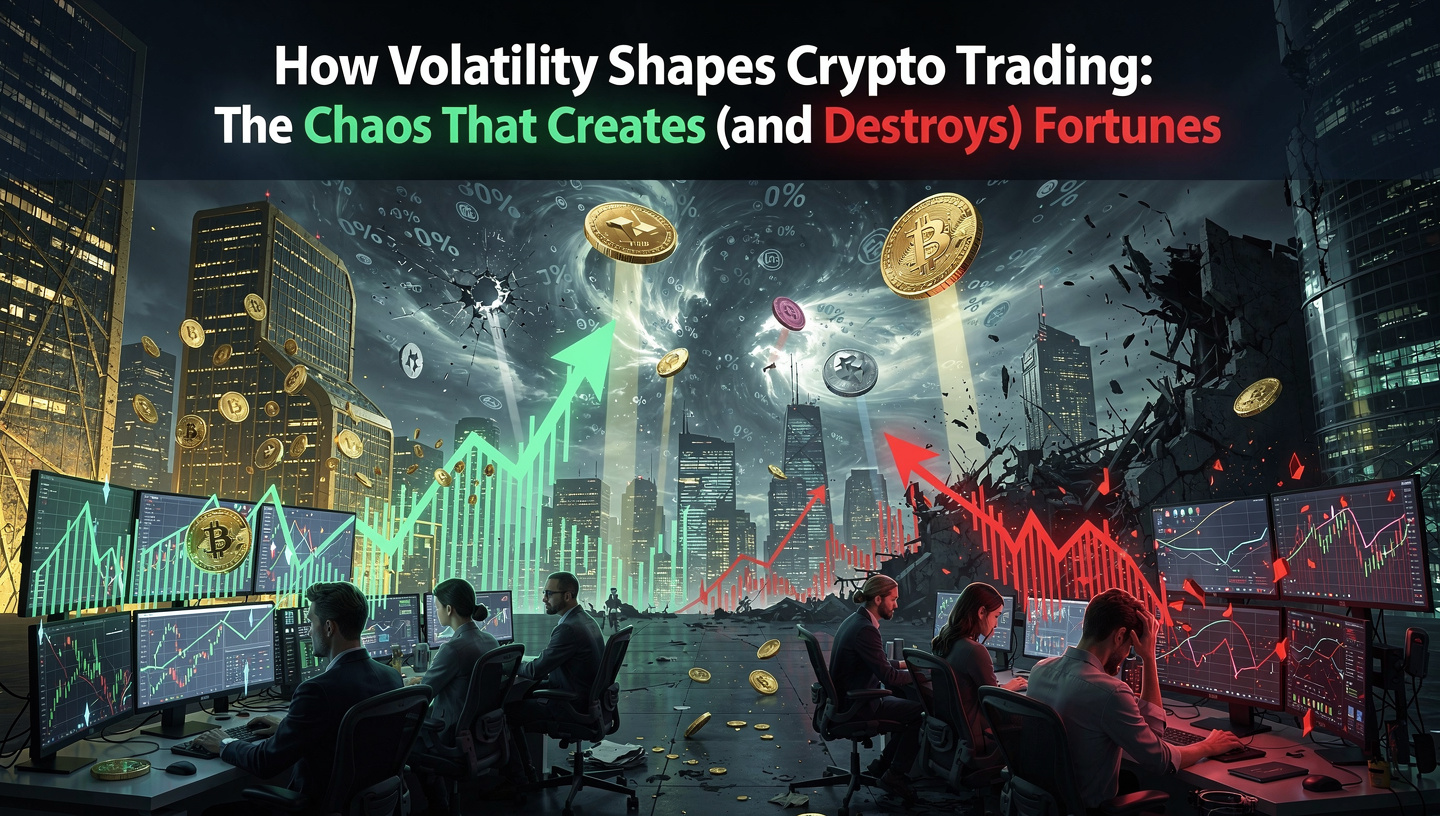
Volatility is not a side effect of crypto markets. It is the market.
Price doesn’t glide here—it snaps, convulses, accelerates, stalls, and occasionally explodes. A single candle can invalidate months of analysis. A tweet can erase a balance sheet. A forgotten wallet can become a legend. Crypto doesn’t reward patience the way traditional finance does; it rewards adaptation to instability. Understanding volatility isn’t optional—it is the difference between compounding and liquidation.
This article dissects volatility from first principles through market structure, trader psychology, liquidity mechanics, derivatives, and macro feedback loops. Not in abstract terms—but in practical, operational detail.
Volatility: The Native State of Crypto
In equities, volatility is episodic. In crypto, it is continuous.
Traditional markets operate inside guardrails: circuit breakers, market hours, centralized liquidity providers, and decades of institutional norms. Crypto operates 24/7, globally, with fragmented liquidity and reflexive narratives. There is no closing bell to dampen panic. There is no central bank stepping in at 3 a.m.
This produces a structurally unstable environment:
- Thin order books relative to market cap
- Retail-heavy participation
- High leverage availability
- Rapid information propagation
- Narrative-driven capital rotation
These ingredients guarantee price instability even in “quiet” periods.
Volatility in crypto is not merely statistical dispersion. It is the emergent behavior of millions of participants reacting simultaneously to price, sentiment, and perceived opportunity.
Why Crypto Volatility Is Structurally Higher Than TradFi
1. Fragmented Liquidity
Crypto liquidity is scattered across dozens of centralized exchanges, hundreds of decentralized venues, and countless trading pairs. There is no single consolidated tape.
This fragmentation creates arbitrage gaps, delayed price discovery, and localized order-book vacuums. When pressure hits one venue, it cascades outward, amplifying movement.
Large players exploit this routinely.
2. Reflexivity Dominates Fundamentals
Crypto markets are reflexive in the Soros sense: price influences narrative, narrative influences adoption, adoption influences price.
Rising prices attract users. Users attract developers. Developers attract capital. Capital drives price higher.
The same loop runs in reverse during drawdowns.
Fundamentals don’t anchor price—they follow it.
3. Leverage Is Ubiquitous
Perpetual futures and margin trading are available to anyone with an email address. Funding rates oscillate wildly. Open interest can double in days.
This creates nonlinear dynamics:
- Small spot moves trigger liquidations
- Liquidations push price further
- Further moves cascade into forced selling
What begins as a 2% dip can become a 20% drawdown in minutes.
Volatility feeds on leverage.
The Psychological Engine Behind Violent Price Swings
Crypto volatility is as much psychological as mechanical.
Markets are moved by:
- Fear of missing out (FOMO)
- Loss aversion
- Recency bias
- Overconfidence
- Panic liquidation
Retail participants tend to buy strength and sell weakness. Professionals do the opposite.
This asymmetry is why volatility transfers wealth from impatient actors to disciplined ones.
The presence of pseudonymous founders like Satoshi Nakamoto and public market influencers such as Elon Musk reinforces narrative volatility. In crypto, perception often outruns reality.
A single headline can reprice the entire asset class.
Volatility as a Wealth-Creation Mechanism
High volatility is not inherently destructive. It is a distribution mechanism.
In efficient markets, opportunity is competed away. In inefficient markets, volatility creates repeated pricing errors.
Crypto remains inefficient.
That inefficiency allows for:
- Momentum strategies
- Mean-reversion systems
- Volatility harvesting
- Arbitrage
- Funding-rate capture
- Options gamma scalping
Every sharp move creates forced participants—liquidated longs, margin-called shorts, emotionally exhausted holders. Capital migrates from reactive hands to prepared ones.
Fortunes emerge not from predicting direction, but from positioning around volatility itself.
Trading Archetypes in Volatile Crypto Markets
The Momentum Trader
Thrives on breakout continuation. Enters strength, exits faster. Vulnerable to false moves and stop hunts. Requires strict risk management.
The Mean-Reversion Trader
Buys panic, sells euphoria. Depends on statistical edges and liquidity support zones. Suffers during regime shifts.
The Volatility Trader
Doesn’t care about direction. Trades options or delta-neutral structures to monetize expanding or contracting volatility.
The Market Maker
Provides liquidity on both sides, harvesting spread and rebates while managing inventory risk.
Each archetype interacts differently with volatility—but all depend on it.
Without volatility, crypto trading becomes irrelevant.
Centralized Exchanges and Volatility Amplification
Major centralized platforms such as Binance, Coinbase, and the now-defunct FTX play a critical role in volatility transmission.
They concentrate leverage, custody, and liquidity.
When one exchange experiences outages, liquidation engine failures, or solvency rumors, the entire market reacts. Exchange risk becomes market risk.
The collapse of a large venue doesn’t just destroy capital—it rewires volatility expectations for years.
Derivatives: The Hidden Accelerator
Spot markets start moves. Derivatives finish them.
Perpetual futures dominate crypto volume. Funding rates act as a real-time sentiment gauge:
- High positive funding = overcrowded longs
- Negative funding = bearish positioning
Professional traders fade extremes.
Options markets add another layer. As open interest grows near key strikes, dealers hedge dynamically, pulling price toward or away from those levels. This creates “pinning” effects near expiration and explosive moves once gamma constraints release.
Volatility clusters around:
- Large option expiries
- Funding flips
- Open-interest peaks
- Macro announcements
These are not coincidences—they are structural.
Institutional Capital Changes the Shape of Volatility (Not Its Existence)
The entrance of firms like BlackRock and MicroStrategy has altered crypto’s volatility profile.
Institutions bring:
- Larger ticket sizes
- Slower execution
- Regulatory constraints
- Balance-sheet sensitivity
This dampens intraday noise but increases macro sensitivity. Crypto now reacts more directly to interest rates, dollar strength, and equity risk sentiment.
Meanwhile, regulated derivatives venues such as CME Group provide hedging infrastructure that didn’t exist in early cycles.
Volatility hasn’t disappeared—it has become more correlated.
Regulatory Shockwaves
Few forces inject volatility like regulation.
Statements from bodies such as the U.S. Securities and Exchange Commission can instantly reprice entire sectors: exchanges, staking platforms, stablecoins, or DeFi protocols.
Regulatory volatility differs from market volatility:
- It arrives without technical warning
- It impacts infrastructure, not just price
- It creates long-lasting uncertainty
Traders who ignore policy risk misunderstand crypto’s maturity phase.
Volatility Regimes: Crypto Moves in Seasons
Crypto does not move randomly. It oscillates between regimes:
- Expansion – Rising price, increasing leverage, narrative euphoria
- Distribution – Choppy highs, smart money exits
- Contraction – Cascading liquidations, capitulation
- Accumulation – Low volume, compressed volatility
Most traders fail by applying the same strategy across all regimes.
Professionals adapt.
They reduce size in expansion extremes. They scale during contraction. They prepare during accumulation.
Volatility regime recognition is a core competency.
Risk Management: The Only Edge That Matters Long-Term
No strategy survives without risk control.
In volatile crypto markets, this means:
- Fixed fractional position sizing
- Predefined invalidation levels
- Maximum daily loss limits
- Correlation awareness
- Liquidity-adjusted execution
Most blowups come not from bad analysis—but from oversized positions in unstable conditions.
Volatility doesn’t kill accounts. Exposure does.
Why Most Traders Lose in High-Volatility Environments
Because they:
- Chase momentum late
- Average down without a plan
- Ignore funding and open interest
- Trade emotionally
- Overleverage
Volatility magnifies every behavioral flaw.
Crypto simply reveals them faster.
Volatility Is Crypto’s Competitive Advantage
From a market design perspective, volatility is crypto’s moat.
It attracts:
- Speculators
- Market makers
- Developers
- Arbitrageurs
- Innovators
It funds infrastructure. It accelerates adoption. It redistributes capital toward those who build systems instead of chasing candles.
A low-volatility crypto market would be irrelevant.
The Final Reality
Crypto volatility is not chaos. It is a complex adaptive system driven by leverage, narrative, liquidity, and human behavior.
It creates fortunes by exposing inefficiencies.
It destroys fortunes by punishing complacency.
Those who survive do not attempt to tame volatility. They structure themselves around it—strategically, psychologically, and operationally.
In crypto, stability is temporary.
Volatility is permanent.
And mastery begins when you stop fearing it and start engineering for it.